

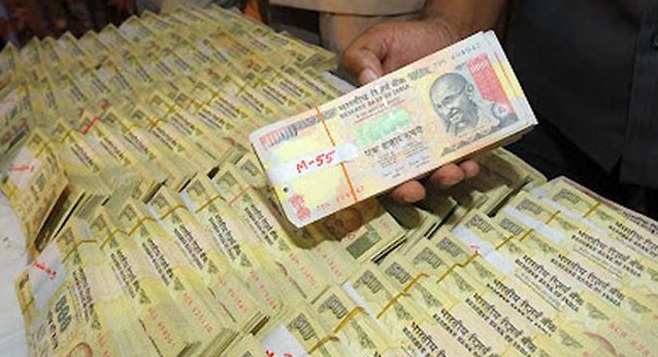
Instances of counterfeit currency detection in Indian banking system have seen an abrupt escalation in the last eight years.
According to reports, data compiled by Financial Intelligence Unit (FIU) shows that the number of counterfeit currency reports (CCRs) have been on the rise. While a mere 8,580 cases were detected in 2007-08, the year 2008-09 saw 35,730 cases, 1,27,781 cases were detected 2009-10, 2,51,448 cases reported in 2010-11, 2,51,448 cases detected in 2011-12, 3,27,382 cases in 2012-13 and 3,53,837 cases reported in 2014-15.
The FIU data, however, does not specify the amount of fake currency detected in these years. Counterfeit currency devalues the real worth of Indian currency and thus the detection is important. A study conducted by Indian Statistical Institute, Kolkata on behalf of the National Investigation Agency (NIA) suggests that fake Indian currency notes (FICN) amounting to Rs 400 crore are in circulation in the country at any given point of time and around Rs 70 crore fake notes are pumped into Indian economy every year. The estimation is based on recovery and seizure made by various agencies. But the actual figure could be much larger.
Counterfeit currency reports (CCRs) are meant to check the extent of fake Indian currency notes (FICN) entering into the Indian banking system.
The FIU data indicates that around 90 per cent of the reports of counterfeit currency detection were filed by private Indian banks.
CCR is defined as the usage of a forged or counterfeit currency note or bank note as genuine or where any forgery of a valuable security or a document has taken place during a cash transaction at a bank.
“The private Indian banks contribute majority of CCRs. The compliance levels of the public sector banks continued to be low despite the matter having been taken up with the RBI,” the FICN report said.
Under the provisions of Prevention of Money Laundering Act (PMLA), all banks operating in the country – either public sector, private and foreign banks –are mandated to report instances of detection of fake currency to the Financial Intelligence Unit (FIU). In 2007, the government had first mandated the FIU to receive such reports from the banks.
The FIU under the Union Finance Ministry acts as the national agency to provide financial intelligence to law enforcement agencies for safeguarding the economy from abuses of money laundering, terror financing and other offences. The FIU disseminates data and informations to investigative agencies time to time.
FIU, during 2014-15, had received a total of 58,646 suspicious transaction reports (STRs) from all types of banks, financial institutions like insurance companies, intermediaries like stock brokers, non-financial businesses and professions like casinos and private locker operators.
As per available data, the maximum STRs reported to the FIU were by banks as compared to any other financial intermediaries.


