Over the past couple of days, Indians are expressing outrage and frustration over what they perceive as a blatant display of hypocrisy in the labelling of crimes as “terror” and “hate crime” based on the religious affiliations of the perpetrators. The recent killing of Gangster Atiq by three assailants, who allegedly chanted “Jai Shri Ram” after the murder, has been labelled as “Hindutva terror” by some media outlets and activists. Several netizens have pointed out that the horrific attack by Adil Ahmed Dhar, who blew up 40 CRPF jawans in a suicide bombing, has not been classified as an act of religious terrorism, despite his Islamist fundamentalist views and statements.
In fact, people are often told that terror has ‘no religion’ but perhaps this statement holds true only in the case of Islamist terror attacks.
A Muslim ex-MP shot dead on live TV by people screaming "Jai Shree Ram" as the police stand by and ministers celebrate.
— Shoaib Daniyal (@ShoaibDaniyal) April 15, 2023
There are significant parts of the Indian Union which have seen a collapse in not only rule of law but basic societal functioning. https://t.co/HKJVbFyuxV
Many netizens have argued argue that if the killers of gangster Atiq, who chanted “Jai Shri Ram” after the murder, can be labelled as “Hindutva terrorists,” then Adil Ahmed Dhar, who openly expressed his hatred towards “cow urine drinking Hindus” and carried out a deadly suicide bombing, should also be classified as religious terrorism.
Remember: Gangster Atiq's murderer chanting Jai Shri Ram after killing him is Hindutva terror, Adil Ahmed Dhar blowing up 40 CRPF jawans because he didn't like 'gaay ka peshab peene wale' is neither hate crime nor an act of terror fuelled by religion.
— Nirwa Mehta (@nirwamehta) April 17, 2023
For years now, Islamists have referred to Hindus as ‘cow urine drinkers’ or used ‘gau mutra’ jibes to derisively mock and insult Hindus. However, the Pulwama terrorist attack was a watershed moment, given that the attack led to the death of 40 CRPF soldiers and a video released in its aftermath saw the terrorist responsible for the ghastly attack spewing venom against Hindus.
This shameful mainstreaming of ‘gau mutra’ jibes for Hindus holds uncanny similarity with the “hooked nose” stereotype that Jews were subjected to in the past. The damaging consequences of such stereotyping became apparent only in the early part of the 20th century, when supporters of Hitler used those archaic typecasts to inflame public sentiments against the Jews.
Jai Shri Ram ≠ Allahu Akbar
A truck driver who ran over 20 people on a bike path in Manhattan was reported to have yelled “Allahu akbar” before being shot by a police officer. The same slogan was yelled by the men who attacked the French weekly Charlie Hebdo in 2015. The same words were heard as a British soldier was run over and subsequently hacked to death in 2013 close to military barracks. There are thousands of other terrorist attacks where the slogan was raised by Islamist terrorists.
In recent years, the slogan “Jai Shri Ram” has become a subject of controversy, with some segments of the media and political groups labelling it as a war cry or an aggressive slogan. However, “Jai Shri Ram” is not a call for violence, but rather a slogan that represents the awakening of Hindus from centuries of intellectual and political slumber, and embodies the ideas of universal peace and brotherhood.
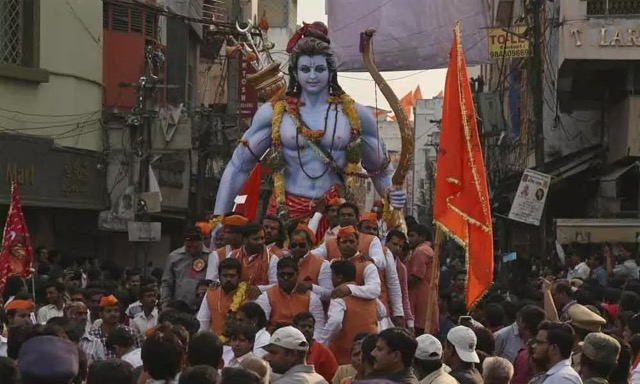
The term “Jai Shri Ram” is a Sanskrit phrase that translates to “Victory to Lord Rama,” one of the most revered deities in Hinduism. Lord Rama is considered to be an embodiment of righteousness, virtue, and compassion, and his story of valour and sacrifice is celebrated in the Hindu epic, the Ramayana. “Jai Shri Ram” is often used as a form of greeting or salutation among Hindus, and it is chanted during religious ceremonies, festivals, and processions.
Contrary to the portrayal by some sections of the media, “Jai Shri Ram” is not a call for violence or aggression. It is a slogan that symbolizes the pride and reverence that Hindus have towards their culture, heritage, and spirituality. It is seen as a way to express devotion to Lord Rama and seek his blessings for victory over ignorance, injustice, and evil.
“Jai Shri Ram” is seen as a rallying cry for Hindus to assert their identity and assert their rights in the face of such challenges.
Furthermore, “Jai Shri Ram” is an assimilative slogan that embodies the ideas of universal peace and brotherhood. Hindu philosophy teaches the concept of Vasudhaiva Kutumbakam, which means “the world is one family.” The slogan is seen as a call for harmony and unity among all individuals, irrespective of their caste, creed, or religion. It is considered a way to foster inclusiveness, tolerance, and mutual respect among different communities.