

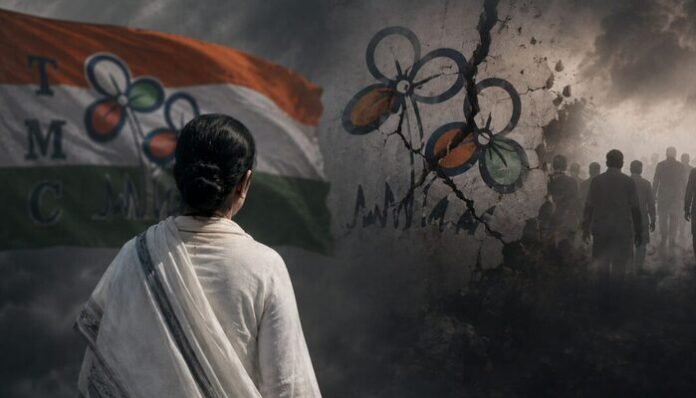
While the landslide electoral victory in the recent West Bengal Assembly elections has strengthened the BJP, the TMC seems to be struggling with internal discord. After facing a humiliating defeat by the BJP, it is clear that all is not well within the TMC cadres.
In politics, an electoral defeat not only brings a reduced number of seats but also tests the morale of a party’s leadership and workers. This is what appears to be happening in West Bengal after the recent electoral reshuffle. Discord within the TMC is slowly coming to the surface. If one observes the events that transpired after the assembly elections, it seems that Mamata Banerjee’s party is slipping into a phase where the electoral setback is turning into a crisis for the TMC’s organisation.
Following the election results, when the TMC protested against the new government in the assembly premises over post-election violence, bulldozer action, and street vendors, an uneasy picture emerged within the party. Out of 80 TMC MLAs, only 36 MLAs, which is less than half, attended the protest.
This is not just a matter of the absence of a few MLAs, but the larger political message that their absence sent out. When a party sits in the opposition, its first major demonstration is considered a test of its morale and unity. The absence of more than half of the party’s MLAs in its first major protest shows that the discontent within the party is now becoming apparent.
This is not the only signal. Earlier, on May 19th, around 15 MLAs of the TMC had skipped a crucial meeting in Kalighat, which was attended by Mamata Banerjee and Abhishek Banerjee. Even among those MLAs who attended the meeting, several questioned the politics of closed-door meetings. Reports indicate that during the meeting, some MLAs clearly stated that public trust will not be restored through mere meetings and strategy discussions and that ground-level action and introspection were needed.
Interestingly, some TMC MLAs from Kolkata and Howrah reportedly posed direct questions to the party’s top brass regarding Jahangir Khan’s withdrawal from the Falta election. A candidate’s withdrawal just two days before the vote was a significant issue in itself, but the party leadership made it even more difficult by not taking any action. Because the Falta assembly seat falls within Abhishek Banerjee’s Diamond Harbour Lok Sabha constituency, questions were also raised about Abhishek Banerjee’s leadership.
For a long time, the party had held the belief that Abhishek Banerjee was the future of the organisation. However, for the first time since the electoral defeat, discussions have begun within the party about his decisions and leadership abilities. These questions started emerging immediately after the electoral defeat. The TMC has issued show-cause notices to five of its spokespersons for allegedly making anti-party statements.
This move itself suggests that the party leadership is uneasy with the voices rising within it. In any political party, when questions arise after a defeat, and they are answered with action rather than dialogue, it is often seen as a sign of internal unease.
If the issue was limited to the displeasure of MLAs, it could still be considered a normal electoral reaction. But in this case, the TMC’s lowest and most important unit, the local bodies, has increased its tension. In the Kanchrapara Municipality of North 24 Parganas, 15 out of 24 councillors, and in the Halishahar Municipality, 16 out of 23 councillors, resigned en masse.
There are speculations in the political circles that the BJP’s growing position in Bengal could further fuel this discontent. The history of Bengal’s politics shows that after a change of power, defection also intensifies. Just as leaders of the Left parties once joined the TMC, it’s not unlikely that new ambitions for a political future will emerge within the TMC as well.
However, we can’t assume today that the TMC is going to collapse tomorrow. But it’s also true that crises in politics don’t come suddenly; their signs appear beforehand. Declining attendance at meetings, questions about leadership, mass resignations, and disciplinary action against party spokespersons are all signs that often precede major political changes.
West Bengal politics currently appears to be at a turning point. The BJP is exuding confidence after its historic victory, while the TMC appears to be teetering between introspection and discontent. The coming months will reveal whether this is merely a temporary setback after defeat or the beginning of a major power shift in Bengal politics.
(This article is a translation of the original article published on OpIndia Hindi.)


