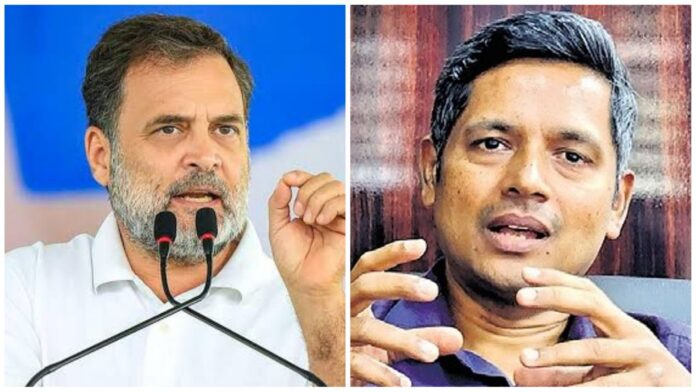
Politics often has a short memory. But sometimes events unfold so quickly that a political attack returns to confront its author before the narrative has even settled. Congress leader Rahul Gandhi may now be facing one such uncomfortable moment.
In a significant bureaucratic development in Kerala, senior IAS officer Ratan U Kelkar, currently serving as the state’s Chief Electoral Officer (CEO), has been appointed secretary to Chief Minister V D Satheesan. The 2003-batch Kerala cadre officer has held several important administrative positions in the state and will now occupy one of the most influential positions within the Chief Minister’s Office.
On the surface, the appointment appears to be a routine administrative decision. Senior bureaucrats are often moved across departments and later entrusted with key responsibilities in governments. Yet what makes Kelkar’s appointment politically explosive is not the move itself, but the context surrounding it.
Just ten days ago, Rahul Gandhi launched a blistering attack after former West Bengal Chief Electoral Officer Manoj Agarwal was appointed Chief Secretary by the newly formed BJP government in the state.
Reacting sharply, Gandhi had alleged that the BJP and the Election Commission were operating a “chor bazaar” (market of thieves), declaring on social media: “The bigger the theft, the bigger the reward.”
The remark was not merely criticism of a bureaucratic reshuffle. It carried a far more serious implication — that a senior election official had allegedly been “rewarded” for facilitating electoral wrongdoing. Congress leaders and the broader opposition ecosystem amplified similar claims, portraying the appointment as evidence that electoral neutrality had been compromised.
The Trinamool Congress also joined the chorus. Party leaders argued that Agarwal’s appointment cast doubt over the integrity of the recently concluded assembly elections. Some went as far as alleging that the Election Commission had effectively aided the BJP.
Yet several facts complicated that narrative.
Manoj Agarwal had originally been selected as West Bengal’s Chief Electoral Officer from a panel sent by the Mamata Banerjee-led government itself. Under his supervision, elections were conducted without major controversy, and reports indicated that he had received praise from election authorities for overseeing the process smoothly.
The accusations therefore rested largely on insinuation rather than demonstrable evidence.
Now comes the obvious question.
If Rahul Gandhi’s principle is that a Chief Electoral Officer moving into a government role amounts to a suspicious “reward,” does the same logic apply in Kerala?
Kelkar’s appointment presents an awkward contradiction.
The Congress-backed alliance, having formed the government in Kerala, has chosen to elevate the sitting Chief Electoral Officer directly into the Chief Minister’s office. If the benchmark established by Gandhi and his allies is applied consistently, critics can now ask whether Kelkar too was being “rewarded.”
Of course, Congress supporters would likely argue that no such comparison exists and that Kelkar’s appointment is simply a normal bureaucratic decision based on experience and administrative competence.
But that response itself exposes the core problem.
If Kelkar’s appointment can be explained through routine administrative logic, then the same reasoning could equally apply to Manoj Agarwal’s case in West Bengal.
Bureaucrats in India frequently transition between electoral responsibilities and executive roles. The civil services system is built around such movement. Election officers are not independent political actors operating outside the administrative framework forever; they remain career bureaucrats who eventually return to government responsibilities.
The issue therefore is not necessarily the appointment itself.
The issue is selective outrage.
Rahul Gandhi’s criticism transformed a bureaucratic decision into alleged evidence of electoral manipulation without publicly presenting concrete proof. Such rhetoric may energise supporters and create dramatic headlines, but it also creates standards that become difficult to sustain consistently.
Political discourse in India increasingly suffers from a phenomenon where allegations become substitutes for evidence. Terms such as “democracy under threat,” “institutional capture,” and now “reward for theft” are deployed with increasing frequency. The problem arises when these phrases are selectively invoked depending on who benefits politically.
Because once the same circumstances emerge within one’s own political ecosystem, the narrative begins to collapse under its own weight.
Kelkar’s appointment has therefore created more than just an administrative reshuffle in Kerala. It has opened a mirror before Congress and Rahul Gandhi.
The question now is straightforward: was the allegation against Manoj Agarwal based on principle or politics?
If it was principle, consistency demands uncomfortable answers.
If it was politics, then the charge of “reward for theft” increasingly looks less like an evidence-based accusation and more like a convenient slogan aimed at shaping public perception after electoral defeats.
The contradiction becomes even more significant because this controversy is not merely about one bureaucratic appointment. It touches upon a larger pattern in contemporary political discourse. In recent years, repeated attacks on the Election Commission have increasingly become a recurring feature of Congress’s political messaging after electoral setbacks. Allegations of institutional bias, claims of democratic subversion, and assertions that the EC is operating in concert with the BJP have frequently surfaced whenever election outcomes have gone against the party.
Critics argue that such a strategy serves a clear political purpose. Rather than compelling introspection over organisational failures, weak state leadership, campaign shortcomings, or a disconnect with voters, the focus shifts outward. Accountability for electoral defeats can be deflected and a larger narrative can be constructed where the Centre, the Election Commission, and institutions of the state are portrayed as conspiring against democracy itself. The political utility of such a narrative is evident: supporters are given an external explanation for defeats rather than being forced to confront uncomfortable questions within the party structure.
The “reward for theft” allegation directed at Manoj Agarwal appeared to fit into this broader pattern. The charge carried a serious implication, that an election official had allegedly facilitated wrongdoing and was subsequently compensated for it. Yet no substantive evidence was publicly presented to establish such a claim. The accusation relied heavily on political insinuation and perception.
This is precisely why Ratan Kelkar’s appointment in Kerala places Congress in an uncomfortable position. If a Chief Electoral Officer moving into a key government role is automatically to be viewed as evidence of institutional compromise, then the same standard should logically apply irrespective of whether the appointment is made by the BJP or a Congress-backed government. If, however, Kelkar’s appointment is viewed as a routine administrative decision based on seniority and experience, then the question naturally arises: why was a similar standard not extended in West Bengal?
Ultimately, the issue is not about Ratan Kelkar or Manoj Agarwal. Bureaucrats routinely transition between election-related and executive responsibilities as part of India’s administrative framework. The real issue is whether allegations against constitutional institutions are being raised on the basis of evidence and principle, or whether they are becoming political instruments deployed selectively after unfavourable electoral outcomes. Repeatedly attacking institutions without substantiating claims may yield short-term political gains, but it also risks gradually eroding public trust in the very democratic structures that political parties claim to protect.