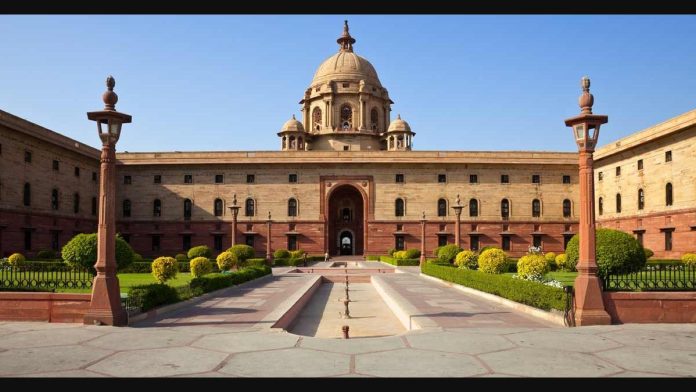
President Droupadi Murmu announced on Thursday that two of the important halls of Rashtrapati Bhavan, namely, Durbar Hall and Ashok Hall, have been renamed as Ganatantra Mandap and Ashok Mandap, respectively, according to a President’s Secretariat release.
According to the release, the renaming was part of making the ambience of the Rashtrapati Bhavan “reflective of Indian cultural values and ethos.”
“Rashtrapati Bhavan, the office and residence of the President of India, is a symbol of the nation, and an invaluable heritage of the people. Continuous efforts are being made to make it more accessible to people. There has been a consistent endeavour to make the ambience of the Rashtrapati Bhavan reflective of the Indian cultural values and ethos,” the release mentioned.
Durbar Hall is the venue of important ceremonies and celebrations, such as the presentation of the National Awards. The term ‘Durbar’ refers to courts and assemblies of Indian rulers and the British.
The release stated that it lost relevance after India became a republic, that is, ‘Ganatantra’. The concept of ‘Ganatantra’ is deeply rooted in Indian society since ancient times, making ‘Ganatantra Mandap’ an apt name for the venue.
“Ashok Hall was originally a ballroom. The word ‘Ashok’ connotes someone who is “free from all sufferings” or “bereft of any sorrow”. Also, ‘Ashoka’ refers to Emperor Ashok, a symbol of unity and peaceful coexistence. The National Emblem of the Republic of India is the lion capital of Ashok from Sarnath. The word also refers to the Ashok tree, which has deep significance in Indian religious traditions as well as arts and culture,” it said.
Renaming ‘Ashok Hall’ as ‘Ashok Mandap’ brings uniformity in language and removes the traces of anglicisation while upholding the key values associated with the word ‘Ashok’, it added.
(This news report is published from a syndicated feed. Except for the headline, the content has not been written or edited by OpIndia staff)