


The Supreme Court on Friday (October 16, 2026) declared a gift deed of temple land to the Tamil Nadu government as void ab initio, holding that the state government is the custodian of temple property and cannot acquire it through a gift from a temporary trustee.
A Bench of Justices PS Narasimha and Alok Aradhe imposed a cost of ₹1 lakh on the Tamil Nadu government, holding that it wrongly deprived the temple of its land for years. The Bench also set aside a Madras High Court decision that dismissed a petition that challenged the gift deed of the temple land to the state government.
“The administration of property belonging to a religious/charitable institution carries with it a duty of preservation, not a power of unfettered disposition,” the Supreme Court said, setting aside a gift deed that transferred the temple land to the state government in violation of the law.
Facts of the case
A Special Leave Petition (SLP) was filed before the Supreme Court concerning 1 acre and 10 cents of land in Kodumudi Village, Erode District, belonging to the Nagapalayam Mariamman-Ponnachiamman Temple. The SLP challenged a gift deed executed on August 30, 2017, by S. Bhoopathy, a temporary trustee, transferring the land to the Tamil Nadu Government, represented by the District Collector and Tehsildar. The transfer was stated to be for the construction of a Taluk Office. The Tehsildar accepted the gift, and the Revenue Department mutated the land in the name of the Taluk Office. Subsequently, a Taluk Office was constructed on the land with public funds.
Villagers challenged the transfer of the land through a writ petition in 2017 but later withdrew it. Later in 2019, the hereditary trustee challenged the transfer before the Madras High Court, arguing that the gift violated Section 34 of the Tamil Nadu Hindu Religious and Charitable Endowments Act, 1959 (HR&CE Act). However, the High Court dismissed the writ petition in March 2019, holding that Section 34 of the HR&CE Act did not expressly prohibit a gift.
The Court also held that whether the land in question fell under the Act was itself a disputed question of fact unsuited to writ jurisdiction. The hereditary trustee was allowed to file a civil suit, but he did not pursue the matter further. In August 2019, temple devotees were allowed to file SLPs against the Madras High Court judgment. The current SLP was filed by the temple devotees, represented by K. Ramalingam, seeking the setting aside of the gift deed.
While the appeals were pending, the State government filed an affidavit before the Supreme Court in February 2022, admitting that the land was inam land granted to the deity for support and maintenance. The government also said that the Revenue Department decided to cancel the gift deed and take the temple land on a renewable lease for a fixed lease amount. The Fair Rent Committee fixed rent at ₹13,235 per month for three years.
What the Supreme Court observed
While analysing the arguments presented by both sides, the Supreme Court explained why temple properties are treated differently from ordinary properties. The Court said that the distinction was made so that the wealth, land, buildings, jewellery and specie, given to temples through faithful offerings by devotees and endowments of kings, is preserved and remains with the deity.
The Court said that every custodian of the temple property, including the State, holds it in trust for the deity. “That wealth, once given, ceases to belong to the donor, to the priest, to the trustee, or to the State; it vests in the deity, and every hand through which it subsequently passes holds it only in trust for the deity and, through the deity, for the community of worshippers it was meant to serve,” the court said.
“A temple property is held for the deity and not for gratuitous disposal by whoever happens to hold the office of trustee, however well-intentioned,” it added.
The law prohibits transfer of an inam property belonging to the deity
Examining the application of the HR&CE Act on the concerned temple property, the Apex Court said that Section 34(5) expressly excludes inams covered by Section 41 from the operation of Section 34. Section 34 of the Act governs alienation of ordinary immovable trust property and permits the Commissioner to sanction an exchange, sale, mortgage, or long lease if necessary or beneficial to the institution. Section 41 permits governmental sanction for such transactions provided they are not carried out through a gift deed. Thus, a gift of inam property cannot be validated even by the Government.
Section 41(1) governs inam property granted for a religious institution’s support or maintenance. It declares any exchange, gift, sale, mortgage, or lease exceeding five years null and void. The Court noted that since the State itself admitted in its affidavit that the temple land is inam property, it is clear from the perusal of the legal provisions that the transfer of the temple land by way of a gift deed is null and void.
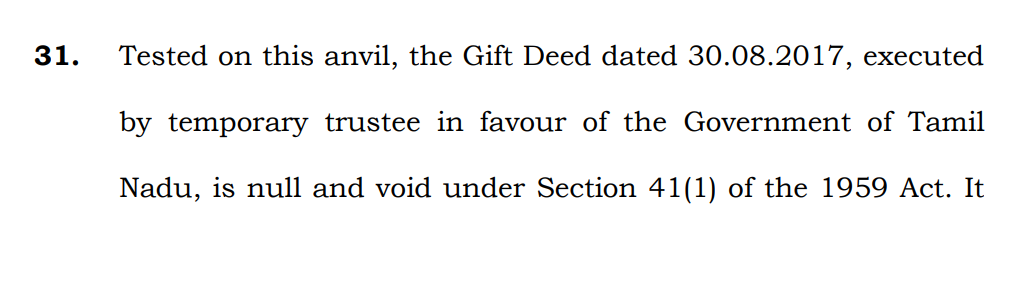
“Tested on this anvil, the Gift Deed dated 30.08.2017, executed by temporary trustee in favour of the Government of Tamil Nadu, is null and void under Section 41(1) of the 1959 Act,” the Court held.
The Bench observed that under the HR&CE Act, the Legislature deliberately prohibited an inam property from being transferred as a gift. “A gift of an inam property dedicated to the support of a deity is, in consequence, void ab initio and no sanction, however solemnly accorded, could have breathed life into it,” the Court stated.
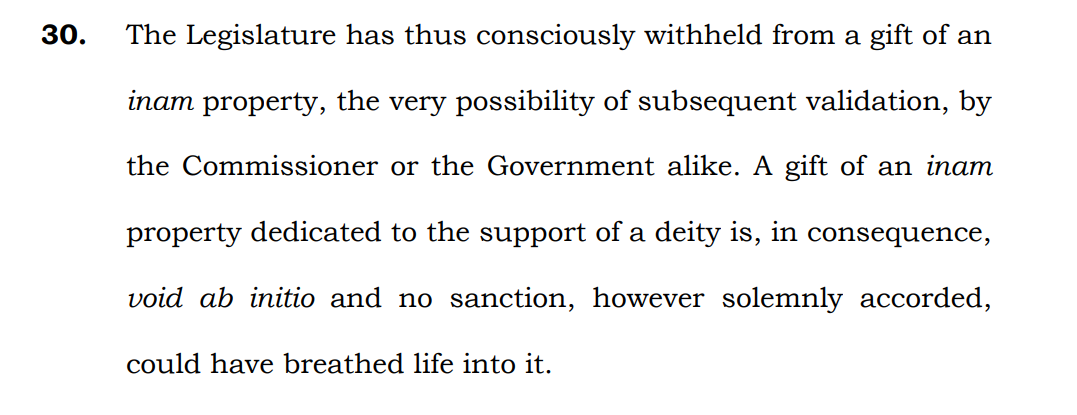
Screenshot from the judgment
Furthermore, the Court said that if the temple land was not admitted to be an inam property by the State in its affidavit, the gift deed would still be void as no Commissioner sanction, prior publication of objections or Government approval was obtained, as required under Section 34 of the Act.
The Court further ruled that even the registration of the gift deed was not valid. It said that Section 22-A of the Registration Act, 1908, as applicable in Tamil Nadu, requires refusal of registration of a transfer of religious-institution property unless the competent authority’s sanction is produced. Since a gift of inam property could never receive valid sanction under Section 41, the registration of the deed had no legal effect.
Hereditary Trustee’s authority not unconstrained
The Court also examined the hereditary trustee’s power in transferring the temple through the gift deed. It observed that a trustee’s authority over the trust property is not “unconstrained”. “Sections 27 and 28 of the 1959 Act oblige every trustee, permanent or temporary, to administer the institution’s properties “as carefully as a man of ordinary prudence would deal with such affairs, funds and properties if they were his own”, and to obey all lawful orders issued under the Act,” the Court noted.
The top court said that a gratuitous transfer, not involving any consideration, of the trust property, which in the present case is temple land, to the government cannot be considered an act of prudence.
The State was wrong in treating the temple land as its own
The Bench strongly criticised the Tamil Nadu government for acting as the owner of the temple property for over four years. “The State, acting through the Commissioner and other functionaries under the 1959 Act, is a custodian and regulator of temple properties, not their owner,” the Court held.
The Court noted that the State government continued to treat the property as its own despite an earlier affidavit by the Assistant Commissioner (HR&CE) acknowledging that the property belongs to the deity. The government changed its stand only after it was ordered by this Court to clarify its stand with respect to the property in an affidavit. The Court rejected the state’s argument that the use of the temple land for a public purpose, which in the present case was the construction of the Taluk Office, legitimised the transfer.
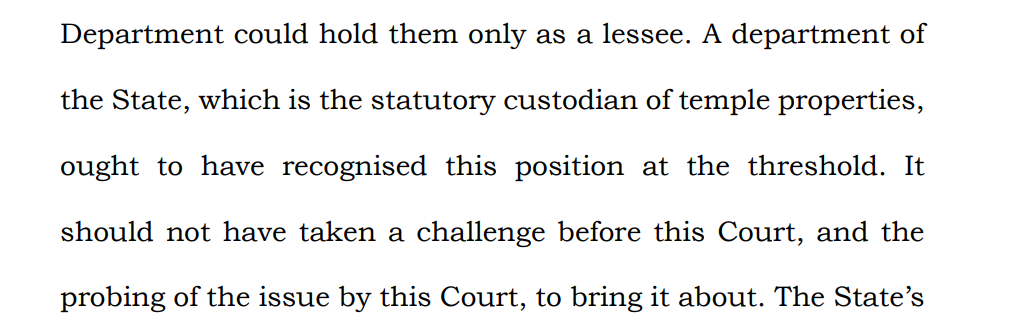
Screenshot from the judgment
“The State’s belated concession cannot obscure the fact that for over four years the property of the Temple was treated as that of the Government on the strength of a deed which, by the State’s own admission, had no sanction in law,’ the Court asserted.
The lease remains, but the State has to pay costs to the temple
The Supreme Court declared the gift deed transferring the temple land as null and void, but it did not annul the lease in favour of the land, considering that the Taluk Office served a public purpose. However, noting that the temple was wrongfully deprived of its property, the Court recalculated the rent as ₹31,000 per month, to be paid retrospectively from March 8, 2019. The rent is to be revised every three years.
The Court granted the government three months’ time to pay the arrears of rent from March 8, 2019, after adjusting the amount already paid. Additionally, taking note of the fact that the state government not only accepted the gift of the temple land in violation of the law but continued to defend it, the Supreme Court imposed a cost of ₹1,00,000 on the government to be paid to the temple within a period of eight weeks.
The Supreme Court directed State and HR&CE authorities to strictly follow Sections 34, 34-A and 41 of the HR&CE Act before effecting or sanctioning any exchange, sale, mortgage, or lease of religious-institution property.


