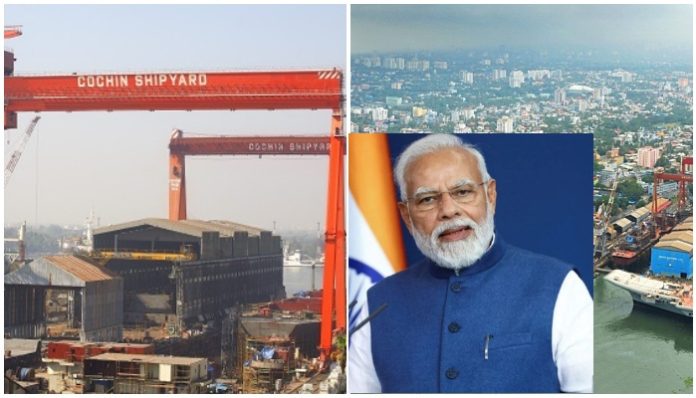
In a monumental stride towards making India a global maritime hub, the Modi government has unveiled plans to develop eight mega shipbuilding and repair clusters along India’s coastline. This ambitious initiative, central to India’s Aatmanirbhar Bharat and Maritime Amrit Kaal Vision 2047 aims to propel the nation into the world’s top five shipbuilding powers by 2047, directly challenging the dominance of China, South Korea, and Japan in the $220 billion global market.
The Blueprint: Clusters, capacities, and coastal transformation
This project is a cornerstone of India’s Aatmanirbhar Bharat (Self-Reliant India) and Maritime Amrit Kaal Vision 2047. The blueprint includes five greenfield hubs in Andhra Pradesh, Odisha, Tamil Nadu, Gujarat, and Maharashtra, designed as integrated ecosystems for ship manufacturing, equipment production, and allied services.
Complementing these are three brownfield expansions at Vadinar and Kandla in Gujarat, and Cochin in Kerala, focusing on specialised ship repair and large vessel construction. Land with statutory clearances and road-rail connectivity has been secured, with state governments forming Special Purpose Vehicles (SPVs) to accelerate development.
'बंदरगाहों की बात' में आज की कहानी: दीनदयाल पोर्ट की!
— Ministry of Ports, Shipping and Waterways (@shipmin_india) June 23, 2025
कच्छ से दुनिया तक — 150 MMT से ज्यादा कार्गो, हाईटेक सिस्टम और ग्रीन एनर्जी।
यही है भारत की बंदरगाही ताकत! ?⚓#DeendayalPort #BandargahonKiBaat pic.twitter.com/1ER5mljZPk
Financial engine room: Policy, funds, and incentives
Fueling this vision is unprecedented financial backing. The Union Budget 2025-26 established a ₹25,000 crore ($3 billion) Maritime Devlopment Fund to finance infrastructure and ship acquisition, targeting ₹1.5 lakh crore ($18 billion) in sectoral investments by 2030. A revamped Shipbuilding Financial Assistance Policy (SBFAP 2.0) allocates ₹18,090 crore ($2.2 billion) for subsidies, including 30% support for green vessels.
The grant of infrastructure status for large ships is expected to reduce capital costs by 20-25%. A flagship ₹57,000 crore investment at Kandla Port featuring a VLCC shipyard for 320,000-tonne crude carriers epitomises the project’s scale.
Global partnerships: Technology transfer and market access
To bridge technology gaps, India is forging strategic global partnerships. South Korea’s HD Hyundai is finalizing a ₹10,000 crore joint venture with Cochin Shipyard in Tamil Nadu for container vessels. European collaborators like Norway’s Kongsberg Maritime and Denmark’s Maersk are advancing projects in smart ports and green shipping, while Japanese giants Imabari and Mitsubishi are being courted for green hybrid vessel projects in Andhra Pradesh.
Cochin Shipyard Limited (CSL), India's premier shipbuilder under @shipmin_india & Hyundai’s KSOE, globally acclaimed shipbuilding giant from South Korea have signed a MoU for long-term collaboration in following key areas:-
— Cochin Shipyard Limited (@cslcochin) July 5, 2025
☑️Joint exploration of new building opportunities in… pic.twitter.com/r13ijWqPL1
Economic ripple effects: Jobs, trade, and security
Economically, the clusters promise transformative impact: India’s domestic shipbuilding market share is projected to surge from under 1% today to 7% by 2030 and 69% by 2047, creating 1.1 million direct and indirect jobs in allied industries. The newly launched Bharat Container Shipping Line (BCSL) will enhance trade resilience, reducing reliance on foreign vessels exposed during crises like Red Sea disruptions.
Sustainability Imperative: Green ports and corridors
Sustainability is woven into the plan, with ports like Kandla, Paradip in Odisha, and Tuticorin in Tamil Nadu pioneering green hydrogen bunkering. A pilot coastal corridor between Kandla and Tuticorin will showcase hydrogen/ammonia-powered vessels, while all major ports must deploy eco-friendly “green tugs” within three months.
Navigating challenges
Despite momentum, the Challenges still remain, including port capacity deficits. Port capacity must quadruple to 10 billion tonnes by 2047 to handle projected 6-7 billion tonne cargo flows. SBFAP 2.0 is giving subsidies to counter 15-20% higher building costs compared to Asian rivals, and execution speed. The Shipping Ministry’s “Chintan Shivir” aims to complete 150 maritime projects by September 2025 to maintain momentum.
The horizon ahead
As cranes rise over coastal Gujarat and Tamil Nadu, India’s shipbuilding gamble embodies a broader economic ambition. With ₹2 trillion already committed to maritime projects and global supply chains diversifying from China, these clusters could anchor India’s ascent as a $30 trillion economy by 2047.
“Ports are pivotal to our Aatmanirbhar Bharat journey,” declared Shipping Minister Sarbananda Sonowal. “We aim not just to build ships, but to craft a new industrial ecosystem”. If successfully executed, these shipyards may well become the engines propelling India from a maritime participant to a global maritime powerhouse.