

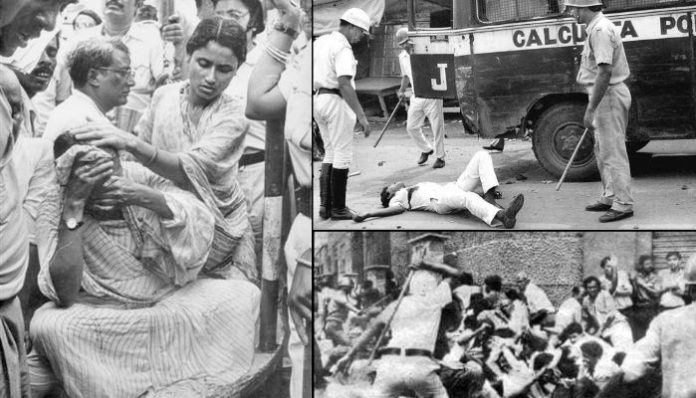
The day was 21st July 1993. Mamata Banerjee, who was the then West Bengal State President of the Youth Congress, had organised a protest march to the Writers’ Building in Kolkata in a campaign dubbed Writers’ Chalo Abhiyan.
Back then, the Writers’ Building served as the Office of the Chief Minister of West Bengal, Jyoti Basu.
The march was nothing new for Mamata Banerjee, who had shaped her entire political career on street fights and public drama. The disruptive style of protests on populist issues kept her in the limelight.
The motive behind the 21st July march to Writers’ Building
After the Jyoti Basu-led-CPIM government won the 1991 Vidhan Sabha election with a large margin, Mamata Banerjee began to peddle the conspiracy theory that the party had won the polls through ‘scientific rigging.’
Back then, votes were cast through ballot papers, and the presentation of voter ID was not mandatory. Incidentally, Mamata Banerjee became the Member of Parliament (MP) from the Kolkata Dakshin constituency in 1991.
She was appointed the Minister of State for Human Resource Development under the Congress-led Narasimha Rao government at the Centre.
Although she was part of the National politics, Mamata Banerjee had her eyes set on the power corridors of West Bengal.
Despite holding an important portfolio in the Narasimha Rao government, she was actively involved in the political affairs of West Bengal.
This was evident from her forced entry to the Writers’ Building in January 1993 with a rape victim, highlighting breakdown of law and order under the CPIM government.
After being unceremoniously pulled out of the office of then Chief Minister Jyoti Basu, Mamata Banerjee made plans to ambush Writers’ Building in the following 6 months’ time.
She needed a new issue, and the election conspiracy theory of alleged ‘scientific rigging’ of votes by CPIM provided the perfect foundation for a new protest and much-needed public drama.
Mamata Banerjee, in her capacity as the West Bengal State President of the Youth Congress, demanded mandating voter ID cards with photos and their categorisation as the ‘only valid document’ for casting votes.
This was the job of the Election Commission of India (ECI). At that time, the Election Commissioner was chosen by the President on the recommendation of the Union Cabinet.
Given that the Congress party was in power at the Centre, it did not make sense for Mamata Banerjee and Youth Congress to launch Writers’ Chalo Abhiyan in Kolkata against the Left government over photo Voter ID issue.
But as history would have it, the events of 21st July 1993 catapulted the political career of Mamata Banerjee.
What happened on that fateful day of 21st July 1993
As part of Writers’ Chalo Abhiyan, members of the Youth Congress gathered at five different points across Kolkata and began marching towards the Office of the West Bengal Chief Minister. The objective was to lay siege to the building.
At about 1 km away from their target destination on Brabourne Road, the police stopped the incoming Youth Congress workers from marching ahead. Section 144 was imposed in the area in advance.
According to the then Police Commissioner Tushar Talukdar, Mamata’s supporters, who were at the Mayo Road Crossing, pelted stones at the police and set multiple vehicles on fire. He said that the warnings given by the on-duty police personnel fell on deaf ears.
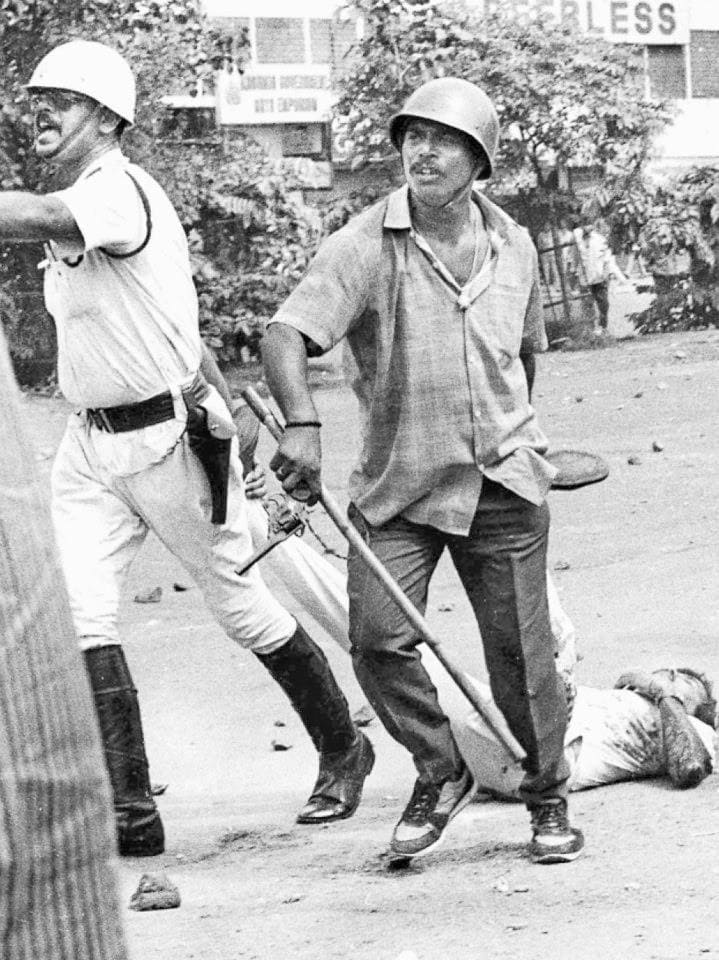
“Watching the unruly crowd, one of my officers said the only option to restore order was to open fire, or else the policemen and the state secretariat would come under attack. The next thing I heard was that the cops had opened fire and many Youth Congress workers were injured. Later, I learnt that 13 people had died,” he told The Telegraph.
The Youth Congress workers attacked the police, forcing the latter to resort to lathi-charge and firing tear gas shells. When they outnumbered the police and sensing no way out, the cops resorted to firing at the incoming mob.
Mamata Banerjee was also injured during the scuffle with the police. She had even climbed a traffic police post in the middle of the road. Youth Congress workers surrounded her and formed a protective ring to shield her from the police.
Sourjya Bhowmick writes in the book ‘Gangster State: The Rise and Fall of the CPI(M) in West Bengal’ (Pages 172-173) –
“Mamata raided the citadel of the state government, the Writers’ Building, on 21 July 1993, with the demand to make voter identity cards mandatory. Thousands of Youth Congress workers had thronged to central Calcutta and marched towards the majestic red Writers’ Building...
…So it did not take much time for the unruly, undisciplined crowd to emerge and spill out onto the streets when Mamata raised her voice against rigging. Section 144 had been imposed, but a part of the crowd broke the curfew on Mayo Road and attacked policemen. When the police started lathicharging, the crowd scattered and rumours of police firing travelled fast to other parts of the city like the Tea Board Crossing, where Banerjee was leading the protest. She tried to control the crowd but to no avail.
…Chief Minister Jyoti Basu gave strict orders to the administration to not allow anyone to seize the state secretariat. The police force had to abide by the instructions. But Congress workers outnumbered the police. In self-defence or enraged that hooligans had injured their colleagues, the police opened fire at the protestors, killing thirteen near the Writers’ Building.“
The aftermath of the fateful day
A total of 13 Youth Congress workers died on 21st July 1993, who are referred to as ‘Martyrs’ by the Mamata Banerjee-led-West Bengal government.
They include Srikanta Sharma, Bandhan Das, Dilip Das, Asim Das, Keshab Bairagi, Biswanath Roy, Kalyan Banerjee, Pradip Roy, Ratan Mondal, Murari Chakraborty, Ranajit Das, Abdul Khalek and Inu.
After coming to power in 2011, Mamata Banerjee formed a judicial commission led by former Chief Justice of Orissa High Court, Susanta Chatterjee, to investigate the 1993 police firing case.
The Commission ordered a compensation of ₹25 lakhs to the family of each of the victims. It noted that the control room police officers ‘overreacted to please their political bosses’ and held them responsible.
The Commission also summoned former Chief Minister Buddhadeb Bhattacharjee, who justified the police action against the incoming mob of Youth Congress workers.
He had stated, “At that time, in principle, I did not feel the need for a judicial inquiry and I still stick to my views. In the name of a march, it was an attempt to capture Writers’ Buildings. Given the situation, the police had to resort to firing.”
Political significance of the Martyr’s Day
The episode of 21st July 1993 stirred a renewed sense of sympathy among the masses for the Banglar meye (daughter of Bengal), Mamata Banerjee. Overnight, she became a star in the political sphere of West Bengal.
Just 5 years later, she broke away from the Congress to start her own political party, i.e. the All India Trinamool Congress (AITC).
The experience of 21st July 1993 came in handy to Mamata Banerjee during the years 2005-2007 when she led mass protests against the CPIM government in Singur and Nandigram.
By 2011, Mamata Banerjee brought an end to the 34-year-old CPIM rule in West Bengal. The campaign of 18 years finally culminated at the Writer’s Building.
The protest march of the Youth Congress has since been appropriated by the TMC and renamed ‘Martyr’s Day’. It is observed each year by the Mamata government with pomp and show at Esplanade More (Dharmatala) in Kolkata.


