

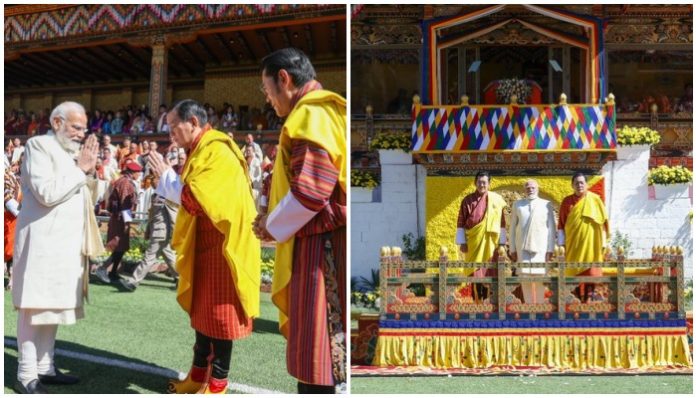
Prime Minister Narendra Modi’s November 11-12, 2025, visit to Bhutan added even more significance, considering the fact that the PM proceeded with his commitments even after the blast in Delhi the previous evening. The journey started less than a day after a devastating blast near Delhi’s famous Red Fort left at least ten people dead and numerous others injured. Every move made by the nation’s leadership is closely examined at times of national crises. A closer look finds a cautious, statesman like strategy that strikes a balance between crisis response and the demands of Indian foreign policy and the country’s long-term security objectives, despite the fact that some have questioned the logic of departing for a foreign trip so soon.
? As PM @narendramodi is enroute to Thimphu, Bhutan, let us watch highlights of the expansive and multisectoral deep rooted ??-?? partnership. pic.twitter.com/AHU4FxzO9R
— Randhir Jaiswal (@MEAIndia) November 11, 2025
The immediate aftermath of the Delhi blast
A huge explosion in a car ripped across a busy crossroads near Red Fort Metro Station in the heart of Delhi on the evening of November 10, 2025, causing loss of life, panic, and heightened vigilance throughout the capital and adjacent regions. In addition to offering his condolences to the victims, Prime Minister Modi reassured the country that relief and investigative measures were in progress. In order to ensure the deployment of top security and forensic agencies, such as the National inquiry Agency (NIA) and the National Security Guard (NSG), to manage both the inquiry and public safety, he promptly reviewed the situation with Home Minister Amit Shah and other officials.
History demonstrates that sudden, crisis-driven shifts in statecraft can occasionally give foes more confidence to test a country’s resolve. Modi showed that the shock or disarray of an attack will not take precedence over India’s primary foreign policy interests by moving forward with the Bhutan visit. In the neighbourhood, where China and Pakistan closely watch India’s capacity to handle pressure on several fronts, this is vital. A modest yet effective deterrent is to show steadiness rather than panic.
Policy paralysis trap: Stability amid shock
Many anticipated that Prime Minister Narendra Modi would postpone or cancel his planned trip to Bhutan after learning of the blast in Delhi. However, he boarded his aircraft as scheduled early the following morning. This may have appeared disconnected to some, but it was actually a planned crisis leadership exercise that avoided what experts in international decision-making refer to as “policy paralysis by shock.”
Shock is the initial period of confusion that follows an abrupt, high-impact event, one that impairs analytical clarity and freezes institutional reflexes, in the study of crisis behaviour. According to Thomas Meszaros and Laurent Danet, the “brutal confrontation with unprecedented problems” that occurs when decision-making units face a surprising occurrence causes confusion, which disrupts both analysis and response mechanisms. This immobility shows itself as confused message, overreaction, or delay, all of which convey weakness and encourage attackers to take advantage of you.
According to the Meszaros-Danet framework, shock is the abrupt, visceral jolt that impairs normal cognition, whereas crisis is a process of rupture that can change a system. Such trauma causes the brain to bypass logical processes and enter what the authors refer to as “psychic sideration,” which is a paralysis of thought and behavior. This results in policy paralysis at the national level, a time of hesitancy during which political institutions stagnate rather than change.
Historical examples demonstrate how this psychological burden causes societies to crumble. The United States first encountered a “strategic and tactical vacuum” following the September 11 attacks before putting together a cohesive response. Later in Iraq, policy overreach resulted from the shock’s immobilization of institutions and distortion of judgment. In a similar vein, India’s leadership descended into introspective caution during the 1962 Sino-Indian War and hesitated for years to project power outside of its boundaries. The consequences of allowing emotional confusion to rule statecraft are evident in each of these instances.
For Modi, it was crucial to show that governance could continue in the face of shock. The visit to Bhutan served as a symbolic reminder that, despite internal unrest, India would continue to fulfill its diplomatic and regional obligations. This is referred to as “managing the entry into crisis” in crisis theory, which aims to stabilize the system before panic strikes. Leaders that take decisive action during the entry period stop uncertainty from spreading through markets, bureaucracy, and public opinion.
Strategic continuity as a counter to shock
According to Meszaros and Danet, a pleasant shock can actually control a crisis by serving as a “psychic anti-inflammatory” that prevents escalation. It translates to “a leader can use decisive, stabilizing acts to reset the national mood” in politics. Modi’s trip to Bhutan served as just that kind of counter-shock. It broke the cycle of dread and conjecture that the attack aimed to establish and replaced it with a picture of order and normalcy.
There are powerful parallels in history.
- During the 1940 London Blitz, Winston Churchill famously carried on with his public schedule, strolling through damaged areas to demonstrate that government was still in place.
- In response to Arab Spring demonstrations in 2011, Morocco’s King Mohammed VI shocked onlookers by voluntarily reducing his personal authority and announced constitutional changes. This move “de-escalated the socio-political crisis” and put an end to turmoil.
What if PM Modi had stayed back
The symbolic impact would have been immediate and detrimental if the Prime Minister had delayed his visit. Internationally, it might have been interpreted as India slipping into defensive introspection, domestically, it would have projected anxiety. These signals have historically carried significant strategic costs.
During the 1986 Chernobyl tragedy, the Soviet leadership’s hesitation and quiet damaged their reputation both at home and internationally. India’s delayed national response to the Mumbai serial blasts in 1993 gave the sense of vulnerability, which for years encouraged cross-border networks. Tehran gained confidence and American deterrence in the Gulf was damaged by the United States’ initial uncertainty during the Iran hostage crisis in 1979.
States that continue to go forward in times of crisis, on the other hand, frequently come out stronger. Despite being taken aback at first, Israel’s leadership during the 1973 Yom Kippur War swiftly switched from shock to counter-action while maintaining strategic initiative. The same idea holds true in diplomacy, a leader’s capacity to multitask under pressure conveys institutional maturity and psychological readiness.
The optics of leadership and logic of deterrence
Credibility in foreign policy is based on consistent behaviour under pressure rather than rhetoric. By moving on with the Bhutan engagement, which is essential to India’s “Neighbourhood First” and “Himalayan Security” policies, Modi demonstrated that overseas outreach and national security management are complementary rather than antagonistic. Bhutan, a crucial buffer state against Chinese advances in Doklam and elsewhere, was also comforted by the judgment that India’s promises are unwavering even in the face of internal upheavals.
According to deterrence theory, such actions bolster a state’s resolve signal, which is the belief that asymmetric provocations cannot influence its decision-making apparatus. On the other hand, by demonstrating how small scale terror can skew India’s strategic schedule, canceling the trip might have inspired the very networks responsible for the explosion. Therefore, Modi’s poise transformed a possible weakness into a declaration of resiliency.
Leadership under crisis? Modi doctrine comes to play
The literature on crisis management emphasises the significance of “psychological preparation for shock.” The notion that leaders ought to prepare for the disruption of routine and prepare institutions to continue operating in spite of it. India’s governance culture has progressively absorbed this philosophy over the last ten years: from the 2016 surgical strikes to the 2020 Galwan conflict, the focus has been on responding calmly before using force. This pattern is maintained by the visit to Bhutan, which demonstrates that India’s natural response to stress is calmness rather than bewilderment.
The goal of the Delhi explosion was to create uncertainty, a tactical negative shock that would cause anxiety, diversion, and reluctance in policy. The positive shock that neutralized it was Modi’s decision to travel rather than withdraw. “Shock can have two effects, either it destroys the ability to think and act, or it stimulates the ability to react,” as noted by Meszaros and Danet. Modi’s response obviously fits the latter.
By upholding diplomatic continuity, he averted the appearance of vulnerability, maintained India’s international rhythm, and reiterated that governance must continue even in the face of terror. Such poise is supported by history; from Churchill to Morocco’s reforms to contemporary deterrence theory, the lesson is consistent “states that master shock control their own fate.”
India-Bhutan ties: Tradition and strategic partnership
Deep mutual trust, a common spiritual tradition, and close proximity are the foundations of India and Bhutan’s long-standing and special relationship. Cooperation on hydropower, trade, cultural exchanges, and defense are characteristics of this collaboration. The landlocked Himalayan nation of Bhutan serves as an essential buffer between China and India. Given Bhutan’s strategic location, India continues to be Bhutan’s most reliable partner, supporting security cooperation and development initiatives.
PM @narendramodi arrived at Paro, Bhutan on a State Visit, where he was received by the PM @tsheringtobgay of Bhutan and accorded a warm welcome. He will join the people of Bhutan in marking the 70th birth anniversary of His Majesty the Fourth King.
— Randhir Jaiswal (@MEAIndia) November 11, 2025
?? ?? pic.twitter.com/8KM27dpb77
Under the radar objectives
Although the official narrative focused on friendship, development, and cultural celebration, the visit was motivated by a number of less obvious but important goals.
- COUNTERING CHINESE INFLUENCE: In the midst of unsolved border conflicts, China is making more and more diplomatic and infrastructural overtures to Bhutan. Modi’s visit quietly challenges China’s expanding influence in the eastern Himalayas while reiterating India’s security commitment to Bhutan.
- BORDER SECURITY AND INFRASTRUCTURE: Confidential discussions on bolstering border control through road and surveillance improvements close to sensitive areas, are part of the visit.
- ECONOMIC INTERDEPENDENCE: The goal of India’s investments in Bhutan’s hydropower projects and new cross-border train connections is to increase economic reliance while lowering Bhutan’s vulnerability to Chinese influence via alternate trade channels.
- SOFT POWER PROJECTION: Modi’s prayers and involvement in Bhutan’s festivities, such as the King’s birthday, will strengthen India’s cultural links and use soft power to sway public and elite opinion in Bhutan in favor of India.
- INTELLIGENCE AND CRISIS PREPAREDNESS: Closed-door intelligence sharing and coordination against potential border or internal security threats are ongoing, with such visits facilitating updates and joint planning.
- WATER AND CLIMATE COOPERATION: Discussions about climate resilience and shared water resource management highlight India’s position as Bhutan’s favored partner in vital environmental areas.
Geopolitical implications
At this crucial point, India’s diplomatic relations with Bhutan must be viewed in the context of the larger South Asian and Himalayan chessboard. Bhutan continues to be a key component of India’s strategy to protect its vital northeastern border and thwart China’s territorial aspirations. The high-profile opening of significant infrastructure projects and cultural diplomacy were calculated actions that strengthened Bhutan’s dependence on India for stable political and economic development. India’s message to adversaries that the country’s strategic interests and external commitments will not be compromised due to terrorist provocations was emphasised by the visit’s timing.
Conclusion
Following the bombing in Delhi, Prime Minister Narendra Modi made a well-considered decision to visit Bhutan, demonstrating statesmanship in a challenging security situation. In addition to advancing vital infrastructure and energy cooperation, the tour will strengthen India’s steadfast friendship with Bhutan and demonstrate the country’s resilience. Modi shows that India’s obligations, both local and foreign, remain solid pillars during upheaval by striking a balance between immediate crisis response and long-term diplomatic priorities. In addition to strengthening India-Bhutan relations, this visit will highlight India’s larger regional goal of fostering stability and fending off outside pressures by unwavering cooperation and strategic vision.
During this time, PM Modi’s leadership blended strategic vision with empathy. He publicly expressed sympathy for the families of those killed in the explosion. At the same time, he advanced a significant diplomatic visit, demonstrating India’s faith in its institutions and unwavering commitment to national security and foreign policy.


