

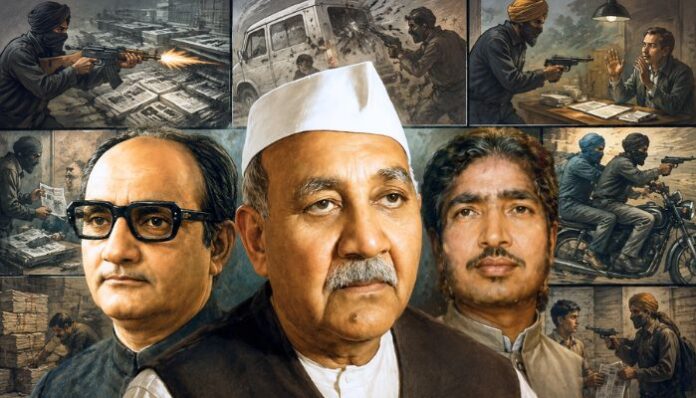
It was the evening of 9th September 1981. Lala Jagat Narain, the 83-year-old founder and chief editor of the Hind Samachar Group of newspapers, was travelling in a grey Fiat bearing the registration number PUQ 8880 from Patiala towards Jalandhar. His driver, Som Nath, was at the wheel. A Royal Enfield Bullet was following them, but neither of them noticed it at first.
When they were almost four kilometres away from Ludhiana, the motorcycle accelerated and pulled alongside the vehicle. Shots were fired at the moving car, but the assailants missed their target. Som Nath tried to turn the vehicle around, but an approaching bus blocked the path.
The motorcycle stopped. Two armed men got off and walked towards the trapped car. They opened fire at close range. Jagat Narain was shot three times and died inside the vehicle. Som Nath suffered bullet injuries.
The murder of Lala Jagat Narain was not an indiscriminate attack during the period of insurgency. The assailants had followed a particular man, blocked his escape and fired until they were certain that the editor who had repeatedly written against Khalistani terrorists would never write again.
The attack became one of the earliest and most consequential attacks on the press during the Punjab insurgency. Over the following decade, Khalistani terrorists killed editors, reporters, radio officials and newspaper employees. They attacked delivery vans, shot hawkers, threatened correspondents and issued diktats specifying which words could be printed or spoken.
The media was no longer merely covering the insurgency. It had become one of its principal battlefields.
Why Lala Jagat Narain became a target
Lala Jagat Narain was not an editor whose influence was confined to a small newsroom. His Hind Samachar Group published the Urdu-language Hind Samachar, the Hindi-language Punjab Kesari and the Punjabi-language Jag Bani. By 1981, the publications had built a substantial readership across Punjab and neighbouring states.
He was also a former Punjab minister, a parliamentarian and a prominent public voice. His editorials opposed communal separation, criticised Jarnail Singh Bhindranwale and warned against the growing use of violence in Sikh politics.
One of the major points of conflict was the 1978 clash between followers of Bhindranwale and the Sant Nirankari Mission in Amritsar. Jagat Narain supported the Nirankaris during proceedings connected to the incident and strongly criticised the killing of Nirankari followers. His newspapers continued to carry editorials against Bhindranwale and those using religious mobilisation to justify violence.
Jagat Narain’s opposition was not presented as hostility towards Sikhs. He consistently argued against turning political or religious differences into a Hindu-Sikh conflict. However, his reach made him particularly dangerous for those seeking to portray Khalistani separatism as the unquestioned voice of Punjab’s Sikh population.
His editorials reached readers in Hindi, Punjabi and Urdu. Killing him could therefore achieve more than revenge. It could warn every editor in Punjab that opposing the militants had consequences.
Bhindranwale was arrested on 19th September 1981 in connection with the conspiracy behind the murder. His arrest triggered violence and political mobilisation, but he was released shortly afterwards. Nachhatar Singh, who was arrested at the scene, was subsequently convicted of Jagat Narain’s murder. Court records show that another accused, Swaran Singh, was acquitted, while a third accused had absconded before the trial. Killing the founder, however, did not silence his newspapers.
Romesh Chandra continued his father’s campaign
After Jagat Narain’s assassination, his eldest son, Romesh Chandra, took charge of the Hind Samachar Group. He had seen what writing against terrorism had cost his father. He also knew that continuing the same editorial line would place him and the organisation under constant threat. Yet the group did not alter its position against violence by Khalistani terrorists.
Romesh Chandra continued writing against the militants and promoted Hindu-Sikh unity. He was also associated with the establishment of the Shaheed Parivar Fund, which collected funds for families affected by terrorism, including both Hindu and Sikh victims.
On 12th May 1984, less than three years after his father’s assassination, Romesh Chandra was shot dead in Jalandhar. Media reports described the killing as another major strike by extremists at a time when violence in Punjab was intensifying rapidly. He was returning from an event when he was riddled with bullets.
The message that Khalistani terrorists wanted to send through Romesh’s murder was clear. When killing one editor failed to change the newspaper group’s position, the terrorists would come after anyone and everyone who had taken his place. But the Hind Samachar Group continued publishing.
By 1989, its three newspapers had a combined weekly circulation of around seven lakh copies. The organisation had become one of the largest newspaper groups in northern India, but its offices increasingly resembled a fortified compound. Sand bunkers, armed guards and special barriers were placed around its premises. Editors carried weapons. Employees avoided telling strangers where they worked. The threat was no longer limited to the owners.
Sumeet Singh was killed for speaking against communal division
Khalistani terrorists did not divide their targets by religion. Sikh journalists who challenged the separatist narrative were also marked for death. Sumeet Singh was the 30-year-old editor of Preet Lari, a progressive Punjabi literary magazine founded by his family. He supported secular politics, communal harmony and cooperation between Hindus and Sikhs.
On 22nd February 1984, Khalistani terrorists attacked him in Lopoke village, around 25 kilometres from Amritsar. Sumeet Singh was shot dead despite his brother reportedly pleading with the assailants and pointing out that Sumeet Singh was himself a Sikh.
Media reports described him as an advocate of Hindu-Sikh unity. The extremists reportedly labelled him a traitor because he rejected the idea that Sikhs and Hindus had to be divided into hostile political camps.
His killing exposed the nature of the campaign. A Sikh identity did not protect a journalist who rejected Khalistan. The determining factor was not the victim’s religion but whether his words helped or obstructed the militant cause.
Baldev Singh Mann and the Sikh Left’s opposition to Khalistan
Baldev Singh Mann was another Sikh writer whose politics placed him directly against the separatists. Mann was a communist activist and editor associated with the Punjabi publication Hirawal Dasta. He wrote articles and addressed public gatherings condemning Khalistani violence and rejecting the demand for a theocratic separatist state.
Shortly before midnight on 26th September 1986, two gunmen opened fire on Mann near Harsha Chhina in Amritsar district as he travelled in a rickshaw. He was on his way to see his newborn daughter. He died at the spot. Mann’s killing came only a day after the communist leader Darshan Singh Canadian was assassinated. Both men were Sikhs. Both had publicly campaigned against Khalistani extremism.
Their deaths showed why the militants also sought to eliminate Sikh communists, secularists and advocates of class politics. These voices contradicted the claim that the conflict represented Sikhs collectively fighting the Indian state or the Hindu community. A Sikh publicly opposing Khalistan was especially damaging to that narrative.
Reporters in Punjab’s districts became easy targets
The assassinations of Jagat Narain, Romesh Chandra, Sumeet Singh and Baldev Singh Mann attracted attention because of their public profiles. District correspondents did not have the same visibility, institutional security or political reach. They were also easier to identify.
A local correspondent lived among the people he covered. Terrorists knew his house, workplace, family and daily route. He could receive a threatening letter in the morning and encounter the men who had sent it by evening.
By May 1988, India Today reported that terrorists had killed at least six journalists and attacked around a dozen others in Punjab during the preceding seven years. The dead included Giani Jagjit Singh, Narendra Pal Singh and other journalists working in the state’s most violence-affected districts.
Giani Jagjit Singh was a Gurdaspur-based journalist who died in an Amritsar hospital in December 1986 after being injured in an armed attack. He was associated with Akali Patrika.
A list of the Hind Samachar Group’s employees who were killed by Khalistani terrorists also listed a person named Jagjit Singh. However, it is unclear whether these were the same person contributing to different publications or two different people.
Narendra Pal Singh, also referred to as Narindar Pal Singh Pal in the media, worked from Tarn Taran for Punjab Kesari and Jag Bani. He was killed in 1987, when Tarn Taran and the border districts had become some of the most dangerous places for reporters operating outside heavily protected newspaper offices.
The danger did not end at the reporting stage. Desk journalists responsible for selecting, editing and presenting news were also targeted. Bant Singh, the chief sub-editor of Jag Bani, was assassinated in May 1988. As a desk editor, he did not need to travel into villages looking for militants. His alleged offence was connected to the material that appeared in the newspaper.
A month later, on 4th June 1988, terrorists riding a scooter shot Parduman Singh outside a small school he operated in Hoshiarpur. He covered the district for the Press Trust of India and The Indian Express and also contributed to Punjab-based publications.
Police did not immediately provide a motive. However, media reports noted that other journalists had been murdered for writing against Khalistan. Parduman Singh was described at the time as the eighth journalist killed by terrorists during the insurgency.
The following month, the Hind Samachar Group lost its news editor, Inderjit Sood. Sood had spent years inside the organisation and had even appeared as a defence witness in litigation connected with the Jagat Narain murder investigation. By July 1988, he held a role that directly influenced how militant deaths and terrorist attacks were presented in the newspapers.
He was shot near the group’s heavily guarded office in Jalandhar after the killing of Khalistan Commando Force chief Labh Singh.
Media houses sympathetic to the terrorists themselves claimed that Sood was assassinated in retaliation for the language used in Jag Bani while reporting Labh Singh’s death. According to the available records, he was murdered because the newspaper had described a dead terrorist without showing the reverence his followers demanded.
The attacks spread to correspondents working without protection
By 1990, the attacks had spread across towns where district correspondents worked largely without the fortified offices and extensive security available to senior editors.
Nanak Chand Nagpal was a veteran press reporter based in Sunam. A Punjab and Haryana High Court judgment from 1987 identified him as a correspondent for the Urdu daily Partap and recorded his role in reporting local judicial and political developments from the town. He was shot near his house in Sangrur district in 1990.
Bhag Singh Khela, a Jagraon-based correspondent for a Jalandhar newspaper group, was shot dead in Sherpur Kalan village in September 1990. Media reports from that time noted that he was a working journalist who had been murdered during a particularly violent week in Punjab.
Balbir Singh Saggu, a reporter and photographer associated with the left-wing newspaper Nava Zamana, had experienced pressure from both terrorists and the police. An India Today account from 1988 said terrorists had forced him to close his photography studio near the Golden Temple several years earlier. The police had also manhandled him while he was covering an assignment.
On 12th November 1990, armed Khalistani terrorists shot Saggu dead on the Guru Nanak Dev University campus in Amritsar. Narendra Sharma, a journalist associated with Punjab Kesari, was injured in the same attack.
Amar Nath Verma was murdered on 8th February 1991. The United States State Department’s human rights assessment for that year identified him as a journalist and editor of the weekly Quomi Bulhara and stated that terrorists had killed him.
These murders formed part of a system of punishment in which journalists could be killed for criticising Khalistan, refusing to print their statements, using an objectionable term or simply working for a publication placed under a boycott.
Hind Samachar’s hawkers and agents were also marked for death
The Hind Samachar Group suffered the most sustained campaign. By 1989, the group had lost its founder, his son and seven editorial employees. Terrorists then changed tactics. Instead of concentrating only on editors and reporters, they began attacking the system that carried newspapers from the printing press to the reader.
In June 1989, Khalistan Commando Force terrorists attacked Hind Samachar employees and newspaper vendors after the group refused an order to stop publishing its three newspapers. Four employees were killed in two attacks near Chandigarh.
Seven newspaper delivery workers, including teenage students, were killed during a series of attacks over the following weeks. A bomb exploded while hawkers were unpacking newspapers in Ludhiana, injuring around a dozen people.
Police personnel began accompanying newspaper vendors on bicycles. Hundreds of officers were deployed each morning to guard distribution routes. Around 30 hawkers stopped working, while circulation reportedly fell by approximately 60,000 copies.
The victims were not all journalists. Those counted among the Hind Samachar Group’s losses included editors, reporters, hawkers, agents, drivers, distributors and security personnel. Their functions were different, but the reason they were targeted was the same. Each helped the newspapers reach the public despite terrorist orders that they be shut down.
On 18th July 1990, gunmen ambushed a Hind Samachar newspaper van travelling towards Ferozepur near Jagraon. All five people inside, including three police guards, were killed. Around 40 vendors, agents and hawkers linked to the Hind Samachar Group were killed. The objective was not merely to kill individual employees. It was to make printing economically and physically impossible.
Terrorists attempted to decide which words could be used
The attacks on journalists were accompanied by written orders, telephone threats and purported codes of conduct. Terrorist statements frequently carried warnings that newspapers had to reproduce the statements in full. Editing, shortening or questioning the claims could invite punishment. Journalists also faced pressure from the authorities, who objected to reports about police abuses or failures in the counter-insurgency campaign.
Reporters were trapped between an administration that wanted favourable coverage and terrorists who believed they had the authority to sentence editors to death.
In November 1990, the Panthic Committee led by Sohan Singh issued a code for journalists, editors and columnists. Those campaigning for Khalistan were to be called “militants” or “freedom fighters”, not terrorists. Government public relations officials were ordered not to issue material in Hindi or English.
Most strikingly, the diktat declared that leaders of the five associated terrorist organisations could pronounce a death sentence on a journalist or editor. The Panthic Committee would decide whether the sentence should be carried out and would also hear any appeal.
The militants had created their own system of accusation, sentencing and execution. A journalist could be condemned by the very organisation he was reporting on, with no law, evidence or independent authority standing between the threat and the bullet.
Rajinder Kumar Talib was killed over broadcasting terminology
The campaign soon extended from privately owned newspapers to All India Radio. Rajinder Kumar Talib, the station director of All India Radio in Chandigarh, was also a respected Urdu poet. On 6th December 1990, two terrorists entered his house and shot him dead.
The five organisations supporting the Sohan Singh-led Panthic Committee claimed responsibility within days. The groups said they had no personal enmity with Talib and described his assassination as the first stage of “operation mother language”.
Their grievance was that All India Radio had not followed the language code imposed by them. A contemporary study in Index on Censorship also recorded that Talib’s killers objected to the use of the word “terrorist” while referring to their armed campaign. His murder was intended to demonstrate that Khalistani organisations could decide the language used by a public broadcaster.
ML Manchanda was abducted to enforce the terrorist code
The most brutal attempt to seize control of broadcasting came in May 1992. ML Manchanda was the station director of All India Radio in Patiala. On 18th May, members of Babbar Khalsa abducted him and issued demands to the government.
The organisation wanted the electronic media to implement its code of conduct. Among the demands was an end to Hindi and other non-Punjabi programming. The militants also objected to terminology used for those carrying out terrorist attacks and attempted to impose rules on the dress and presentation of television broadcasters.
Manchanda was held hostage while negotiations continued. The deadline expired without the government accepting the demands. On 27th May, Babbar Khalsa terrorists killed and beheaded him. His torso was recovered in Punjab, while his severed head was found in Ambala in Haryana.
Manchanda was murdered after the government failed to comply with the organisation’s deadline. Babbar Khalsa claimed the killing, openly connecting it to its effort to impose the media code. Unlike in several other cases, where responsibility remained disputed or the gunmen escaped without being identified, the purpose behind Manchanda’s murder was publicly announced.
The terrorists had abducted the director of a government radio station, negotiated over editorial and linguistic policy, and killed him when the state did not surrender.
The assassination triggered protests by employees of All India Radio and Doordarshan. Yet the terror also produced visible compliance. Broadcast practices changed, Hindi programming was shifted and officials became increasingly cautious about violating terrorist diktats.
A journalist did not need to carry a weapon to become an enemy
Between the assassination of Lala Jagat Narain in 1981 and the beheading of ML Manchanda in 1992 lay a sustained campaign against the people who produced and distributed information.
The methods changed according to the target. Editors were assassinated. District reporters were attacked near their homes. Radio officials were shot or abducted. Hawkers were killed while collecting newspaper bundles. Delivery vans were ambushed. Newsrooms received letters carrying instructions and death threats.
The underlying demand remained the same: submit. A publication was expected to use the terminology chosen by Khalistani organisations. Militant statements had to be printed without alteration. Criticism of separatism could be treated as betrayal. Coverage of terrorist atrocities could lead to a boycott or assassination. Even the continued physical circulation of an offending newspaper became punishable.
The effect went beyond the individual publications whose staff members were killed. Threats encouraged self-censorship, weakened reporting from affected districts and allowed militant claims to circulate with less scrutiny.
Yet newspapers continued to print. Hawkers returned to their routes under armed protection. Editors worked behind fortified walls. Reporters continued sending dispatches from towns where everyone knew their names and addresses.
Jagat Narain was killed because his printed words challenged the rise of terrorist separatism. Romesh Chandra was killed because his father’s death had failed to silence the newspaper. Sumeet Singh and Baldev Singh Mann were killed despite being Sikhs because they rejected communal division and Khalistan. Rajinder Kumar Talib was shot because a broadcaster used terminology the militants opposed. ML Manchanda was beheaded because All India Radio would not surrender its language and editorial policy to Babbar Khalsa.
They did not carry rifles or command security forces. Their offence was editing, reporting, publishing or broadcasting without accepting the authority of men with guns.
No history of the Punjab insurgency can be complete without including the journalists and media workers who continued to publish after Khalistani terrorists had declared that a column, headline, broadcast or newspaper bundle could invite a death sentence.


