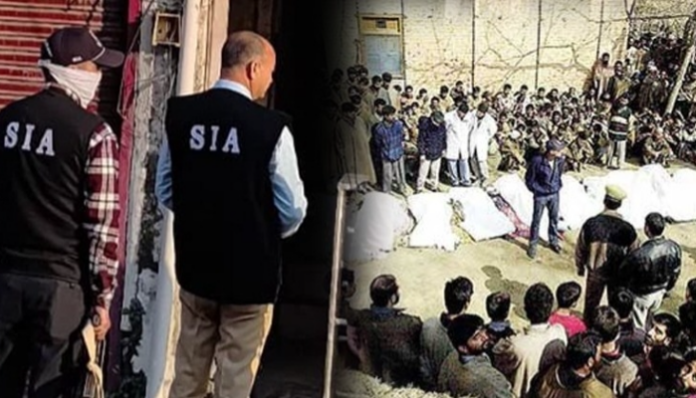
The Jammu and Kashmir State Investigation Agency (SIA) has again started the inquiry into the Wandhama massacre, in which 23 Kashmiri Pandits lost their lives in the Ganderbal region of central Kashmir, after 28 years. The move is part of a larger effort to probe long-standing cases of targeted killings during the peak of terrorism in the valley. The intention is to uncover new evidence regarding the deaths as well as trace and convict the perpetrators.
According to sources, the agency has also intensified its inquiry into the assassination of Justice Neelkanth Ganjoo, who awarded a death sentence to JKLF (Jammu Kashmir Liberation Front) founder Mohammad Maqbool Bhat and that of well-known Kashmiri Pandit lawyer Tika Lal Taploo, who was the vice-president of Jammu and Kashmir BJP (Bharatiya Janata Party) and an RSS (Rashtriya Swayamsevak Sangh) member, reported India Today.
It also reopened the cases about the deaths of writer Sarwanand Koul Premi and his son Virender Koul, as well as Kashmiri Pandit nurse Sarla Bhat. The insiders revealed that SIA raided many places in Kashmir a few days ago in relation to Taploo’s murder and the Wandhama horror. Terrorists and those who assisted them in carrying out these heinous acts are currently being identified by investigators to determine their roles in the attacks.
The agency is also looking into the larger terror network that is involved in these assaults, including potential financial handlers, white-collar terror conspirators and overground aides who are believed to have provided safe homes and reconnaissance. Simultaneous raids have been conducted across north, south and central Kashmir to retrieve digital devices, financial information and historical papers that might help authorities in filling in any gaps in the case. Moreover, the SIA is pursuing leads that remained unsolved for decades through public outreach and digital forensics.
“SIA Kashmir has already launched a focused investigation into these decades-old cases as a mission of utmost importance. All-out efforts are underway to unravel the underlying conspiracies, unearth and establish credible evidence, and identify the perpetrators strictly based on evidence and witness testimony. The objective is clear: to bring these cases to their logical conclusion on the merits, ensuring that truth prevails and those responsible are brought to justice,” a senior official shared.
What was the Wandhama massacre?
The gruesome tragedy happened overnight on 25th January 1998 during Shab-e-Qadr, the holiest night of Ramadan and on the eve of India’s Republic Day. Nearly 20 terrorists with their Kalashnikov rifles arrived at the doors of Kashmiri Pandit families staying in their ancestral homes in Wandhama. The assailants raised no suspicion because they were wearing Army camouflage. They then asked for tea to buy time to contact their collaborators who were covering the residences.
The terrorists completed the coordination and unleashed gunfire on the vulnerable Hindus. Some were hauled up from their homes and had bullets sprayed into their bodies, while others were shot dead at point-blank range with AK-47 rifles. Such an act of targeted savagery and violence had not been witnessed against the community since the 1990 atrocities that prompted the exodus of Kashmiri Pandits
Nine women, nine men and four children were among the twenty-three fatalities. The bodies also included those of five visitors who had travelled from Jammu to meet their relatives in the area. The jihadis claimed the lives of four families that fateful night. Vinod Kumar Dhar, a 14-year-old boy, managed to survive the brutality after going into hiding as his family members were being slaughtered.
However, he was so traumatised that he refused to leave the house whenever army officials showed up. “He just saw people in army uniform killing his family members with brutality and was so afraid,” recounted Kashmiri Pandit activist Sanjay Tickoo. The boy did not step outside until the next morning when Jammu and Kashmir Police reached in their khaki attire.
Afterwards, the attackers desecrated temples and set the Hindu homes on fire, annihilating the Kashmiri Pandit community from Wandhama. Notably, these defenceless victims had decided to remain in Kashmir and did not leave even after terrorism erupted in the region in the early 1990s. The episode caused the community to flee the valley for the second time.
The police attributed the brutality to Pakistan-based Lashkar-e-Toiba (LeT) as Kashmiri Pandits in Jammu and Delhi staged rallies. Nine protestors were hurt as demonstrators in the national capital marched in the direction of the National Human Rights Commission on 26th January and clashed with the cops.
The aftermath
The survivor, who is presently employed by the government on a compensatory basis, reportedly told the authorities that the gunmen were in Army disguises. A formal complaint was submitted at the Ganderbal Police station on his allegations and further statements from the families who escaped the assault. A probe was initiated, but its results were not disclosed.
S L Bhat, the Kashmir Divisional Commissioner at the time, was one of the first to react to the carnage and called it the “worst incident” he had ever seen. He added that “foreign mercenaries” were responsible for the murders. The backlash against the insufficient security arrangements intensified as the Army unveiled that the perpetrators were identified as a gang of 10 to 12 foreigners who were assisted by local terrorists.
According to a spokesperson for the defence ministry at the time, the natives were known to have links to some local political figures, which emboldened them to commit the attack. Hizbul Mujahideen terrorist Hamid Bhatt, also known as Hamid Gada, was neutralised in 2000 by the Jammu and Kashmir Police after it was established that he was responsible for that attack.
He was reportedly the son of the guardian of the renowned Kheer Bhawani temple and had ascended to the highest ranks of Hizbul Mujahideen in the valley after being inspired by Jamaat-e-Islami.
Reopening of old cases
SIA has reopened several cases which revolve around the murders of the Kashmiri Pandits throughout the past three years. The case of retired judge Neelkanth Ganjoo, who was murdered in Srinagar on 4th November 1989, was revisited in 2023. He was attacked because he condemned Maqbool Bhat to death in 1968.
The case of Sarla Bhat, a nurse who worked at the Sher-e-Kashmir Institute of Medical Sciences (SKIMS) in Srinagar, was reopened by the SIA in August of last year. On 18th April 1990, terrorists kidnapped her from her hostel, and her body was discovered the following day with several gunshot wounds. In June, the agency filed a 737-page chargesheet in a court regarding the matter.
On 14th September 1989, Tika Lal Taploo was shot dead outside his residence in Srinagar. It was among the first targeted killings of prominent Kashmiri Pandits as terrorism established roots in the valley. The case is presently under investigation by the SIA.
Similarly, the May 1990 double homicide of 65-year-old Kashmiri Pandit poet and writer Sarwanand Kaul Premi as well as his 27-year-old son Virender Kaul in their hometown of Soaf Shali in Kokernag of Anantnag is also being examined. SIA searched nine places in the union territory on 12th August in relation to the case.