The SC/ST Act, a legislation enacted with the stated objective of protecting Dalit communities from caste-based discrimination and atrocities, has come under scrutiny for rampant misuse. Amid growing public anger over the SC/ST Act, which the Modi government made more stringent, former Chief Justice of India (CJI) BR Gavai said that, like the Domestic Violence Act, the SC/ST Act’s provisions are also being misused. However, the former CJI said that it is for the Parliament to make necessary amendments to prevent the “benevolent” Act’s misuse.
Miscreants misusing SC/ST Act: Former CJI B R Gavai admits the flaw in the law, but says amending a law is Parliament’s job
Appearing on a Times Now show, India Upfront on 22nd September, former CJI BR Gavai said that the SC/ST Act was enacted to protect Dalits from untouchability and discrimination; however, some of its provisions are being misused by ‘miscreants’.
“People belonging to the SC and ST communities have suffered for ages on account of historical and social reasons. In order to protect them from untouchability, discrimination or harassment, this Act (SC/ST Act) was enacted. But, like many other Acts such as the Domestic Violence Act, there are always provisions that are misused by miscreants.”
Former CJI Justice B.R. Gavai Exclusive
— TIMES NOW (@TimesNow) September 22, 2026
People belonging to the SC and ST communities have suffered for ages on account of historical and social reasons. In order to protect them from untouchability, discrimination or harassment, this Act (SC/ST Act) was enacted. But, like many… pic.twitter.com/rTh7Iyh6oC
In a landmark 2018 judgment, the Supreme Court acknowledged SC/ST Act misuse and ruled that additional safeguards be provided
Notably, Justice Gavai was part of the Supreme Court bench that ruled in the 2018 Dr Subhash Kashinath Mahajan v. State of Maharashtra case that additional safeguards must be provided to civil servants before arresting them under the SC/ST Act.
The Supreme Court had ruled that additional safeguards must be provided to civil servants before arresting them under the SC/ST Act. The Court stated that the approval of an appointing authority or an S.S.P is required before arresting a public servant accused under the Act.
The apex court, back then, stated that the approval of an appointing authority or an S.S.P. is required before arresting a public servant accused under the Act.
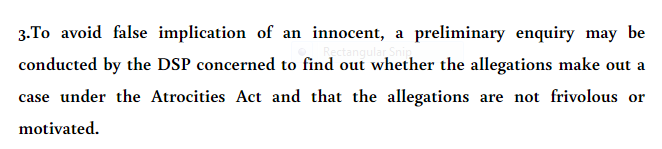
The court said that to avoid false implications, a preliminary enquiry by the DSP must be conducted to find out whether the charges are correct and not frivolous.
The Supreme Court had diluted the original 1989 Act, barring automatic arrests, requiring a preliminary inquiry by police before filing an FIR, and allowing anticipatory bail.
Modi government filed a review petition; when rejected, it passed a bill overturning the SC order
In response to the Supreme Court ruling, the Modi government moved a review petition before the Supreme Court for this ruling. However, the court rejected the petition, stating that its judgment is not in conflict with the SC/ST Act and does not dilute it in any way. Rather, the ruling only flagged the issue: “Can the liberty of an innocent be taken away without application of mind? We only said to protect an innocent from being falsely implicated under the Act, which has stringent provisions. People agitating may not have read the judgment. They may have been misled.”
Following the original court ruling, widespread violence erupted across several states after Dalit groups called for a Bharat Bandh.
Months later, in August 2018, the Modi government passed the bill to reverse the Supreme Court’s order. Later, in October 2019, the Supreme Court restored the original provisions of the SC/ST Act, stating that the previous order had strayed into the legislative domain.
Only society can build pressure on government to amend SC/ST Act: Ex-CJI BR Gavai advocates Gen-Z-style pressure building
During the Times Now interview on Tuesday, the former CJI said that the judiciary did what it could in 2018 regarding additional safeguards to prevent the misuse of the SC/ST Act.
Justice Gavai said that the government took a different direction in this regard. He opined that if certain provisions of a law are susceptible to misuse, requisite amendments should be made instead of scrapping the law altogether.
Thus, it is the Parliament and not the judiciary that can make necessary amendments to the SC/ST Act to prevent its misuse. For this, Gavai suggested that society should build pressure on the Parliament.
When asked about how to build this pressure, BR Gavai suggested that a social movement akin to the recent Gen-Z protests can put pressure on the government to add safeguards to the SC/ST Act.
“Judges, the judiciary can’t do anything. Parliament has to do it. Just like the Gen-Z movement created pressure, a social movement can put pressure on govt to add safeguards to SC/ST Act,” he said.
SC/ST Act misuse for vengeance and compensation
After the Central government strengthened the SC/ST Act, succumbing to street veto and political-electoral compulsions, this law secured a reservation-like sacrosanctity. Since then, there has been a dramatic increase in the filing of SC/ST Act cases, a significant number of which turn out to be fake and driven by the motives of either vengeance against so-called upper caste individuals, or monetary compensation, or both.
Between 2018 and 2022, conviction and charge-sheeting rates have remained low despite a rise in case numbers, with conviction rates falling from 39-40% in 2020 to 32-33% in 2022. In addition, 60% of cases registered under the SC/ST Act ended in acquittal or discharge.
Between the years 2019 and 2023, while total reported atrocities against Scheduled Castes surged to a five-year peak of 53,372 cases in 2023, around 14% to 15% of all disposed cases annually were essentially concluded without reaching trial under these final closure report grounds.
In 2020, the Rajasthan Police declared that more than 40% of cases filed under the SC/ST Act were fake.
The majority-acquittal outcome across the board indicates that a significant share of cases registered under the SC/ST Act were never caste-based atrocities to begin with.
From political vengeance, revenge against general category lovers, college colleagues, to compensation claims, OpIndia extensively reported earlier on the misuse of the SC/ST Act against general category individuals.
Notably, under the SC/ST (Prevention of Atrocities) Rules, 1995, as amended in 2016 by the Modi government, 25% to 50% of the amount is released by the District Collector within seven days of the FIR’s filing, another 25% after the chargesheet is filed, and the balance on conviction, drawn from a schedule that ranges between ₹1 lakh for offences like caste slurs up to ₹8.25 lakh for murder or gang rape.
In recent years, several courts have raised alarms over the misuse of the SC/ST Act for vengeance driven by various non-caste atrocity reasons, and for compensation money.
The Allahabad High Court bench of Justice Santosh Rai recently directed the Uttar Pradesh Government to initiate an inquiry into the process through which benefits under the SC/ST Act and the Rules framed thereunder are claimed and disbursed. The court directed particular scrutiny into the cases involving repeated claims by the same complainants or family members.
The direction was issued to the UP government when the court heard the case of one Santosh Kumar Dohrey, an advocate by profession, and his family members received roughly ₹23,36,250 in financial relief or compensation across various criminal cases under the 1995 Rules.
There are well-oiled broker networks actively involved in the systematic filing of cases under the SC/ST Act by falsely implicating upper-caste individuals to obtain compensation.
In August 2025, a Special SC/ST Court in Lucknow sentenced a lawyer to life imprisonment after he was convicted of filing false rape cases under the Scheduled Castes and Scheduled Tribes (Prevention of Atrocities) Act, 1989. The advocate, named Parmanand Gupta, used a Dalit woman working under his wife to file a large number of fake rape cases against various men. The scam was exposed after the Dalit woman revealed everything after becoming an approver in a case.
As if the prevalent misuse of the SC/ST Act for compensation money was not alarming enough, the Modi Government has reportedly proposed a 40% increase in compensation for SC/ST victims of atrocities, based on the rise in the Consumer Price Index (CPI). Under a reported proposal sent to the Expenditure Finance Committee for approval, the minimum compensation is expected to rise to ₹1 lakh and the maximum to about ₹12 lakh.
Invocation of SC/ST Act in Sahil Wakode suicide case against IIT Bombay professor triggered a broader debate around the legislation’s misuse
The issue of largescale misuse of the SC/ST Act gained national attention in 2021, when a Brahmin man named Vishnu Tiwari was set free by the Allahabad High Court after he spent 20 years in jail on false charges of rape and the SC/ST Act.
Tiwari, a resident of Lalitpur village, was booked on charges of rape, sexual exploitation, and criminal intimidation under the Indian Penal Code (IPC) and other sections of the SC/ST (Prevention of Atrocities) Act, when a woman from Silawan village, which is 30 km away from his place, accused him of raping her. He was held guilty by a trial court and sentenced to life imprisonment at the age of 23 in the year 2000. In the 20 years he spent in jail, Tiwari lost all his family members.
The Court’s acquittal was based on the medical examination report, which said that no sperm or injuries were found on the prosecutrix, who was five months pregnant at the time. Her testimony also indicated that she was not a ‘stellar witness’.
While the SC/ST Act misuse issue gained nationwide traction in 2021, the recent suicide case of an IIT Bombay student, Sahil Wakode, has reignited the debate around the issue.
Sahil Wakode, a 2nd-year BTech student at IIT Bombay, took his own life on Friday (18th September) after being caught red-handed by Professor Suryanarayana Doolla. He later committed suicide in his hostel room.
Thereafter, protests emerged on the campus of the institute, demanding action against the esteemed faculty member. A day later, on Saturday (19th September), Sahil’s parents alleged that Professor Doolla had been mentally harassing and using casteist slurs against their son for 3 months at the behest of IIT Bombay’s Director Shireesh Kedare.
One of the key demands of Wakode’s father, Ravindra, is the immediate release of financial compensation under the SC/ST (Prevention of Atrocities) Rules, 1995.
While Wakode’s death has been given a caste discrimination spin, not a single complaint was ever filed against Professor Doolla or Shireesh Kedare either with the administration or the SC/ST cell of IIT Bombay during Sahil’s tenure at the institute.
Meanwhile, Professor Doolla has received broader support, with many describing the SC/ST Act charges against him as vengeance for his decision to call out Wakode for using a mobile phone for cheating.
While the BJP largely remains indifferent to the mounting criticism of its amendment of the SC/ST Act, or has only boasted about making the law more stringent, demands to place necessary safeguards and reform the financial compensation criteria are increasing to prevent the Act’s misuse.