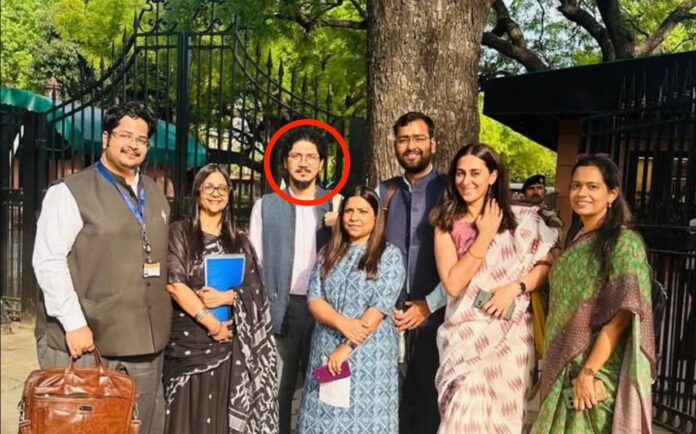
The Joint Parliamentary Committee examining the Constitution (One Hundred and Thirtieth Amendment) Bill, 2025, along with the Jammu and Kashmir Reorganisation (Amendment) Bill, 2025 and the Government of Union Territories (Amendment) Bill, 2025, is examining legislation with enormous constitutional and national significance. The committee was constituted in November 2025 and is headed by BJP MP Aparajita Sarangi. The three Bills were referred to the committee after being introduced in Parliament in August 2025.
Against that backdrop, Jindal Global Law School’s decision to send a particular professor as part of its delegation before the committee deserves scrutiny.
JGLS recently announced that it had been invited to provide its expert suggestions to the Joint Parliamentary Committee. According to the school’s own announcement, a team led by Professor (Dr.) Dipika Jain, Executive Dean of JGLS, appeared before the committee and offered suggestions and reforms concerning the proposed constitutional framework.
Among those named as part of the team was Arijeet Ghosh, currently an Associate Professor at JGLS.
There is nothing inherently unusual about a constitutional law professor appearing before a parliamentary committee. In fact, parliamentary committees routinely seek inputs from academics, experts, civil society organisations and other stakeholders. The Lok Sabha Secretariat itself invited memoranda and suggestions from experts, institutions and stakeholders concerning these Bills.
The question, however, is about the particular expert being presented by an institution as part of a team providing constitutional advice to Parliament.
Arijeet Ghosh is not an unknown academic. JGLS’s own faculty profile describes him as an Associate Professor specialising in Constitutional Law, Human Rights and Criminal Justice Institutions. It also records his experience as a consultant to the 21st Law Commission of India and his work with legal-policy and human-rights organisations.
But Ghosh also became the centre of a major controversy in 2021-22 after a video of him from a Jindal Global Law School classroom had gone viral.
In the video, Ghosh was heard discussing Jammu and Kashmir and saying that it must be referred to as “India-occupied-Kashmir”. He further said that although India describes Jammu and Kashmir as Indian territory and “Indian-administered-Kashmir”, he considered it an aspect of occupation and said this was what Kashmiris also said.
The controversy was not merely about an academic discussing a politically sensitive issue. The terminology used by Ghosh was itself significant. Calling Jammu and Kashmir “India-occupied-Kashmir” is not a neutral description of India’s constitutional position. It is language associated with a fundamentally different characterisation of India’s relationship with the territory. It fuelled separatist sentiments and echoed Pakistan’s stance on the issue, effectively legitimising the disputed status of Jammu and Kashmir.
Ghosh also appeared to acknowledge the highly emotive nature of the subject, referring to popular cinematic rhetoric surrounding Kashmir before saying that he did not want to get into that aspect. Yet the central proposition had already been stated: he had characterised Indian control over Jammu and Kashmir as an occupation.
That statement, whether understood as an expression of an individual academic’s political or legal opinion, is part of Ghosh’s publicly documented record. It is therefore reasonable to ask why an institution advising Parliament on legislation that expressly concerns Jammu and Kashmir would consider him an appropriate member of its expert delegation. And how could the institution and the JPC be sure his past views on Jammu and Kashmir didn’t affect his present opinions on the concerned legislation?
If JGLS wants to portray its appearance before the JPC as an example of “rigorous legal scholarship” contributing to a national constitutional debate, it cannot reasonably expect the public to ignore the previous public record of the individuals it chooses to put forward as “experts.”
The irony becomes sharper because Ghosh’s present academic profile explicitly lists Constitutional Law as one of his areas of expertise. He is therefore not appearing before Parliament merely as an incidental participant. He is being presented as a constitutional-law academic whose expertise is relevant to the questions before the committee.
And the questions before this particular committee include Jammu and Kashmir.
This is where institutional credibility matters.
Parliamentary committees are not academic seminars where every proposition can simply be treated as another interesting intellectual exercise. They are part of the legislative process. Their consultations can influence how MPs understand proposed legislation, constitutional provisions and their consequences.
That does not mean experts appearing before committees must agree with the government, the ruling party or even the constitutional status quo. Quite the contrary. Strong constitutional scrutiny requires disagreement, criticism and competing legal interpretations.
But there is a difference between inviting an expert because his arguments challenge the government’s position and failing to conduct due diligence on an expert whose previously recorded public statements raise questions directly relevant to the subject under consideration.
The Centre and the parliamentary committee therefore have a legitimate institutional interest in knowing who is being presented to them as an expert, what their publicly documented positions have been, and whether there are potential credibility or conflict concerns that ought to be considered.
This is particularly important when the institution making the submission is a prominent private law school that repeatedly positions itself as a contributor to national legal and policy debates.
Jindal Global Law School has every right to defend Ghosh’s academic freedom and to explain why it considers his expertise valuable. It can also clarify whether his views on Kashmir have changed, whether the 2021 statement represented a personal political opinion rather than a legal conclusion, and what position he actually took before the JPC.
But silence would leave an obvious question hanging.
Why was a professor who publicly described Jammu and Kashmir as “India-occupied-Kashmir” selected by JGLS to be part of the team advising a parliamentary committee examining legislation that specifically concerns Jammu and Kashmir?
The issue is not that Parliament should only hear people who agree with the government. It is that Parliament should know exactly whose expertise it is receiving and what publicly documented positions those experts have previously expressed. Those who take maximalist positions like branding Jammu and Kashmir as ‘Indian occupied Kashmir’ and therefore fanning separatist sentiments are something of grave concern for the sovereignty of India.
The JPC is examining constitutional legislation of immense consequence. The standard for institutional due diligence should therefore be correspondingly high.
At the very least, the episode should prompt a broader question: when universities and private institutions send “experts” to Parliament, should the government and parliamentary committees conduct a basic background check on their public record? And shouldn’t the JPC and the Parliament take objection to the inclusion of dubious characters like Mr Ghosh?
In matters involving the Constitution, national sovereignty and Jammu and Kashmir, asking that question is hardly unreasonable.
Expertise matters. So does credibility. And Parliament deserves both.