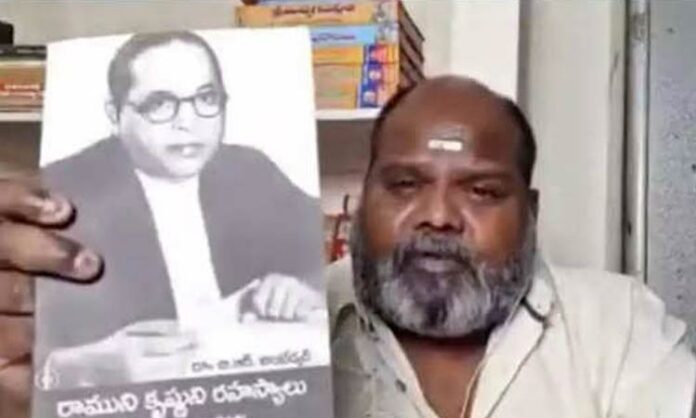
A book criticising Dr BR Ambedkar had not even been formally launched. Its author was already behind bars.
Hamara Prasad, founder of the Rashtriya Dalita Sena, was arrested by Telangana Police on September 17, a day before the scheduled launch of his Telugu book Kalpitha Nayakudu (The Fabricated Leader). The arrest came amid protests in several districts over the book’s contents, title and cover.
A case was registered against Prasad at the Central Crime Station (CCS), Hyderabad, under Sections 353(2), 196, 350 and 61(2) of the Bharatiya Nyaya Sanhita (BNS), concerning alleged statements causing fear or alarm, promoting enmity, intentional insult or provocation, and criminal conspiracy.
The arrest became publicly known on Friday, when Prasad was produced before the Telangana High Court.
The episode raises a question larger than one author or one book: when protests against controversial speech are followed by the arrest of its author and seizure of copies, does the resulting law-and-order situation end up determining what can be published?
A book challenging an established narrative
The Fabricated Leader is a roughly 730-page Telugu work that takes a critical view of established narratives surrounding Ambedkar.
Hamara Publications presents it as a challenge to widely circulated political and historical narratives, inviting readers to question established accounts and examine questions of history, society and national identity.
Prasad has also said on social media that his work seeks to challenge personality cults and present what he describes as the “real history” of India.
The book’s interpretation of Ambedkar can certainly be disputed. Critics can challenge its sources, arguments and historical claims. But that debate is meaningful only if the work can first be examined and its claims answered.
Ambedkar himself warned against hero-worship
There is a striking irony in the controversy.
Ambedkar himself warned Indians against turning political leaders into objects of unquestioning devotion. In his concluding speech to the Constituent Assembly on November 25, 1949, he cited John Stuart Mill’s warning against laying one’s liberties at the feet of even a great man.
Ambedkar then issued his own famous warning: “Bhakti in religion may be a road to the salvation of the soul. But in politics, Bhakti or hero-worship is a sure road to degradation and to eventual dictatorship.”
The point was not that great men should not be respected. It was that democratic citizens must retain their political judgment instead of surrendering it to personalities.
That makes the current controversy particularly noteworthy. Respecting Ambedkar’s legacy and allowing Ambedkar to be criticised are not mutually exclusive propositions.
If Prasad’s account is wrong, it can be rebutted. If his historical claims are false, evidence can expose them. If his interpretation is distorted, Ambedkar’s own writings can be placed alongside it, and the contradiction demonstrated.
From outrage to police action
The controversy, however, moved quickly beyond criticism of the book.
Protests were reported in several Telangana districts, including Adilabad, Asifabad and Medak. Dalit organisations reportedly held a rally in Asifabad, while protesters in Indravelli and Nirmal reportedly burnt Prasad’s effigy and demanded action against him.
In Dubbaka and Tadwai, representatives of Telangana Mala Mahanadu and Ambedkar associations approached the police with complaints over what they described as objectionable remarks about Ambedkar.
The State subsequently told the Telangana High Court that Prasad had been arrested and several physical copies of the book had been seized to prevent any untoward incident.
That sequence is what makes the case significant. The controversy did not end with people denouncing the book; it moved into the criminal justice system before the scheduled launch had even taken place.
The High Court intervention
Chandramouli, the petitioner, approached the Telangana High Court through a lunch-motion petition seeking to stall the proposed launch.
The petition objected to the book’s title, cover and contents, with the petitioner arguing that certain portions could promote hostility among Ambedkar’s followers. It also sought restrictions on circulation of PDF versions.
The High Court sought details from the State regarding action taken to remove the book from online platforms and bookstores.
By then, however, the government informed the court that Prasad had already been arrested and that copies had already been seized. Prasad was subsequently in judicial remand.
At the time of publication, the author’s website and the Amazon listing showed the book as out of stock.
In other words, the book’s scheduled launch became almost secondary to the legal controversy surrounding it.
The real issue: offence, offensiveness and illegality
None of this means Prasad is entitled to immunity from prosecution.
The police have invoked specific provisions of the BNS, and those allegations must be tested through the criminal justice process. If particular passages satisfy the statutory ingredients of an offence, the law can and should take its course.
But three concepts need to be kept separate: something can be offensive without being criminal, controversial without being unlawful, and historically wrong without being illegal.
The problem with the heckler’s veto
The broader concern can be described through the idea of the heckler’s veto: the possibility that someone can effectively control another person’s speech by threatening disruption in response to it.
The danger is not that every protest is illegitimate. Protest is itself an essential form of expression.
The danger arises when the anticipated consequences of a protest become the reason for restricting the original speech rather than restraining those responsible for unlawful conduct.
A simple principle follows: the person who threatens disorder should not automatically acquire the power to determine what somebody else is allowed to say.
That principle is particularly important in a country as politically and socially diverse as India, where almost every major historical figure has supporters who consider criticism of their icon unacceptable.
Why rebuttal matters more than removal
There is a straightforward way to challenge a book that gets Ambedkar wrong: read it and rebut it.
If its sources are unreliable, identify them. If its historical claims are false, produce the historical record. If its interpretation contradicts Ambedkar’s own writings, quote those writings and explain the contradiction.
That would not weaken Ambedkar’s legacy. It would demonstrate that his legacy can withstand scrutiny.
Indeed, there is something inherently stronger about allowing Ambedkar’s own ideas to defeat arguments made against him rather than relying on the State to prevent those arguments from being heard.
This is especially relevant given Ambedkar’s own warning against political hero-worship.
A precedent beyond Ambedkar
The implications of this episode extend beyond the immediate dispute.
Today, the controversy concerns a book critical of Ambedkar. Tomorrow, another group could object to a book critical of Gandhi, Nehru, Savarkar, a religious figure, a political party or an ideological movement.
India’s public discourse is already intensely contested. If every offended constituency can seek restrictions by pointing to the possibility of protests, fewer difficult subjects will remain open to serious discussion.
The answer is not to immunise controversial publications from law. It is to ensure that the law is applied because its ingredients are satisfied, not simply because a publication has generated sufficient outrage.
The State’s responsibility
The Telangana government has a legitimate responsibility to prevent violence and maintain public order. But those two objectives should not be conflated with preventing people from encountering controversial ideas.
If there is a credible threat of violence, those making the threat can be dealt with under the law. If a publication itself constitutes an offence, its author can be prosecuted on the evidence.
The critical distinction is between responding to unlawful conduct and pre-emptively suppressing speech because someone might react unlawfully to it.
That distinction determines whether the State is enforcing the law or allowing public pressure to shape its application.
Ambedkar’s warning deserves to be remembered
Prasad’s book may ultimately prove to be historically convincing, deeply flawed, provocative or simply wrong. Readers can decide that only after examining it.
Ambedkar’s supporters have every right to reject its arguments and defend his legacy. They also have every right to demand that demonstrably unlawful material be dealt with according to law.
But Ambedkar himself warned against political Bhakti and hero-worship because he understood the danger of surrendering democratic judgment to personalities.
His warning therefore deserves to be remembered precisely when criticism of a revered figure becomes a source of public anger.
A confident intellectual legacy does not need every critic silenced. It can answer criticism with evidence, argument and Ambedkar’s own words.
If The Fabricated Leader violates the law, let the courts determine that on the evidence. If it is merely a controversial interpretation of history, then let the battle over it take place where ideas are supposed to be tested: in public debate.
The loudest protest should not become the loudest voice in deciding what Indians are allowed to read.