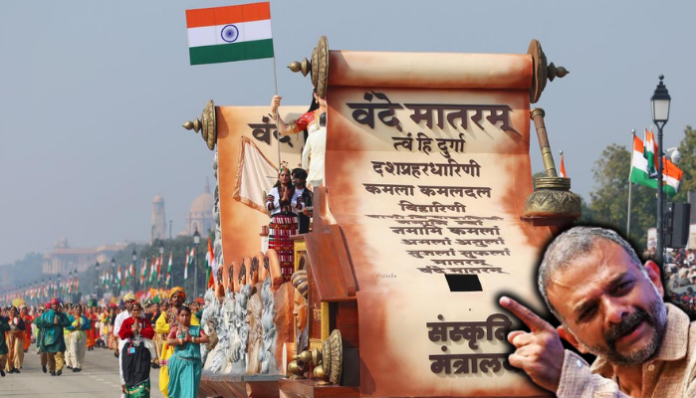
On Tuesday (22nd September), the Supreme Court asked the Central government to submit a response to a plea by Carnatic vocalist and notorious Hinduphobe TM Krishna challenging the constitutional validity of the 2026 amendment to the Prevention of Insults to National Honour Act. This amendment makes the intentional prevention of the singing of the National Song Vande Mataram or disrupting an assembly singing it a punishable offence attracting three years in jail.
The Supreme Court bench comprising Chief Justice of India (CJI) Surya Kant, Justice Joymalya Bagchi, and Justice V. Mohana asked the Union government to respond to TM Krishna’s plea within two weeks.
What plea moved by TM Krishna contends
In his plea, TM Krishna claimed that the later stanzas of Vande Mataram contain references to Hindu deities Durga, Lakshmi and Saraswati.
The plea argues that the Central government’s directions that the full Vande Mataram song be sung at specified government, ceremonial, and cultural occasions, and penalising disruption of its singing, go beyond regulating protocol.
In addition, TM Krishna contended that such a rule forces citizens to participate in singing the last four stanzas.
“In consequence and in effect, the Impugned State Action does not merely regulate national protocol or prescribe a uniform code of conduct for public functions. It compels a ceremony of assent to a symbol whose last four stanzas, Stanzas 3 to 6, are expressly devotional, deity-invoking and non-secular,” the plea argues.
The controversial Carnatic vocalist claimed that the measures laid out by the Central government violate fundamental rights under Articles 14 (equality), 15(1) (protection against discrimination), 19(1)(a) (freedom of speech and expression), 21 (life and personal liberty) and 25(1) (freedom of conscience and religion).
“By mandating the rendition of all six stanzas under penal sanction, the State transforms what is unquestionably a contested historical symbol into a compelled orthodoxy,” it adds.
Furthermore, the plea contends that the first two stanzas were originally composed as a separate patriotic lyric, and the remaining four were included when Vande Mataram was incorporated into the Bankim Chandra Chattopadhyay-authored novel Anandamath.
It mentioned the 1937 decision of the Congress Working Committee to adopt only the first two stanzas for singing at national gatherings after Muslims raised objections.
“The measure (2026 directions) is formally neutral but, manifestly, substantively coded: it sends a signal of majoritarian religious alignment and inflicts expressive subordination on believing Muslims and other conscientious objectors,” the plea adds.
Appearing for TM Krishna, controversial lawyer S Muralidhar argued that law does not define national song, making it open to misuse. In addition, the plea claims that a penal statute in this regard cannot be vague.
The plea seeks Supreme Court directions to strike down the amendment to Section 3, overturn the Centre’s law, declaring that only the first two stanzas of Vande Mataram constitute the National Song.
What the Supreme Court said
During the hearing on Krishna’s plea, Justice Joymalya Bagchi invoked the 1986 Bijoe Emmanuel case wherein the Supreme Court protected Jehovah’s Witness Christian students from legal scrutiny, who refused to sing the national anthem due to religious beliefs, emphasising freedom of conscience under Article 25.
“We expect that law of the land, as laid down in Bijoy Emmanuel, will govern. What is a national song is clear. Nobody who feels an infraction of Art. 25, 26 rights would be subjected to [penal consequences]. It’s not remit of court to second-guess what are national aspirations. It is for the state. Person can decide whether to sing 1 or 4 stanzas. There can’t be penal consequences,” Justice Bagchi said.
Justice Bagchi also orally stated that the Constitution makes no mention of a national song in Article 51A.
“Even the Constitution didn’t mention the national song in Article 51A. By customs and usage, the national song has always been mentioned and understood as Vande Mataram, with the two stanzas,” Justice Bagchi said.
However, said that the court will examine the matter to the extent of penal consequences, adding that courts cannot dictate on the declaration as a national song.
Muralidhar argued that the Central government cannot rely on an office memorandum to impose consequences of a penal statute regarding the National Song.
Meanwhile, Tushar Mehta, the Solicitor General representing the Central government, asked the court not to issue a notice, as that would sensationalise the matter. He argued that the petition was designed to play to the gallery and that the legislation made by the Parliament is in accordance with the Constitutional procedures.
“Let me be given a copy. Notice will create a sensation, which appears to be the object… Parliament, I said that is the constitutional way, not what the Naxalite wants,” Mehta said.
Vande Mataram got legal protection after an amendment to the law
On 30th July 2026, the Lok Sabha passed the Prevention of Insults to National Honour (Amendment) Bill, 2026, providing legal protection to the national song Vande Mataram on a par with the national anthem Jana Gana Mana. The legislation was cleared by a voice vote amid noisy protests and a brief debate, a day after the Rajya Sabha had approved it.
The amended Section 3 of the Prevention of Insults to National Honour Act, 1971. Under the existing law, intentionally preventing the singing of the national anthem or causing disturbance to any assembly engaged in its singing attracts imprisonment of up to three years, a fine, or both. The amendment extends identical protection to Vande Mataram. Anyone found intentionally preventing its rendition or disrupting a gathering singing the national song will face the same penalty.
The legislation, however, does not make singing Vande Mataram compulsory, nor does it punish those who choose not to sing it.
On 11th August 2026, President Droupadi Murmu gave her assent to the passed bill. With the President’s approval, the Bill has now become law.
For the first time in the Independence Day celebrations at the Red Fort, ‘Vande Mataram’ was rendered in full at the historic venue on 15th August 2026.
From a patriotic song to a subject of politics and Islamist intransigence: History of Vande Mataram
Written by Bankim Chandracharya in 1875, Vande Mataram was first published in the literary journal Bangadarshan on 7th November, 1875, and was later included in his 1882 novel Anandamath.
The song soon became a significant part of the national movement. Its use as a political slogan dates back to 7th August, 1905, during the Swadeshi movement. Large gatherings used the song to express patriotism and opposition to British rule.
‘Vande Mataram’ was first sung publicly at the Indian National Congress session in Calcutta in 1896, where Rabindranath Tagore sang it and later composed its music. Over the years, it became closely associated with the freedom struggle and inspired many people who took part in the movement.
The song was adopted as India’s national song by the Constituent Assembly in 1950. The Union government launched a year-long programme last November to mark 150 years of ‘Vande Mataram’.
The song Vande Mataram, however, was marred by political controversy in the 1930s. The Muslim League, under Muhammad Ali Jinnah, objected to the song’s religious imagery. The League argued that the idea of treating the motherland as a divine figure could conflict with Islamic beliefs. It also raised concerns about the portrayal of Muslim rulers in Anandamath.
Notably, the main offence over the full Vande Mataram song stemmed from the lyrics “त्वंहिदुर्गादशप्रहरणधारिणीकमलाकमलदलविहारिणीवाणीविद्यादायिनी, नमामित्वाम्नमामिकमलांअमलांअतुलांसुजलांसुफलांमातरम् (Thou art Durga, Lady and Queen, With her hands that strike and her swords of sheen, Thou art Lakshmi lotus-throned, And the Muse a hundred-toned, Pure and perfect without peer, Mother lend thine ear, Rich with thy hurrying streams, Bright with thy orchard gleams, Dark of hue O candid-fair In thy soul, with jewelled hair And thy glorious smile divine, Loveliest of all earthly lands, Showering wealth from well-stored hands! Mother, mother mine! Mother sweet, I bow to thee, Mother great and free.)
The issue was discussed within the Congress party. In October 1937, the Congress Working Committee decided that only the first two stanzas of ‘Vande Mataram’ should be sung at public functions. The Congress party essentially surrendered before the bigotry and intransigence of Mohammed Ali Jinnah; only a decade later, he spearheaded Direct Action Day, and India’s partition on Islamic lines.
The matter was discussed by Jawaharlal Nehru. Nehru acknowledged that ‘Vande Mataram’ had been closely linked with Indian nationalism for more than three decades, but also supported avoiding some stanzas containing allegorical references at national events.
In consequence of Congress’s abject surrender, the Vande Mataram song was mutilated, and four stanzas were dropped out of six to satisfy those who, just years after, betrayed the nation.
Even MK Gandhi, in 1937, advocated that only the first two stanzas, which do not mention overt Hindu religious imagery, be sung. Thus, in the Faizpur Congress Session in that year, only the first two stanzas of Vande Mataram were sung.
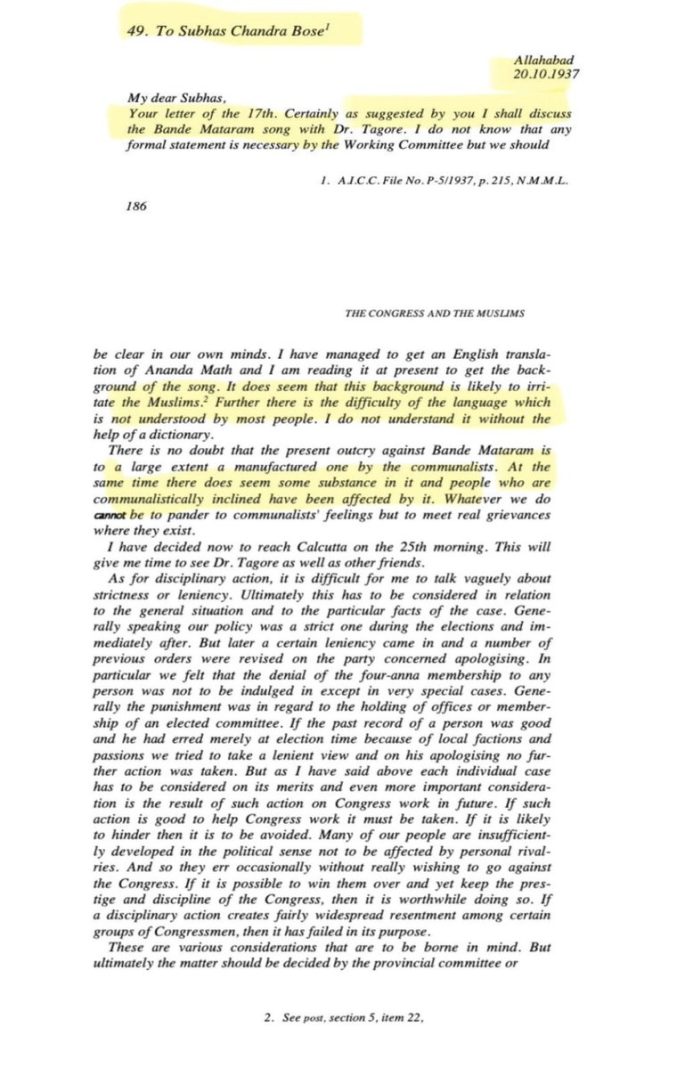
In his letter to Subhash Chandra Bose dated 20th October 1937, Nehru said that the Vande Mataram song was meant to “irritate the Muslims.”
“I have managed to get an English translation of Ananda Math and I am reading it at present to get the back- ground of the song. It does seem that this background is likely to irritate the Muslims…There is no doubt that the present outcry against Bande Mataram is to a large extent a manufactured one by the communalists. At the same time there does seem some substance in it and people who are communalistically inclined have been affected by it. Whatever we do cannot be to pander to communalists’ feelings but to meet real grievances where they exist,” Nehru wrote.
The practice of accommodating the unreasonable demands of Islamists in the name of protecting secularism has not subsided post-partition. Rather, with the presence of Muslim appeasing political parties like Congress and Islamist sympathisers like TN Krishna, the opprobrious practice has continued.
TM Krishna: The notorious Hinduphobe who labelled Anandamath as ‘anti-Muslim’
Thodur Madabusi Krishna, better known as TM Krishna, is an Indian Carnatic vocalist, author, and self-styled liberal social activist. Born on 22nd January 1976, in Chennai, India, Krishna has gained widespread recognition for his excellence in Carnatic music, a classical music tradition of India. He is the grandnephew of former Indian finance minister TT Krishnamachari, who was among the founders of the Madras Music Academy.
Besides music, TM Krishna is also known for his self-styled social activism and advocacy for various Islamo-leftist causes. He is also a staunch supporter of EVR Periyar.
Krishna has earlier made statements against particular castes and communities, especially the Brahmins, by quoting EVR Periyar. For those unversed, Periyar had a long history of spreading hate against Hindu deities, including breaking Murthis to Ravana Leela.
In March 2023, TM Krishna released a song in honour of Periyar to commemorate 100 years of his “anti-caste” movement. The post shared by TM Krishna was reshared by Tamil Nadu Chief Minister MK Stalin as well. Unsurprisingly, the Tamil Nadu CM had come out in support of TM Krishna when the renowned musicians protested against Madras Music Academy over conferring the Sangitha Kalanidhi Award to TM Krishna.
TM Krishna has closely worked with Tamil writer Perumal Murugan, who has misrepresented Hindu temple festivals of yore in order to cast aspersions on the character of Indian men and women.
On Diwali in 2023, TM Krishna took to X to express his support for Palestinians, saying that he found it difficult to celebrate the festival of lights at such a time.
“Difficult to celebrate the festival of lights when for people of Palestine lights indicate incoming death. Support for the Palestinians is support for all those who have been marginalised. In prayer for peace and a return of humanity. Support for the Palestinians is support for all those who have been marginalised,” he wrote along with a photo of himself.
In an op-ed on 14th January 2024, TM Krishna trained guns at Infosys founder N Narayan Murthy and Sudha Murthy for endorsing longer work hours by likening their views to “Brahminism”, followed by an unending rant.
In another casteist op-ed on 11th February 2024, he began by writing that the Indian classical dance form Bharatanatyam has been appropriated by Brahmins, leading to its alteration and erosion.
TM Krishna, despite being a Carnatic vocalist himself, has said that Carnatic music and Bharatanatyam are not superior to other art forms. “Carnatic music is just like gaana, cinema music, or rock and roll,” he said in an interview in January.
In 2018, irked by the outrage from Hindu connoisseurs of the arts for performing Christian hymns in Carnatic, TM Krishna vowed that he would sing one song on Allah and Jesus every month. The same year, he admitted that he feels no empathy when RSS members are killed by communists or Islamists in places like Kerala.
In a September 2020 opinion piece, TM Krishna declared that Guru-Shishya parampara in Indian arts is abusive and should be abolished. He used the case of sexual abuse allegations against the Gundecha brothers to demonise the entire tenet of the Guru-Shishya tradition, which has given India great artists and performers.
In 2022, he performed in an event marking the Gujarat riots titled “Gujarat 2002-2002. Memories of Struggle.” He performed an “Urdu bhajan” at the event.
In February 2026, TM Krishna gave an interview to leftist propagandist Akash Banerjee, wherein he claimed that Vande Mataram was not fit to become the country’s national anthem.
TM Krishna also declared the book Anandamath to be not just anti-establishment (British and Muslim establishment at that time) but also anti-Muslim. “In the book, it is a song that is sung by Hindu Sanyasis, while they are attacking villages where Muslims live. It is a book that is establishing the superiority of the Hindu community and the need for their control coming back,” Krishna said.