

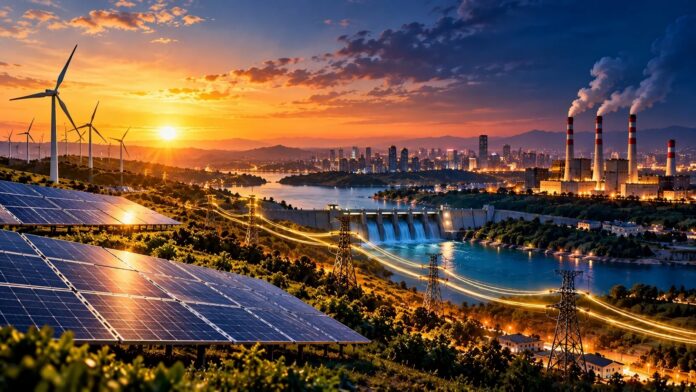
India’s electricity sector is undergoing a remarkable transformation, but there exists a contradiction. Renewable energy capacity is expanding at an unprecedented rate, with non-fossil sources now accounting for more than 54% of the country’s installed power capacity. Yet coal remains the backbone of electricity generation, particularly during periods of peak demand.
This contradiction reveals one of India’s most pressing energy challenges: installing clean energy capacity is not the same as ensuring a reliable electricity supply around the clock.
On September 10, 2026, India’s peak electricity demand reached 269.2 gigawatts (GW), an exceptionally high level for the monsoon season. Humid conditions, uneven rainfall and increased agricultural pumping contributed to the surge. The figure offered a glimpse of India’s rapidly growing electricity requirements. According to Central Electricity Authority projections, peak demand could rise from 243.3 GW in 2023–24 to 334.3 GW by 2029–30 and 366.4 GW by 2031–32.
These projections are crucial because India’s energy transition is occurring alongside rapid industrialisation, urbanisation and rising household consumption. Air conditioning, electric vehicles, data centres and expanding manufacturing facilities are adding substantial demand. India must therefore achieve two objectives simultaneously: produce significantly more electricity while progressively reducing dependence on fossil fuels.
The fundamental difficulty lies in the difference between installed capacity and actual generation. Solar plants produce electricity when sunlight is available, while wind generation depends on weather conditions. Neither can independently guarantee continuous supply. Solar output falls sharply in the evening, precisely when household electricity consumption increases. This creates the electricity-grid challenge commonly called the duck curve, requiring other sources to rapidly compensate for declining solar generation.
The September demand surge demonstrated why coal remains indispensable. Coal and lignite reportedly supplied approximately 188.8 GW, or 70.1% of peak demand. Wind contributed 18.2 GW, large hydropower 24.5 GW and nuclear energy approximately 6.2 GW. Solar generation was unavailable at the reported evening peak.
Consequently, despite expanding renewable capacity, India is planning to add approximately 80–97 GW of coal-based generation capacity, including more efficient ultra-supercritical plants. This reflects the need for dependable electricity during periods when renewable generation cannot meet demand.
Hydropower provides another important source of flexibility. Hydro turbines can increase output within minutes, helping balance fluctuations in electricity consumption. However, hydropower depends on adequate reservoir storage. Uneven monsoon rainfall and reported regional water-storage deficits of 8–15% during 2026 constrained its contribution, increasing reliance on thermal generation.
This exposes the interconnected nature of India’s water and energy security. Reservoirs must support irrigation, drinking water and electricity generation. Climate variability can therefore affect agricultural production and power availability simultaneously.
Energy storage is emerging as the critical missing component of India’s renewable transition. Grid-scale batteries can store surplus daytime solar electricity for evening consumption, while pumped-storage hydropower can shift energy between periods of low and high demand. Without sufficient storage infrastructure, adding renewable capacity alone cannot eliminate the need for conventional power stations.
Nuclear energy offers another potential solution. India’s installed nuclear capacity stands at approximately 8.78 GW, with ambitions to reach 14.8 GW by 2028, around 20 GW by 2031–32 and eventually 100 GW by 2047. Unlike solar and wind, nuclear reactors can provide continuous low-carbon electricity. However, substantial investment, regulatory requirements and long construction periods mean there is a long wait before we reach there.
India’s energy future will therefore depend on combining multiple technologies rather than relying on any single source. Solar and wind can provide increasingly affordable clean electricity, batteries and pumped storage can address intermittency, hydropower can balance sudden fluctuations, and nuclear energy can strengthen dependable low-carbon supply. Coal will remain necessary during the transition, but its contribution can decline as these alternatives mature.
Ultimately, the success of India’s energy transition cannot be measured merely by the number of solar panels installed or the percentage of renewable capacity added. What matters is how much clean electricity actually reaches consumers, how reliably the grid handles peak demand, and how effectively storage and transmission infrastructure reduce fossil-fuel dependence.
Read the real data behind India’s electricity production, goals and roadmap in the full article here on Chapter One Magazine.


