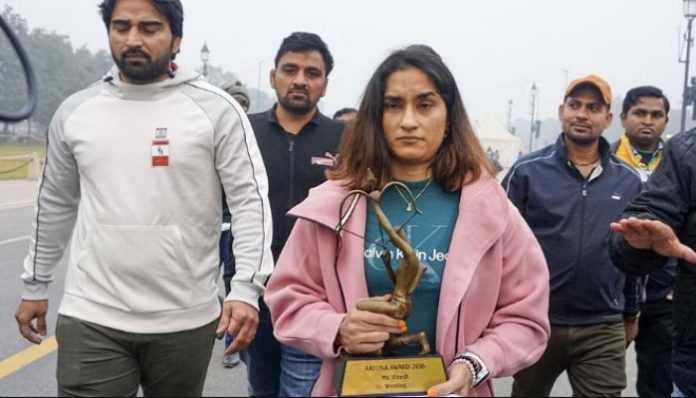
On 30th December (Saturday), Wrestler Vinesh Phogat returned her Arjuna and Khel Ratna Awards days after making the announcement to that effect. She left her awards at the Kartavya Path pavement in the national capital after Delhi Police stopped her from reaching the Prime Minister’s Office for security reasons.
Earlier on 26th December (Tuesday), Phogat had announced through her X (formerly Twitter) account that she would be returning her Khel Ratna and Arjuna Award claiming that the awards were meaningless at a time when wrestlers are struggling to get justice.
In her post dated 26th December, Phogat had also shared a letter that she wrote to Prime Minister Narendra Modi. In the letter, she urged PM Modi to take action against Brij Bhushan Sharan Singh whom she alleged of making statements in the media. Notably, legal cases against Brij Bhushan Singh are already ongoing.
Meanwhile, on Saturday (30th December), Phogat attempted to reach the prime minister’s office to return her awards but she was prevented by the Delhi police from reaching the PMO. Subsequently, she left the two awards at the Kartavya Path which were later picked up by the Delhi Police.
Reacting to the development, Bajrang Punia tweeted, “May this day not come in the life of any player” which was retweeted by Sakshi Malik, another rebel wrestler who had launched a protest earlier this year.
यह दिन किसी खिलाड़ी के जीवन में न आए। देश की महिला पहलवान सबसे बुरे दौर से गुज़र रही हैं। #vineshphogat pic.twitter.com/bT3pQngUuI
— Bajrang Punia ?? (@BajrangPunia) December 30, 2023
Earlier on 22nd December, Bajrang Punia had announced that he was returning his Padma Shri award to Prime Minister Narendra Modi which was awarded to him in 2019.
Previously, on the day when elections for the newly-elected Wrestling body concluded and Sanjay Singh was elected as its President, Sakshi Malik held a press conference. Unhappy with the election of Brij Bhushan Singh’s loyalist Sanjay Singh as WFI Chief, Malik announced her retirement from the sport.
The recent decisions come days after the Sports Ministry suspended all the activities of the newly-elected Wrestling Federation of India body till further notice. The Ministry took action against the sporting body stating that it announced junior national championships with “complete disregard for the existing rules and regulations”.
The ministry also reportedly said, “The newly elected body appears to be in complete control of former office bearers, disregarding the Sports Code.”
Following the decision, the Ministry of Youth Affairs and Sports wrote to the Indian Olympic Association to form an ad hoc committee to replace the Wrestling Federation of India (WFI).