

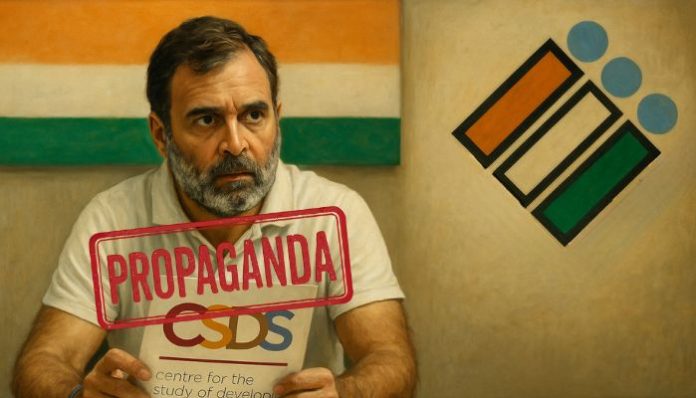
On 18th August, Congress spokesperson Pawan Khera posted a graphic on X to question the Election Commission of India. In his post, he claimed that within six months between the 2024 Lok Sabha and the Maharashtra Assembly polls, around 40% of the electorate were deleted from Ramtek and Deolali constituencies. On the other hand, Nashik West and Hingna gained around 45% of the electorate. Taking a jibe at the Election Commission, he wrote, “Next they will announce that 2 plus 2 equals 420.” The source of the data was Lokniti-CSDS.
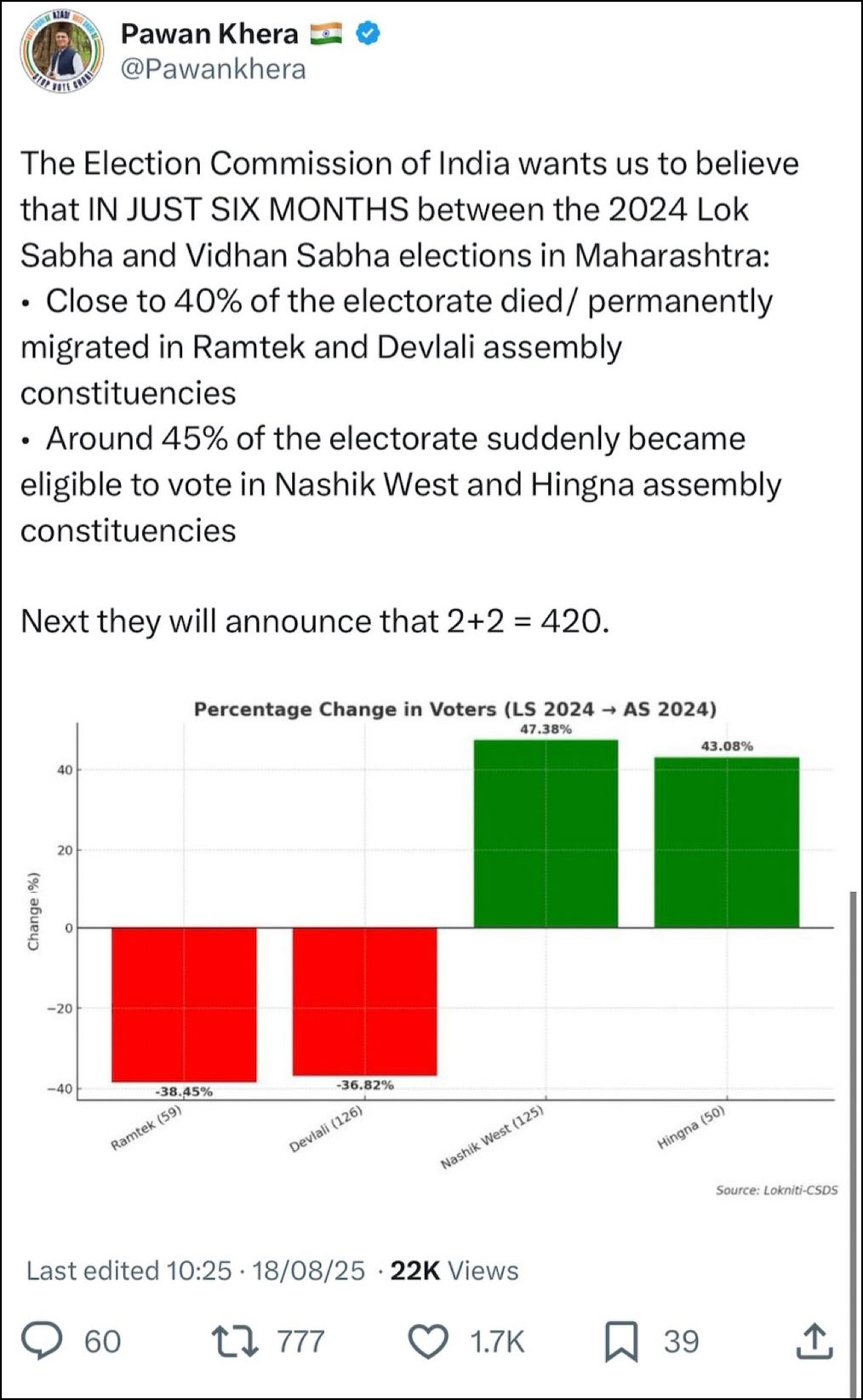
Notably, his post was based on the figures first pushed by Sanjay Kumar of the Centre for the Study of Developing Societies (CSDS) who, on 17th August, posted the figures raising doubts on the working of the Election Commission of India. However, within 48 hours, the claims by both Sanjay Kumar and Congress leaders who shared the data collapsed like a house of cards.
What Sanjay Kumar had said before deleting the post
In his now-deleted post on social media platform X, Kumar spotlighted two seats as examples of abnormal surges. He claimed that for Nashik West, the Lok Sabha roll was 3,28,053 and the Assembly roll was 4,83,459, which he presented as an increase of 1,55,442 and 47.38 per cent.
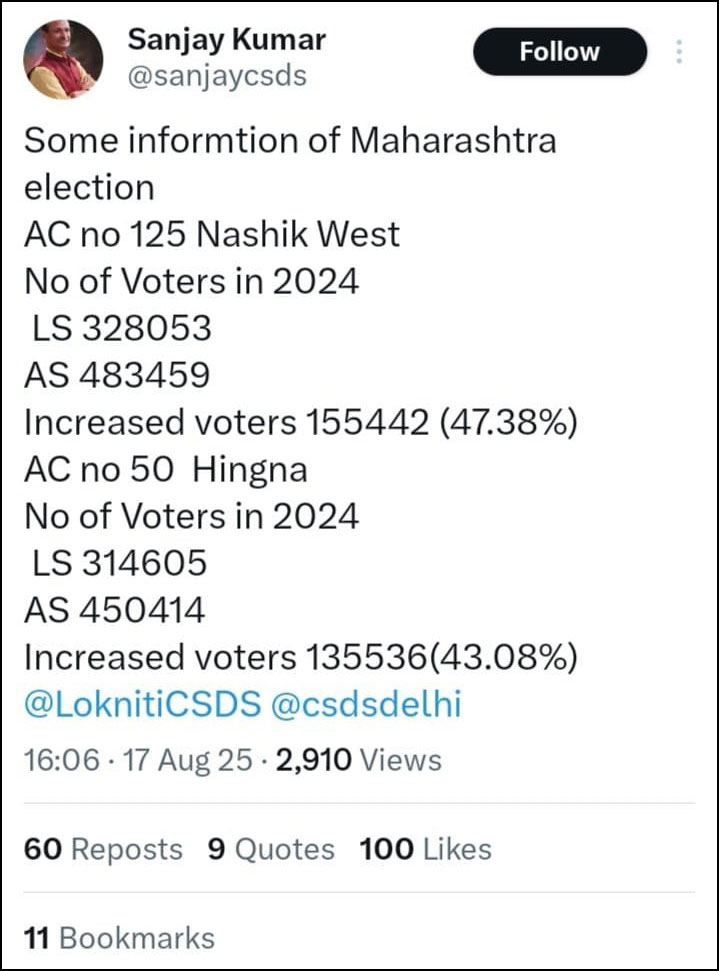
Similarly, for Hingna, he claimed that the Lok Sabha roll was 3,14,605 and the Assembly roll was 4,50,414, an increase he put at 1,35,536 and 43.08 per cent.
The framing of the post suggested that the Assembly electorate had swelled beyond plausible bounds within a few months. His figures were then amplified not only by Congress and other opposition party supporters but also by Congress leaders like Pawan Khera himself to question the Election Commission’s credibility.
The apology from Sanjay Kumar
Within 48 hours, on 19th August, Sanjay Kumar took a U-turn and issued a public apology on X. He accepted that the numbers in his earlier post were incorrect. He said the error occurred because his “data team misread rows” while comparing the 2024 Lok Sabha and 2024 Assembly datasets.
I sincerely apologize for the tweets posted regarding Maharashtra elections.
— Sanjay Kumar (@sanjaycsds) August 19, 2025
Error occurred while comparing data of 2024 LS and 2024 AS. The data in row was misread by our Data team.
The tweet has since been removed.
I had no intention of dispersing any form of misinformation.
He further informed in the post that the previous social media post was deleted and said there was “no intent to spread misinformation”. However, the misinformation is already out and there is a possibility that it will be used for months to come for propaganda forwards on WhatsApp and social media posts without much chance of scrutiny.
What the official data shows and why he had to apologise
His claims fell apart after he was fact-checked by several social media users. Data verified by OpIndia confirmed that Sanjay Kumar’s numbers were inflated beyond doubt.
For example, in Nashik West, Lok Sabha electorate numbers were at 4,56,319 compared to the number of electorates in Maharashtra Assembly elections which were at 4,83,719. The increase is 27,400, which is about six per cent. There is no jump of 1.5 lakh as claimed by Sanjay.
Similarly, in Hingna for Lok Sabha, the number stood at 4,24,454 and for Assembly elections, the number stood at 4,50,439. The increase is 25,298, which is far below the 43.08 per cent claimed in the viral post.
In the case of Ramtek, for Lok Sabha the number of the electorate was 2,76,827 compared to Assembly elections which stood at 2,87,301. The increase is 10,474, which is about 3.8 per cent. The chart Khera shared showed a collapse of nearly forty per cent. The official record shows a small rise.
Similarly, in the case of Deolali, for Lok Sabha, the numbers stood at 2,77,600, and for Assembly elections, it was 2,88,816. The increase is 11,216. The claim of a massive fall is false.
These four entries are enough to establish the point. The sensational percentages that travelled through politics and media were not drawn from constituency abstracts. They came from a spreadsheet that was “misread” by the “data team” of CSDS. A simple double check would have stopped the error at source.
There is a basic rule that any serious analyst must follow before publishing comparisons, that is, double check the numbers. In fact triple check, and check them again to ensure there are no mistakes. Lok Sabha and Assembly rolls are prepared for different electoral events and are revised on different schedules. If one still chooses to compare, one must match the same Assembly segment across both cycles, cite the certified counts, and explain the additions and deletions. Nothing like that was done by Sanjay Kumar’s team, which shows a lack of any groundwork. The apology reduced the fiasco to “rows misread”. The facts show that fundamental verification was missing.
BJP hits back at CSDS
The controversy around Sanjay Kumar’s misleading voter roll claims prompted a sharp counter from the Bharatiya Janata Party (BJP). Its IT Cell chief, Amit Malviya, accused the CSDS of being more than just a research institution and accused it of playing a dangerous game of narrative-building for years.
Malviya pointed to repeated infusions of foreign funds into CSDS from organisations including the Ford Foundation, IDRC Canada, DFID UK, NORAD Norway, the Hewlett Foundation and others. He suggested that these donors are not neutral but carry political agendas. According to Malviya, their interests lie in weakening India’s social fabric by nurturing division, especially within Hindu society.
CSDS and the Dangerous Game of Narrative-Building
— Amit Malviya (@amitmalviya) August 19, 2025
The Centre for the Study of Developing Societies (CSDS) has long positioned itself as a research institution, but a closer look at its funding sources, survey designs, and outputs reveals a troubling pattern.
1. Foreign Funding… pic.twitter.com/Z0DE6u8PZo
He argued that the Lokniti-CSDS programme has consistently projected Hindu society through the prism of caste. On the other hand, Muslims have been presented as a monolithic bloc. CSDS has carefully avoided their own internal stratifications such as Ashraf, Ajlaf, Arzal, and others. The result, he said, is an artificial reinforcement of caste division among Hindus, giving Congress and sympathetic media convenient points every election cycle.
The very institution whose data Rahul Gandhi leaned on to defame the voters of Maharashtra has now admitted that its figures were wrong — not just on Maharashtra, but even on SIR.
— Amit Malviya (@amitmalviya) August 19, 2025
Where does this leave Rahul Gandhi and the Congress, which brazenly targeted the Election… pic.twitter.com/4o99YDvsMx
He also pointed out that CSDS surveys lack scientific rigour, with caste identities often guessed rather than systematically recorded, and yet newspapers of record like The Hindu and The Indian Express give their findings legitimacy. The institution, in his words, is not producing scholarship but playing strategy, manufacturing divisions and presenting them as research.
In his framing, CSDS’s errors are not innocent mistakes like “rows misread” but deliberate agenda-driven settings gone awry. He further asserted that these agendas are designed to reinforce narratives favourable to the Congress while undermining public faith in institutions like the Election Commission.
Conclusion
Pawan Khera and other Congress supporters used Sanjay Kumar’s claims to attack the Election Commission. Within 48 hours of the initial post by Sanjay Kumar, an apology came and the post was deleted. He admitted the mistake. However, Pawan Khera did not apologise. He simply deleted the post.
This must be seen as a cautionary tale. When a researcher with institutional authority publishes unverified numbers, political actors will weaponise them at once. By the time the correction arrives, the false narrative has already done its work. The responsibility therefore lies first with the source. If you plan to allege dramatic swings in electorates, you must show your tables, cite Form 20, and present the arithmetic clearly. None of this happened in this case. The result, a needless dent in public trust and a readymade talking point handed to the propagandists.


