

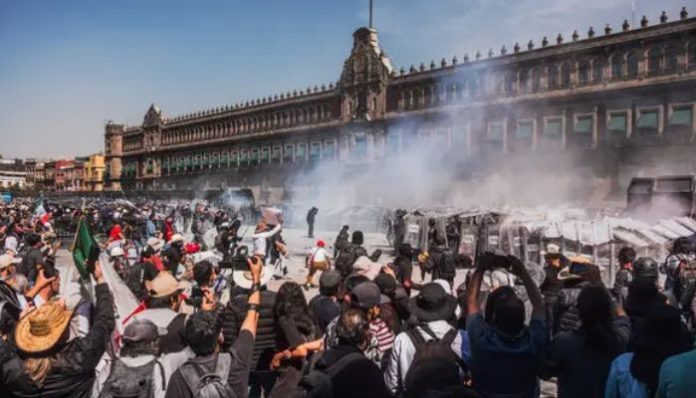
On 15th November (local time), thousands of people took to the streets of Mexico City in a sweeping “Generation Z” or “Gen Z” mobilisation against rising crime, corruption and impunity. The protest gained nationwide momentum following the assassination of Michoacan Mayor Carlos Manzo on 1st November. The protest soon turned into violent clashes outside the National Palace which intensified public scrutiny of President Claudia Sheinbaum’s security policies.
BREAKING: MEXICO? THE NATIONAL PALACE HAS FALLEN
— Jim Ferguson (@JimFergusonUK) November 15, 2025
The National Palace in Mexico City has been overrun — crowds flooding the gates, barriers collapsing, and the government losing control in real time.
This is not a protest.
This is a national eruption — the kind that signals… pic.twitter.com/V4GEZydhLg
Violence breaks out at National Palace
The protest began as a youth-driven rally but it soon escalated when hooded protesters tore down metal fences protecting the National Palace where President Sheinbaum lives. Police responded to the violence with tear gas and fire extinguishers but the crowds continued to move ahead, banging on barricades and hurling projectiles at the security personnel.
?Scenes out of Mexico City are absolutely unreal right now.
— TheCommonVoice (@MaxRumbleX) November 15, 2025
A mob dragging a Mexican officer into the crowd and beating him while others tear down security barriers tells you everything about how fed up people are with their own government.
This isn’t some minor protest,… pic.twitter.com/fjeoUCVGbl
According to a statement by public safety secretary Pablo Vazquez Camacho, 100 police personnel were injured and 40 were hospitalised for contusions and trauma. Around 20 civilians were injured as well. 20 people were arrested by the authorities and 20 more were detained for administrative offences. Camacho condemned the “organised groups” that he said instigated violence during the Gen Z march.
MASSIVE ‘narco state’ graffiti appears outside Mexico City’s National Palace
— RT (@RT_com) November 15, 2025
LARGE Straw Hat Pirates’ Jolly Roger — seen in protests from Indonesia to Nepal — also spotted
Gen Z plotting mass protests; authorities say it’s ‘not spontaneous’ pic.twitter.com/2Ar3DRh0dW
Carlos Manzo’s killing becomes the rallying cry
Carlos Manzo was the mayor of Uruapan in Michoacan. He was shot dead during a public Day of the Dead event. He was known for openly challenging drug-trafficking networks in his region. His murder shook the country and galvanised a movement demanding accountability.
Protesters donned straw hats symbolising Manzo’s political movement and carried banners that read “We are all Carlos Manzo”. They chanted “Carlos did not die, the government killed him” and “Out, Morena” during the protests that echoed across central Mexico City.
Now: A large Straw Hat Pirates' Jolly Roger flag is out at the Zócalo in front of the National Palace in Mexico City. The flag comes from the “One Piece” manga and anime series, and has been used in protests in places such as Indonesia, Nepal, and Madagascar pic.twitter.com/z1Nehcyc4z
— Brendan Gutenschwager (@BGOnTheScene) November 15, 2025
Some demonstrators travelled from Patzcuaro and Uruapan, insisting Manzo was targeted “because he confronted criminals when others would not.”
Government questions motives behind the march
President Sheinbaum, however, questioned the intentions behind the protests and claimed that those were “inorganic” and influenced by right-wing political opponents. She also accused social-media bots of inflating turnout. However, the participants rejected the claims and said the protests sprouted as a spontaneous reaction to the murder of Carlos and increasing criminal activities in the country.
Some Gen Z influencers distanced themselves ahead of the event, even as former President Vicente Fox and billionaire Ricardo Salinas Pliego publicly encouraged the protests.
Global protest symbols emerge in Mexico
The Straw Hat Pirates’ Jolly Roger, a skull-and-crossbones flag from the manga One Piece, appeared prominently across the march. The symbol has become an emblem of youth resistance worldwide, seen in major protests from Nepal to Indonesia and the Philippines throughout 2025. In Mexico, it has been adopted by young protesters frustrated by insecurity, corruption and a sense of abandonment by state institutions.
