

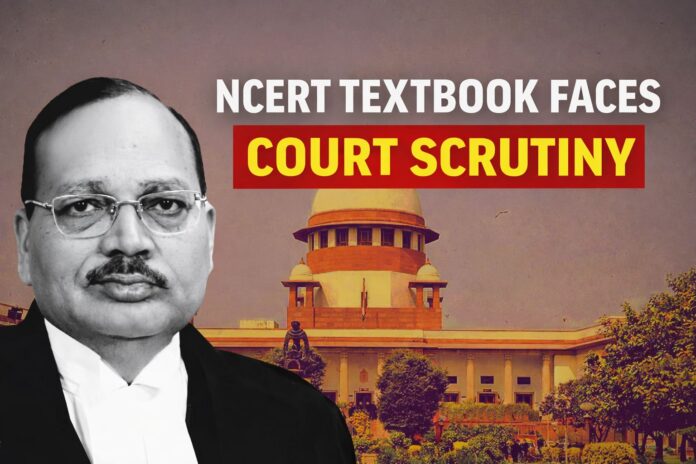
The Supreme Court on Wednesday expressed strong displeasure over a newly introduced Class 8 NCERT social science textbook that contains references to corruption in the judiciary, with Chief Justice of India Surya Kant declaring that he would not “allow anyone on earth to defame the judiciary.”
A Bench led by the CJI took suo motu cognisance of the issue after senior advocates Kapil Sibal, A.M. Singhvi, and Mukul Rohatgi flagged the matter before the court. The Chief Justice said the inclusion appeared to be part of a “deep-rooted and calculated conspiracy” to tarnish the image of the judicial institution, which continues to enjoy the highest level of public trust.
“I have already taken suo motu cognisance of it,” CJI Kant said in open court, adding that judges of the Supreme Court and High Courts were deeply perturbed by the development. He also revealed that he had been receiving calls from various quarters expressing concern over what he described as a “selective reference” to corruption in the country’s most trusted institution.
Kapil Sibal argued that it was deeply objectionable for school children to be taught that the judiciary is corrupt, especially when public faith in courts remains strong. A.M. Singhvi echoed this concern, pointing out that while corruption exists in many spheres, the textbook curiously singles out the judiciary and makes no comparable reference to corruption in politics, bureaucracy, or business. Mukul Rohatgi also supported the objections raised before the court.
“Wait for a day. I have already taken suo motu cognisance,” the CJI said, indicating that the court would examine the issue in detail.
The controversy centres on a revised NCERT social science textbook for Class 8, which includes a chapter titled “The Role of the Judiciary in Our Society.” Unlike earlier editions that primarily explained the structure of courts and access to justice, the new chapter expands its scope to discuss systemic challenges facing the judicial system. These include corruption, a massive backlog of cases, and a shortage of judges.
One section of the chapter states that “people do experience corruption at various levels of the judiciary” and notes that this particularly affects access to justice for the poor and disadvantaged. It adds that efforts are being made at both the State and Union levels to improve transparency, including through technology, and to take swift action against instances of corruption.
The textbook also presents data highlighting the scale of pendency in Indian courts, estimating that around 81,000 cases are pending in the Supreme Court, about 62.40 lakh in High Courts, and nearly 4.70 crore in district and subordinate courts.
While the revised chapter aims to introduce students to the real-world challenges of the justice system, the Supreme Court’s sharp reaction signals serious concern over how such sensitive issues are being presented to young students, especially when, in the court’s view, the framing risks undermining public confidence in a cornerstone institution of Indian democracy.
The dispute traces its origins to a recently released NCERT Social Science textbook for Class 8, Exploring Society: India and Beyond, which, for the first time, introduces students to systemic challenges facing the judiciary, including corruption and case backlogs. Earlier editions were largely confined to explaining the structure, role, and independence of courts, with only passing references to delays in justice. The new chapter, “The Role of the Judiciary in Our Society,” expands this scope by listing “corruption at various levels of the judiciary” and “massive backlog” as among the key challenges, while also outlining internal accountability mechanisms such as codes of conduct, complaint procedures, and the impeachment process.
It cites data on pendency, over 81,000 cases in the Supreme Court, about 62.40 lakh in High Courts, and around 4.70 crore in district and subordinate courts. It argues that, where it exists, corruption disproportionately harms the poor and disadvantaged, even as governments attempt to improve transparency through technology and oversight.
The chapter also seeks to familiarise students with the judiciary’s constitutional role through recent examples, including the striking down of provisions related to electoral bonds and parts of the Information Technology law that curtailed free speech, asking students to reflect on why an independent judiciary is essential. These revisions are part of NCERT’s broader overhaul of textbooks in line with the National Education Policy, 2020, and the new National Curriculum Framework, under which new books for Classes 1 to 8 have been rolled out after the post-COVID-19 rationalisation of older content.
