

A major political debate has erupted over India’s foreign policy following a sharp intervention by Congress Parliamentary Party Chairperson Sonia Gandhi. In an opinion piece published in The Indian Express on Saturday, 27th June, 2026, the veteran leader levelled a blistering attack on the Narendra Modi government.
She criticised the administration’s stance on the humanitarian crisis in West Asia, stating that its “stony silence” and “inaction” on Israel’s “Gaza genocide” are not just morally reprehensible but also inexplicable from a national interest perspective. Gandhi claimed that by deviating from its historical geopolitical positions, India has alienated itself from long-standing allies in Palestine, Iran, and the larger West Asian region. She argued that this diplomatic withdrawal has distanced India from global public opinion while letting Pakistan swoop in to claim the space of a mediator, a role she believes India had a natural claim to, given its historically friendly ties with all regional players.
In her editorial, Gandhi specifically targeted the prime minister’s diplomatic scheduling, calling Prime Minister Narendra Modi’s visit to Israel ahead of the joint US-Israel military actions involving Iran a “bewildering strategic decision.” She urged that the spirit of Indian nationhood demands that it speak up for Palestinians whose children have been so brutally targeted. To ground her arguments, she referenced international findings, noting that in September 2025, the UN Independent International Commission of Inquiry concluded that Israeli authorities were committing genocide in Gaza. She wrote that in June 2026, the same commission, now headed by retired Indian jurist Justice S. Muralidhar, reiterated those findings, focusing on the heavy toll inflicted on the youngest citizens.
Quoting the UN findings, Gandhi wrote, “The 94-page report is a harrowing read, with grim details on the extent of the devastation perpetrated by Israel in Gaza and the genocidal intent underpinning its actions. At least 20,000 children have been killed, and another 44,000 have been wounded, many for life.” She asserted that the targeting of children is a deliberate strategy, pointing out that “twenty-seven per cent of those killed or wounded have been children, and many of the boys were found with bullets on the head and neck. Ninety-seven per cent of Gaza’s schools have been destroyed.” She added that the destruction of healthcare infrastructure has led to a 300% increase in miscarriage and childbirth complications.
While Gandhi described the October 2023 attack by Hamas on Israel as a “dastardly, horrific, and absolutely unacceptable attack,” she argued that the subsequent retaliation by Israeli armed forces has been characterised by “wanton cruelty and barbarity.” She noted, “Senior Israeli leaders, down from Prime Minister Benjamin Netanyahu and his senior cabinet colleagues themselves, have called for the ‘complete siege’ and ‘total annihilation’ of Gaza, denounced the Palestinians as ‘animals’ who have ‘no right to exist’, and defined success for Israel as ‘hundreds of thousands fleeing Gaza’.”
Congress’s top brass backs the Op-Ed
Sonia Gandhi’s positions quickly received strong backing from the top leaders of the Congress party, who used the opportunity to demand a reset in India’s global alignments. Sharing the article on the social media platform X, Congress President Mallikarjun Kharge called the piece evocative and stated that it serves as a “stark reminder of how our current foreign policy has alienated our historical allies in Palestine, Iran, and the larger Middle East.”
Congress Parliamentary Party Chairperson, Smt. Sonia Gandhi's evocative piece calling out Modi Govt's silence and inaction for our Palestinian brothers and sisters whose children have been brutally targeted is a stark reminder of how our current foreign policy has alienated our… pic.twitter.com/VSWCA0qJPv
— Mallikarjun Kharge (@kharge) June 27, 2026
Leader of the Opposition Rahul Gandhi also shared the editorial on X to amplify its message across digital platforms. He noted, “Through her editorial, Congress Parliamentary Party Chairperson Sonia Gandhi ji calls on India to reclaim its independent foreign policy, uphold humanitarian values, and speak up with moral clarity on Gaza.” The coordinated push by senior leadership signals that the Congress party intends to make the government’s West Asia policy a central point of political contestation.
“We are slipping further into Israel’s strategic orbit, at a time when the world is increasingly pivoting away from it. The Prime Minister’s visit to Israel will go down in history as a bewildering strategic decision.
— Rahul Gandhi (@RahulGandhi) June 27, 2026
The spirit of Indian nationhood demands that we speak up for… pic.twitter.com/GmB28smfl1
India’s deep strategic dividends from Israel
International relations must be guided by tangible national security benefits rather than ideological sentimentality. India and Israel have developed a strong partnership over the last three decades. Although India recognised Israel in 1950, full diplomatic relations were established in 1992. Since then, ties between the two countries have expanded significantly in areas such as defence, technology, agriculture, cybersecurity and trade.
During the current government’s tenure, India has become Israel’s largest weapons buyer, with bilateral trade expanding dramatically from USD 200 million in 1992 to more than USD 6 billion by 2024. This economic and defensive bond is backed by a Bilateral Investment Treaty signed in September 2025, which has given a further fillip to trade in sectors like petroleum, chemicals, engineering goods, and polished diamonds.
Security experts emphasise that Israel has consistently proven to be a vital defence partner during times of acute national crisis when other global powers were reluctant to provide immediate assistance.
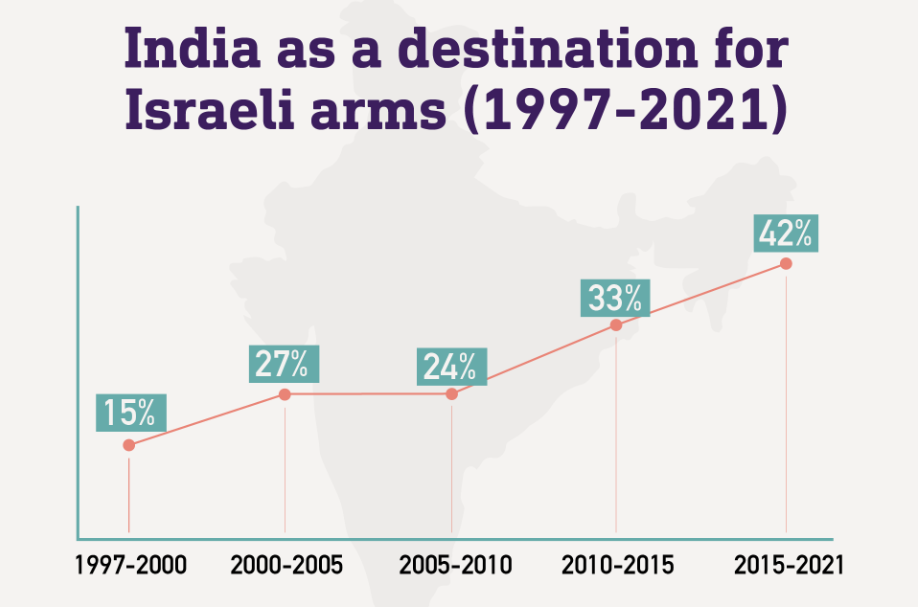
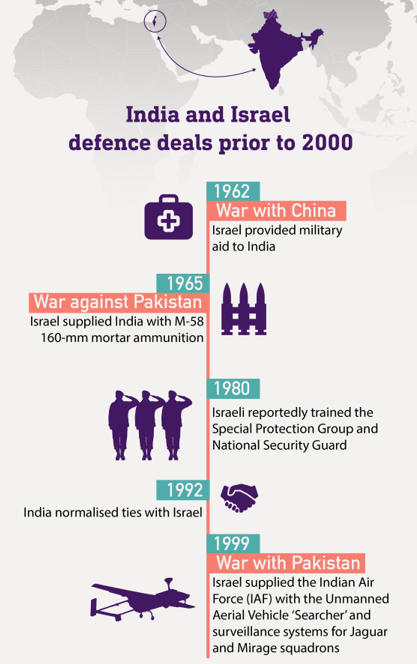
India’s defence deals with Israel date back long to 1962, when Israel provided military aid to India in its war against China. In 1999, during India’s war with Pakistan, Israel supplied the IAF with the Unmanned Aerial Vehicle ‘Searcher’ and surveillance systems for Jaguar and Mirage squadrons. The defence ties with Israel have notched up since 2014, with around 42.1% of all arms exports from Israel landing in India, with Azerbaijan, Vietnam, and the US making up the other major customers.
India’s partnership with Israel is not limited to defence. Exports are, however, concentrated across a few key sectors, like gems and jewellery, especially cut and polished diamonds, which are sent to Israel’s large diamond trading hubs. Apart from this, petroleum products, organic chemicals, plastics, and engineering goods also form a major portion of the exports. In very recent years, there has been a sharp drop in Indian exports to Israel – PM Modi’s visit can supposedly perk up the exports again, courtesy strategic deals and tie-ups across areas.
How the India-Israel partnership helped during Operation Sindoor
The practical value of this defence partnership was put on full display during the border escalation known as “Operation Sindoor.” The conflict escalated sharply following a deadly attack by Pakistani terrorists on 22nd April, 2025, in the Baisaran Valley of Pahalgam, where 26 Hindu tourists were killed by cross-border militants. In response to this provocation, the Indian Armed Forces launched a fierce, targeted counter-attack codenamed Operation Sindoor, aimed at neutralising terrorist infrastructure and launchpads run by Lashkar-e-Taiba and Jaish-e-Mohammed in Pakistan and Pakistan-occupied Kashmir.
The 23-minute operation, which commenced at 1:05 AM on 7th May, relied heavily on sophisticated Israeli-manufactured technology alongside indigenous and Russian systems to strike enemy positions and secure Indian airspace against incoming retaliatory threats. Israeli military hardware played a decisive role in ensuring the operation’s success:
- Harop Loitering Munitions: The Indian Armed Forces deployed Israeli-made Harop kamikaze drones specifically designed to destroy air defence systems and radar units. Capable of staying over target areas for up to nine hours and equipped with a 50-pound warhead, these drones operated with high autonomy. During the operation, they successfully struck and eliminated a crucial Pakistani air defence facility in Lahore.
- Heron Mk2 UAVs: For surveillance and reconnaissance, the air force used Heron Mk2 drones, which can cruise at altitudes up to 35,000 feet and stay airborne for over 40 hours. Operating from forward bases, these long-endurance drones provided real-time intelligence, target acquisition, and battle damage assessments across the rugged northern terrain, remaining safely out of reach of conventional ground-based anti-aircraft weaponry.
- SkyStriker Drones: Manufactured through a partnership between Israel’s Elbit Security Systems and India’s Alpha Design Technologies in Bengaluru, these quiet, electrically propelled loitering munitions were used for covert low-altitude strikes. Carrying 5 to 10 kilogram bombs, they successfully engaged specific tactical targets even in environments where GPS signals were disrupted.
- Barak 8 Missile Defence System: Developed jointly by India’s DRDO and Israel Aerospace Industries (IAI), the Barak 8 long-range surface-to-air missile system proved critical in protecting the domestic front. When Pakistan attempted a retaliatory strike by firing a Fatah-II ballistic missile aimed toward Delhi, the Barak-8 system successfully intercepted and destroyed the incoming missile over Sirsa, Haryana.
- Spice-2000 Precision Bomb Kits: Indian warplanes used Israeli-designed Spice-2000 guidance kits to convert standard general-purpose bombs into smart, “fire-and-forget” precision stand-off weapons. Using advanced scene-matching algorithms, these bombs accurately penetrated the roofs of targeted terror camps while minimising collateral damage to surrounding civilian areas.
- Tavor X95 Assault Rifles: On the ground, elite special forces units, including MARCOS and Garud commandos, were equipped with compact, bullpup-shaped Tavor X95 rifles manufactured under license in India. These rifles provided high reliability and manoeuvrability during close-quarters security operations.
The clean sweeps achieved during Operation Sindoor, which resulted in the elimination of nearly 100 terrorists, including close relatives and top commanders of JeM chief Masood Azhar and LeT strategist Abu Jundal, demonstrated how deeply embedded Israeli defence tech is within India’s operational readiness.
India’s Two-state policy and national interest
India officially supports a two-state solution that recognises both Israel and Palestine and advocates peaceful resolution through dialogue and diplomacy. From this perspective, the primary obligation of the Indian state is to protect its own citizens, defend its borders, and secure its economic interests. Getting deeply involved in distant ideological disputes offers no clear strategic returns and risks disrupting vital defence supply lines.
India’s long-standing, official diplomatic position remains a clear, balanced Two-State Policy: the formal recognition of an independent, viable Palestine alongside a secure, recognised state of Israel. Beyond upholding this balanced diplomatic stance at international forums, the specific internal dynamics or military conflicts of the region are external matters. Trying to force India to take an aggressive, unilateral stance against a critical defence partner like Israel is seen as a move that undermines the country’s pragmatic security calculus.
Congress has a history of Muslim appeasement that overlooks the nation’s interests
Congress’s intense focus on international conflicts like the Gaza crisis is driven less by global strategy and more by a long-standing domestic political tradition of minority vote-bank appeasement. This political mindset frequently forces the party to overlook core national interests in favour of domestic electoral calculations, a criticism that has been levelled against the party since the early post-independence era.
This pattern of prioritising specific political fallout over uniform justice dates back to the highest echelons of post-independence governance under Prime Minister Jawaharlal Nehru. Historical records from December 1948 reveal that Nehru personally intervened in a massive ₹50 lakh income-tax evasion case involving Huseyn Shaheed Suhrawardy, Butcher of Bengal, who was widely seen as the chief architect of the communal violence during the 1946 Direct Action Day in Calcutta.
In an official letter dated December 12, 1948, addressed to Finance Minister John Matthai, Nehru intervened in the tax proceedings against Suhrawardy, explicitly cautioning that any “high-handed” fiscal action could lead to negative political reactions among Muslim leaders in both India and Pakistan. Nehru wrote, “There are certain public consequences of what might be done to Suhrawardy. Every such action has certain reactions both in India and Pakistan.” He urged the finance ministry to halt asset execution proceedings.
This prime ministerial protection allowed a figure responsible for widespread communal violence, which killed thousands of Hindus in Bengal, to smoothly liquidate his commercial assets in India, evade a major financial liability, and safely move to Pakistan, where he eventually rose to become the prime minister.
The legacy of the UPA and modern electoral dynamics
This historical appeasement towards Muslims continued through the UPA government’s tenure between 2004 and 2014, under Prime Minister Manmohan Singh and UPA Chairperson Sonia Gandhi. During this period, the administration faced frequent accusations of leaning heavily into identity politics. Prime Minister Manmohan Singh’s public statements asserting that minority communities, particularly Muslims, must have the “first right on the resources” of the country.
Further policy decisions from that era are evidence of this political lean, including a May 2012 Planning Commission proposal to mandate a 15% allocation of funds within all central schemes specifically for minority groups.
Additionally, the UPA formed the Sachar Committee and the Justice Ranganath Misra Commission to evaluate and address the socioeconomic status of Muslims. The Misra Commission’s recommendations included a controversial proposal to grant a 10% reservation to Muslims and a 5% reservation to other minorities, along with extending Dalit reservation benefits to individuals who converted to Islam or Christianity. It also suggested carving out an 8.40% sub-quota for Muslims within the existing 27% OBC quota. Meanwhile, the Sachar Committee drew sharp criticism for recommending an unprecedented headcount of Muslim personnel serving within the nation’s security forces.
This political legacy faced internal scrutiny following the Congress party’s severe defeat in the 2014 general elections. The party appointed an internal review committee headed by former Defence Minister A.K. Antony to investigate the loss. The Antony Committee report explicitly acknowledged that the party’s public image had suffered, concluding that repeated statements regarding specific reservations and a perceived pro-minority bias had alienated the majority Hindu community. The committee noted that the party had struggled under the political stigma of being perceived as prioritising one community over others.
This approach remains visible in the political rhetoric and electoral strategies of Rahul Gandhi and Priyanka Gandhi Vadra. In 2010, Rahul Gandhi had told the American ambassador Timothy Romer that the Hindus of the country are a bigger threat than the Muslim terrorists.
In another controversial political remark, Rahul Gandhi described the Indian Union Muslim League (IUML) as a ‘secular party’, even though the party has described itself as “a political entity dedicated to safeguarding Muslim rights” in a petition filed before the Supreme Court.
During his visit to the US in June 2023, an interviewer asked Gandhi why Congress was in alliance with a Muslim party (IUML) in Kerala when it opposes the ‘Hindu’ BJP. “You talked about secularism and democracy while opposing the Hindu party BJP, however, the Congress in Kerala has been in alliance with the Muslim party, the Muslim League in Kerala, the state from which you were an MP,” the interviewer asked. Responding to the question, Gandhi asserted that the Muslim League (IUML) was “a completely secular party”. “Muslim League is a completely secular party, there is nothing non-secular about the Muslim League. I think the person has not studied the Muslim League, “Gandhi said.
BJP hits back at Sonia Gandhi’s formulations
The ruling Bharatiya Janata Party (BJP) launched a sharp counter-offensive against Sonia Gandhi’s opinion piece, accusing the Congress leadership of trying to inject domestic vote-bank calculations into sensitive matters of international diplomacy and national defence.
BJP national spokesperson Shehzad Poonawalla strongly criticised the Congress party for what he described as a highly selective application of humanitarian concern. Addressing the media, he stated, “Sonia Gandhi speaks up for the Muslims in Gaza, they tweet about Rafah, but they are silent on Hindus in Dhaka. This shows that for them, even foreign policy is calculated on the table, on the calculus of vote bank.”
The ruling party maintained that the opposition’s public statements are politically motivated attempts to misinform the public and undermine India’s global standing, placing short-term electoral considerations above the country’s long-term defence partnerships and strategic autonomy.


