

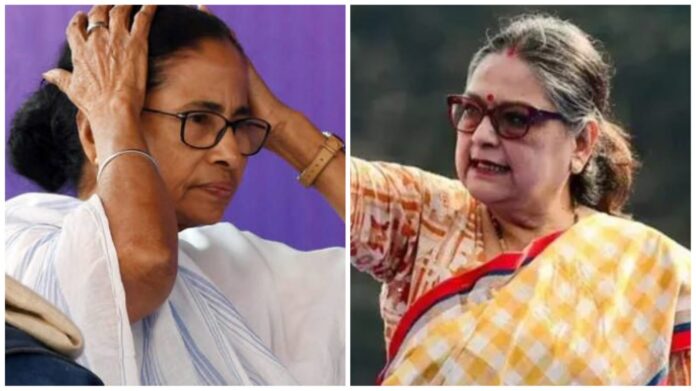
Trinamool Congress chief and West Bengal Chief Minister Mamata Banerjee’s political troubles appear to be deepening at a crucial juncture. Even as she attended a high-profile INDI bloc meeting in New Delhi aimed at showcasing Opposition unity, a major rebellion appears to have erupted within her own party, with a group of Trinamool MPs declaring their intention to align with the National Democratic Alliance (NDA).
The rebellion was led by senior Trinamool MP Kakoli Ghosh Dastidar, who publicly announced that nearly 20 party MPs have decided to formally communicate their desire to join the NDA. According to her, the decision reflects both the prevailing political mood and extensive consultations among party colleagues.
“Going by the people’s verdict, we believe our future political course should be aligned with the NDA,” Ghosh Dastidar told reporters. The rebel MPs have submitted a letter to Lok Sabha Speaker Om Birla conveying their intention to associate with the NDA.
The development comes amid growing dissatisfaction within sections of the Trinamool Congress leadership. In Ghosh Dastidar’s case, the immediate trigger appears to have been her removal from the post of the party’s Chief Whip in the Lok Sabha. She described the decision as “arbitrary” and “unilateral”, arguing that a public announcement alone does not immediately alter the constitutional and parliamentary status of the position.
Another rebel MP, Sharmila Sarkar, confirmed that the dissident lawmakers are attempting to form a separate parliamentary bloc. According to her, the group has proposed Ghosh Dastidar as its chief whip while veteran MP Shatabdi Roy would serve as deputy leader.
The timing of the revolt is particularly significant. Sources indicate that the rebel MPs met at the residence of senior BJP leader Bhupendra Yadav in Delhi, barely a kilometre away from the venue where Mamata Banerjee was participating in the INDIA bloc deliberations. Ironically, one of the key issues reportedly discussed at the Opposition meeting was the growing challenge posed by internal dissent within alliance partners.
Political observers note that the numbers being claimed by the dissident MPs are crucial. If the group indeed commands the support of around 20 lawmakers, it would comfortably cross the threshold required under anti-defection provisions, suggesting that the move may have been carefully planned rather than being a spontaneous act of rebellion.
The parliamentary revolt also mirrors developments unfolding in West Bengal. A separate group of 58 Trinamool MLAs, reportedly led by expelled rebel leader Ritabrata Banerjee, has claimed to represent the “real” Trinamool Congress. The state-level rebels have expressed dissatisfaction with the party leadership’s decision to appoint Shobhandeb Chatterjee as the Leader of the Opposition in the West Bengal Assembly.
The twin rebellions, one in Parliament and another in the state assembly, represent one of the most serious internal challenges faced by Mamata Banerjee in recent years. While the Trinamool Congress leadership has not yet issued a detailed response to the latest claims, the developments threaten to overshadow the party’s efforts to project itself as a key pillar of Opposition unity at the national level.
With the INDI bloc attempting to present a united front against the BJP-led NDA, the emergence of a potentially large-scale rebellion within one of its most prominent constituent parties could significantly alter political equations in both West Bengal and New Delhi in the months ahead.
