

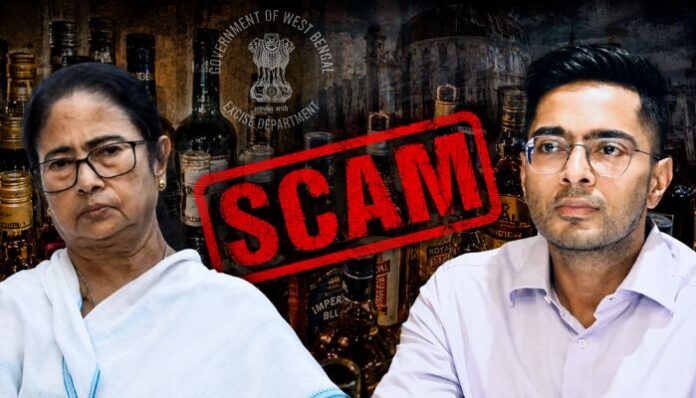
The political storm around liquor distribution policies, which first grabbed national attention during the controversy over Delhi’s excise policy, has now found echoes in West Bengal. Fresh reports have emerged regarding the liquor trade in the state during the tenure of the Trinamool Congress (TMC) government, with a confidential Excise Department document pointing towards a systematic restructuring of the liquor distribution network that benefited a select group of entities and created a monopolistic ecosystem.
According to the report, the changes introduced in West Bengal’s liquor distribution policy after 2017 were carried out at the behest of TMC Supremo Mamata Banerjee and her nephew Abhishek Banerjee. A copy of the report accessed by OpIndia claims that the revised system gradually pushed out the earlier model of private wholesale distribution and replaced it with a structure that enabled a handful of favoured intermediaries to dominate the liquor supply chain.
After the Delhi Liquor Excise scam, it is now Bengal’s turn. The Excise Department altered policy and bottlers were extorted on every crate of liquor and beer. The proceeds, amounting to thousands of crores, found their way to the TMC and Abhishek Banerjee.https://t.co/xmxYRk7VVK
— Amit Malviya (@amitmalviya) June 7, 2026
The allegations are significant because they suggest that what was officially presented as a reform to streamline liquor distribution has instead become a mechanism for extracting money from private bottlers and liquor manufacturers.
A confidential report prepared by the Excise Department examined these changes in detail. According to the findings, the restructuring that began in 2017 fundamentally altered how liquor moved from manufacturers to consumers across West Bengal. The report argues that the traditional principles of free competition and decentralised distribution were replaced by a tightly controlled network that concentrated enormous power in the hands of a few selected players.
The chart that shows how TMC centralised the whole process of liquor distribution
One of the most important elements of the report is a distribution channel chart that explains how liquor products traditionally move through the market and how the system evolved in West Bengal under the previous Mamata government.
The chart begins with the manufacturer’s warehouse or “Mother Godown,” from where products move to a Carrying and Forwarding Agency (C&FA). The C&FA acts as a storage and logistics hub before goods are supplied further down the chain.
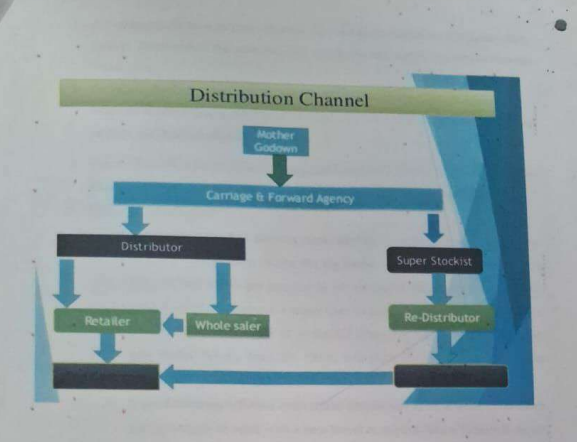
From there, products are usually supplied to distributors or super stockists. These distributors are authorisabhed business partners of a company and are responsible for ensuring that products reach retailers and wholesalers across different regions.
The chart illustrates that distributors form a critical link between manufacturers and retailers. They maintain sales teams, collect orders from the market, manage stock movement, and ensure that products are available across retail outlets. In many industries, distributors also provide credit facilities to retailers and wholesalers, helping maintain smooth cash flow within the market.
Wholesalers occupy another important position in the chain. They purchase products in bulk from distributors and then break those larger quantities into smaller lots for retailers. Their profits come from the difference between the purchase price and resale price.
Under a healthy market structure, manufacturers, distributors, wholesalers and retailers each perform distinct functions. Competition among multiple distributors and wholesalers helps ensure efficient pricing, wider availability and a smooth flow of goods.
According to the report, however, the changes introduced in West Bengal disrupted these traditional market principles by concentrating distribution power in a much smaller group of entities, reducing competition and creating opportunities for rent-seeking behaviour.
Why distributors and wholesalers matter
The report detailed the distinction between distributors and wholesalers.
A distributor generally enters into agreements with manufacturers and serves as an official channel partner. Distributors are responsible not only for selling products but also for marketing them, maintaining supply networks and expanding market reach. They usually operate across larger territories and deal with retailers, wholesalers and sometimes even direct consumers.
Wholesalers, on the other hand, primarily buy products in bulk and resell them to retailers. They function as intermediaries whose main objective is inventory management and profit generation through bulk purchasing.
The report argues that these functions are fundamentally different and that combining them under a government-controlled structure created operational distortions. It notes that distributors typically bear commercial risks associated with distribution, whereas wholesalers focus on inventory movement.
According to the report, the liquor distribution reforms introduced in West Bengal blurred these distinctions and created a model that did not fit established business principles.
The 2017 shift towards a government-controlled distribution structure
The report identifies 2017 as the turning point.
That year saw the formation of the West Bengal State Beverages Corporation Limited (WBSBCL), a government-owned company that took over wholesale distributorship of packaged liquor in the state. Through WBSBCL the Mamata Banerjee-led TMC government took up the liquor business.
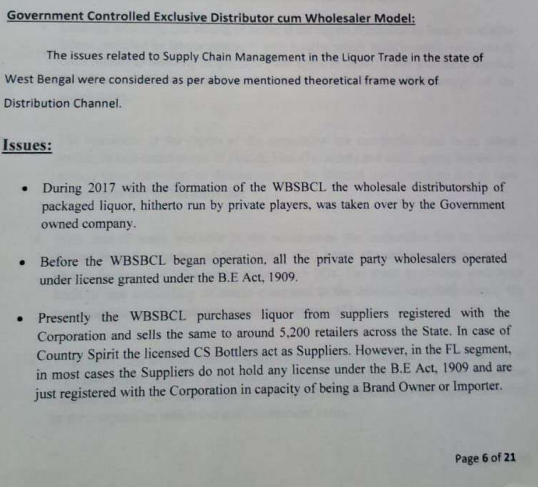
Before WBSBCL came into existence, wholesale distribution was largely handled by private license holders operating under the Bengal Excise Act of 1909. These private wholesalers purchased products from manufacturers and supplied them to retailers across the state.
Following the creation of WBSBCL, the corporation became the central purchaser and distributor of liquor products. It began procuring liquor from registered suppliers and selling it to approximately 5,200 retail outlets throughout West Bengal.
The report points out a legal concern regarding this arrangement. While Section 20 of the Bengal Excise Act requires a licence for the sale of liquor, many suppliers in the foreign liquor segment reportedly operated merely as registered brand owners or importers rather than licensed sellers. Despite this, they were permitted to sell products to the corporation and issue invoices.
According to the report, this created a situation that appeared inconsistent with the spirit of the Act.
Why retailers and manufacturers complained
The report highlights several operational and financial issues arising from the new model.
One major complaint concerned the absence of credit facilities. Under the earlier private wholesale system, retailers often received products on credit. This allowed them to maintain stock without making large upfront payments.
After WBSBCL took over, retailers reportedly had to pay the full procurement cost in advance. Since taxes and duties account for roughly 70-80% of the Maximum Retail Price (MRP) of liquor, this significantly increased the financial burden on retailers.
The report argues that this shift blocked substantial amounts of working capital throughout the supply chain. Smaller retailers were particularly affected because they now had to invest more money upfront while receiving none of the credit support previously available.
As a result, market volumes reportedly declined, and revenue growth suffered.
Warehousing and logistics problems
The report also raises concerns about the corporation’s warehousing and logistics infrastructure.
WBSBCL reportedly operated dozens of depots across the state, including facilities for country spirit, foreign liquor and beer. However, many of these depots were established on an ad-hoc basis and lacked proper compliance certifications, including fire safety approvals.
Loading and unloading operations were often handled by local labour groups, leading to variations in costs and operational inefficiencies. The report further notes allegations that local syndicates exercised influence over these activities.
Inventory management also became a major issue. The report states that the corporation frequently failed to follow the “First In, First Out” (FIFO) principle, resulting in stock ageing and storage complications.
Space shortages in warehouses led to restrictions on supply approvals, particularly during peak demand periods such as festivals and summer months when liquor consumption typically increases.
The report argues that many of these problems would not have arisen under a competitive private distribution network.
WBSBCL tried to function simultaneously as a distributor and wholesaler
The report ultimately concludes that the corporation’s structure was inconsistent with established business principles.
According to the findings, WBSBCL attempted to function simultaneously as a distributor and wholesaler while not assuming the commercial risks normally associated with either role.
The report argues that because the corporation could not actively promote products like a private distributor, manufacturers were forced to engage separate promotional agents.
Similarly, they had to rely on independent carrying and forwarding agents for logistics.
This created a situation in which manufacturers were dependent on multiple entities that were neither organically connected to the distribution channel nor directly accountable under the traditional liquor trade framework.
The report states that instead of simplifying the supply chain, the system added more layers and more costs.
Allegations of a new monopoly emerging
According to the report, things changed with the advent of WBSBCL. The new system introduced a new set of distributors who extorted the bottlers. This system was allegedly put in place under the stewardship of then Excise Commissioner Uma Shankar S, allegedly operating at the behest of now embattled TMC leader Abhishek Banerjee. The system, the report documents, was run by a close nexus of several senior officers at the Excise Directorate.
As the report states, “the concept of decentralised business, fair trade practices, healthy competition and multi-supply points gave way to a Monopolistic Business Model.”
Money collection network and the Camac Street connection
The most explosive allegation in the report concerns the collection of money from manufacturers and bottlers.
The report claims that the introduction of selected distributors was designed to extract money in the name of revenue generation.
According to the allegations, distributors imposed charges of ₹4 per crate as warehouse rent and ₹3 per crate as transportation costs.Manufacturers and bottlers were compelled to pay these charges irrespective of actual logistics costs. The report further says that portions of these collections were diverted outside official channels.
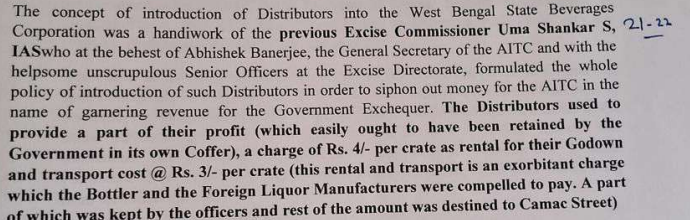
According to the findings, these funds flowed to 9 Camac Street, also known as Shantiniketan, which has long been associated with the nephew of former Chief Minister Mamata Banerjee and TMC national general secretary Abhishek Banerjee.
Pressure on bottlers to join the system
The report and related accounts also claim that bottlers who resisted the new arrangement faced significant pressure.
One example frequently cited is IFB Agro Industries Ltd.
The company wrote multiple letters to Excise Department officials expressing concerns about what it described as unlawful interference and coercive practices.
In one communication, the company stated that it had repeatedly raised concerns regarding “illegal interference by certain Excise Officials arising out of our refusal to comply with their unlawful demands.”
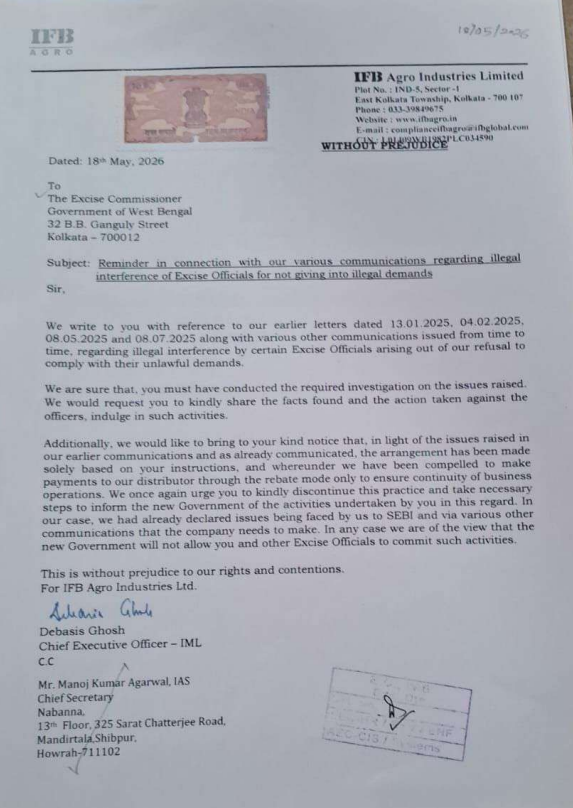
The company further requested that investigations be conducted and actions taken against officials involved in such activities.
“We are sure that you must have conducted the required investigation on the issues raised. We would request you to kindly share the facts found and the action taken against the officers, indulge in such activities.”
“Additionally, we would like to bring to your kind notice that, in light of the issues raised in our earlier communications and as already communicated, the arrangement has been made solely based on your instructions, and whereunder we have been compelled to make steps to inform the new Government of the activities undertaken by you in this regard,” the letter read.
The officials behind the centralised Policy framework
The report named the five officers who were involved in drafting the policy framework that led to the creation of WBSBCL.
These included former Special Commissioner (Revenue) and General Manager (Operations) Goutam Ghosh, Senior Joint Commissioner Shantanu Acharya, Deputy Commissioner Sanchayan Ganguly, Additional Commissioner Rajarshi Chakraborty and Special Commissioner Kunas Biswas.
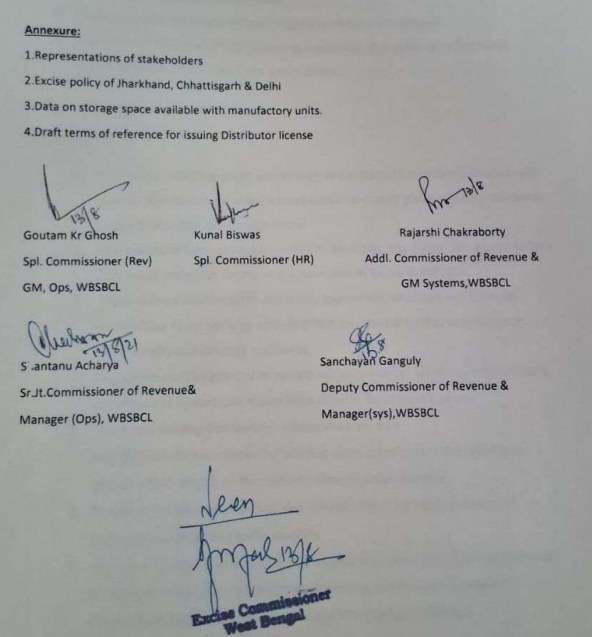
According to the report, these officials played key roles in designing and approving the new policy architecture.
One of the report’s most serious criticisms concerns the introduction of a two-tier excise duty collection system.
Previously, duty collection largely occurred at the manufacturing stage, which is generally considered the safest and most efficient method of revenue collection.
The new model split duty collection between the manufacturing stage and the distributor stage.
According to the report, this resulted in delayed revenue realisation and disruptions within the distribution network because distributors frequently failed to maintain sufficient balances for additional duty payments.
The report argues that this not only complicated the system but also weakened revenue efficiency.
Conclusion
The confidential Excise Department report presents a detailed and controversial account of how West Bengal’s liquor distribution network evolved from a competitive wholesale model into a tightly controlled system after 2017 under the previous TMC Government. At the centre of its findings are allegations of monopolisation, excessive control, operational inefficiencies and a collection mechanism that extracted money from manufacturers and bottlers.
The report argues that the creation of WBSBCL fundamentally altered the traditional distribution chain, replacing decentralised competition with a structure that concentrated power in the hands of a few intermediaries. It further says that this model not only increased costs for businesses and retailers but also created opportunities for political and bureaucratic influence over the liquor trade.


