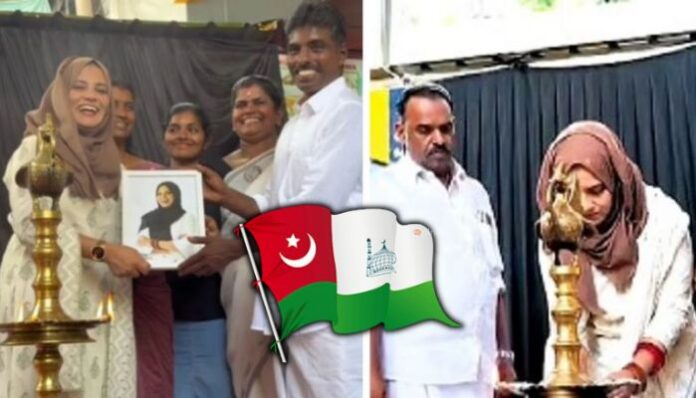
A controversy has erupted in Kerala over Muslim League MLA from Perambra, Fathima Thahiliya, lighting a ceremonial oil lamp (Nilavilakku) at a restaurant inauguration event in her constituency. Islamist outfit Samastha Kerala Jamiyyathul Ulama, the premier council of Sunni-Shafi Islamic ‘scholars’, has directed Muslims to refrain from indulging in rituals of non-Muslims as they are Haram in Islam.
On 3rd June 2026, the Central Mushawara of the Samastha Kerala Jem-Iyyathul Ulama held a meeting in Kozhikode to discuss the IUML MLA lamp lighting issue. Following the meeting, the Islamist outfit issued a directive, in which they said that lamp lighting is a practice followed by Hindus for a long time. Samastha stressed that Muslims performing rituals of other faiths that have no basis in Islam would essentially be departing from Islam.
The decision was taken during discussions regarding the ongoing Nilavilakku controversy. “In specific contexts, the lighting of the nilavilakku has long been practised by non-Muslims as a distinct religious ceremony. If a Muslim engages in such a practice e while accepting and basing it upon the Islam-opposed beliefs associated with it by those who perform the ritual, such an act would amount to leaving the fold of Islam,” the Islamist outfit said in a statement.
“On the other hand, if it is done without accepting or basing it upon such beliefs, but merely as an act of resembling non-Muslims, then the act is prohibited and sinful,” it added.
Secularism ends when Islam begins: Kerala Muslims are pivoting to deeper Islamisation while Hindus are busy secularising their faith
This, however, is not the first time that a Muslim organisation in Kerala has issued such ‘directives’ discouraging Muslims from being secular and performing any act or ritual linked to the faiths of Kafirs. Samastha is reported to have urged Muslims against lighting Nilavilakku earlier as well.
In fact, Samastha has continuously been pushing for adherence to radical Islamist, rather than purely Islamic practices. In February this year, Samastha adopted a resolution raising concern over what they described as ‘increasing attempts to draw Muslim women into public activities’ that could distract them from what they see as their ‘core responsibilities’. It warned that the influence of modern lifestyles and liberal ideas could push women to cross moral limits, especially in public spaces, which the scholars said should be avoided.
In 2021, the Samastha-affiliated students’ group, Samastha Kerala Sunni Students’ Federation (SKSSF), demanded that a new Muslim-majority ‘Malabar state’ be carved out from Kerala. SKSSF’s mouthpiece Satyadhara’s editor Anwar Sadiq Faisi demanded the creation of a new ‘Malabar state’ out of Kerala. According to Faisi, Kozhikode should be the state capital of the newly carved Malabar state. This demand is due to the Muslim majority in the Malabar region.
In 2019, Samastha Kerala Jamiyyathul Ulama said that women should offer their prayers inside their homes, reiterating its stand of opposing the entry of women into the mosque. Then General Secretary of Samastha, K Alikkutyy Musaliyar said, “We cannot allow the court’s interference in the religious matters. We should heed only religious leaders on such issues.”
An interesting fact to note here is that despite its Islamist beliefs, Samastha Kerala Jamiyyathul Ulama identifies as a rather moderate Muslim organisation in Kerala. In February 2026, Samastha passed a resolution opposing theocratic ideology propagated by the Jamaat-e-Islami, calling Jamaat’s pan-Islamist political ideology “extremist”.
In 2022, Sunni leader Nasar Faizi Koodathayi, the general secretary of the Samastha Kerala Jam-Iyyathul Qutba committee, said that the Constitutional pledge administered to Kudumbashree volunteers stating that Muslim women shall have equal legal rights to their father’s estate amounted to a violation of the fundamental rights of Muslims. He said that the oath violated the Quran, which states that men are entitled to double as much as women in the share.
Several Muslim organisations in Kerala have earlier cautioned Muslims from ‘fully’ participating in the Hindu festival of Onam, citing its core Puranic elements and the Mahabali legend linked to Lord Vishnu’s avatar. They say that celebrating festivals of polytheists or Kafirs amounts to Shirk. Notably, Islam mandates opposition to idol worship and other rituals of polytheists, like Hindus and the destruction of idols.
Back in 2016, Salafi Muslim preachers explicitly called Onam and Christmas “haram” for Muslims because “at the core there is a Hindu myth”.
In August 2025, a female Muslim school teacher, Khadija, asked Muslim students not to take part in Onam celebrations, calling the festival ‘polytheistic’ (Kuffar). “We Muslims should live by adhering to Islam. Onam celebrations are polytheistic and should not be encouraged. Neither our children nor we should encourage Onam celebrations in any way. Joining in with the customs of people of other religions may turn into shirk,” Khadija was reported to have said.
From supposedly ‘moderate’ Sunni Muslim organisations, extremist outfits, Maulanas, to school teachers, a significant section of Muslims in Kerala is pushing for strict adherence to Islamic customs and beliefs. They are not shying away from openly urging their co-religionists, even a sitting MLA, to avoid performing Hindu rituals like lamp lighting, etc.
Recently, an unfinished gym building in Kerala’s Palakkad gained national attention as it was being advertised as “Islam-friendly” on social media. The gym’s Muslim owner, Nawas Muthu T, recently declared that a fresh model, which is intended to blend “fitness with faith”, is going to be introduced in conformity with Islamic practices and customs.
Like it or not, Keralite Muslims have absolute clarity about adherence to their faith. Muslim organisations also ensure that the community, especially youth, does not go overboard, beyond the permitted pretence of secularism, and deviate from Islam.
The conduct of Kerala Hindus, on the contrary, presents an alarming asymmetry. A significant section of Malayali Hindus travels the extra mile to accommodate the beliefs of other faiths, while the ‘others’ aggressively assert their religiosity. Many ‘secular’ Malayali Hindus reframe their own festivals and traditions as regional or cultural practices. Look at the secularisation, rather de-Hinduisation of Onam.
Although Onam is associated with new crops, the festival is mainly rooted in the Hindu scriptural legend of the greatness of King Mahabali (also known as Raja Bali) and how Lord Vishnu, in his Vamana avatar, gave him a boon that he could come back to meet his subjects once a year.
The Hindu festival of Onam has for centuries been a commemoration and celebration of the return of King Mahabali. However, in recent years, Onam has been reduced to a mere ‘harvest festival’. This blatant secularisation of Onam is being collectively carried out by Islamists, Christian groups, Islamo-leftists, and of course, delusionally secular Hindus.
The Hindu connection of Hindu festivals is being systematically erased. Our festivals and traditions are either being portrayed as some sort of carnival or are being appropriated by non-Hindus.
In Tamil Nadu, Hindu-hating Dravidianists have been executing a similar playbook to secularise Pongal or Makar Sankranti and dissociate it from its Hindu religious roots. Just as Onam is being labelled a ‘cultural’ festival in Kerala, Pongal is being promoted as a ‘Tamil’ festival of agrarian gratitude in Tamil Nadu.
Similarly, beef (cow meat) eating has become cool, a flex, and the highest expression of secularism among a section of Keralite Hindus, even as Hindu scriptures, like the Vedas, strictly prohibit cow slaughter and consumption of cow meat. Cow meat eating is labelled as a ‘part of our history, syncretic culture and cuisine’, and beef-parotta has become a symbol of Keralite secular resistance against ‘Sanghis’, a term originally meant to address members of the RSS, which now has its scope expanded to any practising and unapologetic Hindu.
It is a disturbing irony that while rape Jihadis who trap Hindu women by feigning love or faking religious identity almost always resort to forcing Hindu women to consume cow meat. The act is rooted in the perverted Islamist mindset of humiliating the Kafirs by doing extreme mockery of their faith. They enjoy these deeds as acts of Islamic conquest on infidels. In Kerala, however, a section of Hindus voluntarily indulges in this adharma to boost their suicidally secular credentials.
The same ‘secular-progressive’ lot slips into hibernation when Muslim individuals and organisations give regressive statements, direct co-religionists to avoid doing ‘sinful’ acts Hindus call rituals. It, however, is also interesting how Muslims brandish the constitution as a shield when convenient.
Ironically, Islamists invoke secularism to demand personal-law protections and state support on issues like the hijab or Halal to protect Islamic exclusivity and communal autonomy. The Hindu majority, meanwhile, is either pressured or voluntarily, as in the case of Kerala, dilutes its own religious-cultural expressions, strips its own festivals of the inherent religiosity, for the sake of maintaining farcical communal harmony and secularism. While Muslims proceed with non-negotiable doctrinal clarity no matter how regressive it may be, Hindus have even become conditioned to boast their unilateral surrender as virtue and accommodative pluralism.
Willingly or unwillingly, secularism in India is largely the Hindu majority’s burden to bear.