

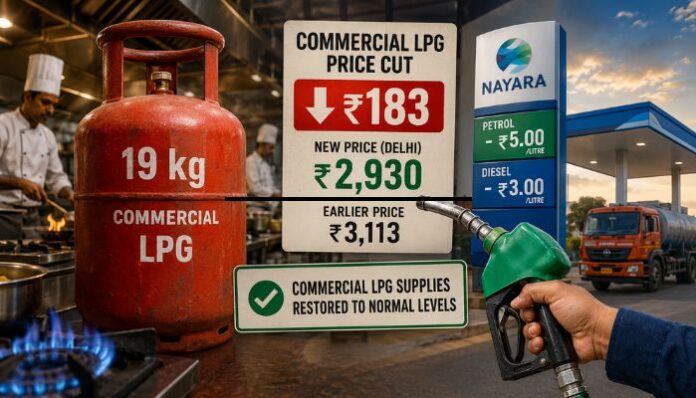
The central government has announced a major cut in the price of commercial LPG cylinders, offering relief to restaurants, hotels and other businesses after weeks of sharp price hikes caused by the conflict in West Asia. The price of a 19-kg commercial LPG cylinder has been reduced by ₹183. In Delhi, the new price now stands at ₹2,930, down from the earlier ₹3,113.
The reduction comes just a few days after the government restored commercial LPG supplies to the levels that existed before the Iran conflict. During the crisis, businesses faced both higher prices and supply restrictions as authorities tried to conserve fuel stocks amid uncertainty over imports.
Commercial LPG supplies restored to normal
The Petroleum Ministry said the decision was taken after the domestic supply situation improved and imported LPG cargoes were expected to arrive. It also announced that bulk LPG supplies, which had been suspended at the beginning of the conflict, have now been partially restored to 50% of their pre-war consumption levels.
At the height of the West Asia crisis, commercial LPG availability was badly affected as imports became uncertain. Prices were raised several times, and supplies to many sectors were reduced. Although supplies were later restored to around 70% of normal levels, many businesses continued to receive only half of their regular allocation.
To manage the shortage, oil refineries were instructed to produce more LPG by diverting hydrocarbon streams typically used for petrochemical production.
Confirming the latest decision, the Petroleum Ministry said, “In a major relief to industrial and commercial LPG consumers, the government has removed all sectoral restrictions on the supply of non-domestic packed LPG and restored supplies to the levels prevailing before the West Asia crisis.”
During the conflict, the government had also used powers under the Essential Commodities Act to ensure that C3 and C4 hydrocarbon streams were used mainly for LPG production. Now that supplies have improved, these raw materials will gradually be diverted back to petrochemical industries while maintaining domestic LPG production above 40,000 tonnes per day.
Nayara Energy cuts petrol and diesel prices
Along with the LPG price reduction, private fuel retailer Nayara Energy has also reduced petrol and diesel prices across its network. The company has lowered petrol prices by ₹5 per litre and diesel prices by ₹3 per litre at more than 7,000 fuel stations across the country.
This is the first reduction in retail fuel prices by any oil marketing company in more than two years. Pump prices may still differ from one state to another because of local taxes such as VAT.
NAYARA ENERGY CUTS PETROL PRICE BY RS 5 /LITRE, DIESEL BY RS 3 /LITRE
— Nabila Jamal (@nabilajamal_) July 1, 2026
The Rosneft-backed private fuel retailer, which runs over 7,000 outlets across the country, has rolled back its March hike as global crude prices tumble amid the Iran-US de-escalation
Brent has fallen nearly… pic.twitter.com/RVLhkqJGHd
Interestingly, Nayara had also been the first company to increase fuel prices when tensions between Iran and the United States were at their peak earlier this year. At that time, petrol prices had gone up by ₹5.30 per litre and diesel by ₹3 per litre because of fears of global supply disruptions.
However, public sector oil companies, Indian Oil Corporation (IOC), Bharat Petroleum Corporation Limited (BPCL) and Hindustan Petroleum Corporation Limited (HPCL), have not yet changed their fuel prices. These three companies together operate more than 90% of India’s fuel stations.
Nayara Energy, which is majority-owned by Russia’s Rosneft, operates a 20-million-tonne-per-year refinery at Vadinar in Gujarat. According to PTI, the company has adequate fuel supplies and is fully prepared to meet demand across the country.
Why have crude oil prices fallen
The latest price cuts have come as global crude oil prices have eased following an improvement in the situation in West Asia.
The Strait of Hormuz, through which nearly one-fifth of the world’s crude oil passes, is now open despite the disruption caused during the US-Iran conflict. As concerns over supply shortages have eased, international crude oil prices have softened, allowing governments and fuel retailers to roll back some of the emergency measures introduced during the crisis.
Reflecting the improving situation, the Centre also announced that from Wednesday, 1st July, it will remove restrictions imposed on state-run oil companies for selling petrol and diesel to bulk consumers. The government has also scrapped the temporary limit of 200 litres of diesel per vehicle.
These restrictions had been introduced on 12th June after disruptions in global energy supplies due to the tensions around the Strait of Hormuz.
