

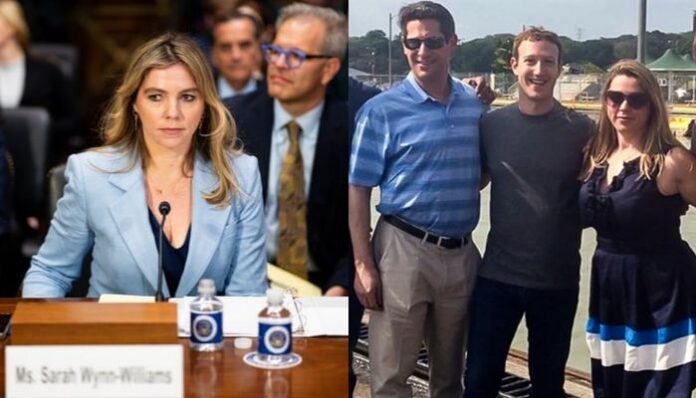
Meta whistleblower Sarah Wynn-Williams, whose memoir, “Careless People”, offers a shocking insider account of her time as an executive at the social media behemoth, has sued the company. Sarah Wynn-Williams has alleged that Meta is trying to “silence her”.
“Whistleblower Sarah Wynn-Williams, the former Facebook global public-policy director and author of the #1 New York Times bestselling memoir Careless People, today filed suit against Meta Platforms, Inc. in the U.S. District Court for the Northern District of California. She asked the court to enjoin a retaliatory private arbitration proceeding Meta brought against Ms Wynn-Williams and vacate an arbitration “Interim Award” barring her from speaking about the company or promoting her bestselling memoir in any way, which Meta has exploited to seek severe financial penalties against her anytime she speaks or appears in public,” a statement issued by Sarah’s legal team on 25th June reads.
“This is in addition to Meta claiming damages of $50,000 for every purported violation of the non-disparagement provision of her Severance Agreement, including each book sold as a separate violation, together with compensatory and punitive damages,” it adds.
Sarah Wynn-Williams had joined Meta in 2011 as a public policy expert and continued there for around six years.
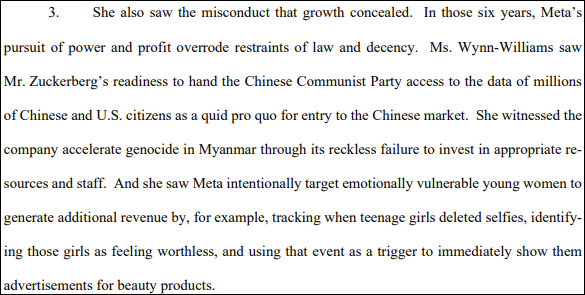
In her complaint, Wynn-Williams alleged that in those six years, “Meta’s pursuit of power and profit overrode restraints of law and decency.”
She alleged that Facebook co-founder and CEO Mark Zuckerberg was ready to hand the Chinese Communist Party access to the data of millions of Chinese and U.S. citizens as a quid pro quo for entry to the Chinese market.
“Ms. Wynn-Williams saw Mr. Zuckerberg’s readiness to hand the Chinese Communist Party access to the data of millions of Chinese and U.S. citizens as a quid pro quo for entry to the Chinese market. She witnessed the company accelerate genocide in Myanmar through its reckless failure to invest in appropriate resources and staff. And she saw Meta intentionally target emotionally vulnerable young women to generate additional revenue by, for example, tracking when teenage girls deleted selfies, identifying those girls as feeling worthless, and using that event as a trigger to immediately show them advertisements for beauty products,” the complaint reads.
In addition, it has been alleged that complainant Sarah Wynn-Williams “endured pervasive and repugnant sexual harassment and assault at the hands of Meta executives—chief among them Joel Kaplan, then Facebook’s Vice President of Global Policy and Ms. Wynn-Williams’s direct supervisor.”
The complaint further alleges that Meta initiated private arbitration without the knowledge of Wynn-Williams and obtained a sweeping pre-emptive gag order even though there has been no adjudication of any wrongdoing on her part.
“This is an unconstitutional prior restraint on her First Amendment rights that no court could lawfully issue, and Meta is exploiting its overbroad and vague terms to surveil and threaten Ms. Wynn-Williams with sanctions anytime she speaks or appears in public. This has silenced Ms. Wynn-Williams, including recently at the Hay Festival, a prominent gathering in the United Kingdom where she had been invited to speak on a panel but instead was compelled to remain silent during the discussion,” the complainant’s legal team said.
Even Wynn-Williams’s silent appearance at public events has been intolerable for Meta, which has sought an additional hearing in the arbitration “to add further speech-repressing sanctions and financial penalties.”
Wynn-Williams’s book Careless People contains accusations of a toxic internal culture, including sexual harassment and gender-based discriminatory practices. The book was published in March 2025.
Following the book’s publication, Meta had sought an emergency order against Sarah Wynn-Williams, preventing her from promoting her book. Meta had argued that the whistleblower had signed a severance agreement that included arbitration and non-disparagement clauses.
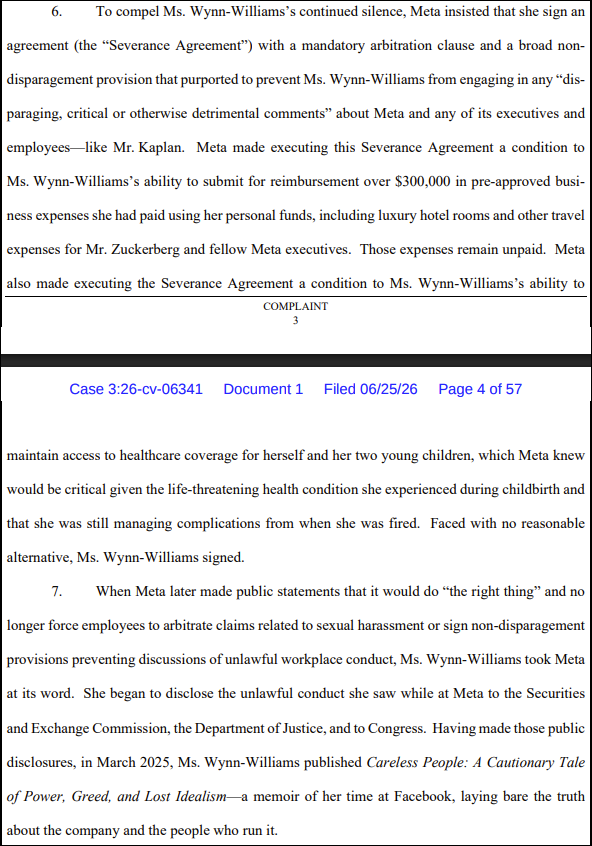
In a 285-page declaration attached to the complaint filed before the District Court for the Northern District of California, Wynn-Williams contended that the severance agreement is unenforceable partly because it was signed under financial duress. It says that when Facebook fired Wynn-Williams in August 2017, the company knew her termination would take away “critical employment benefits” – described as “cornerstones of her financial stability” – meaning she “had no choice” but to accept the severance agreement, allowing her to retain many of the benefits and obtain a significant cash payment.
