

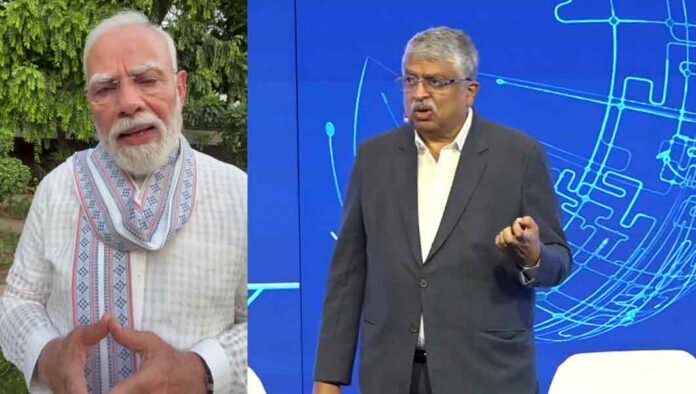
Prime Minister Narendra Modi has announced the formation of a high-powered task force under the leadership of world-renowned technology expert Nandan Nilekani to overhaul India’s examination system and restore full credibility to upcoming tests. In another video shared on Instagram, the Prime Minister underlined the government’s continuous efforts to safeguard the future of students, declaring that those who have played with the prospects of young aspirants are already rotting in jails while fast-track courts have been created to deliver swift justice.
The task force has been formed with several experts from various domains, including education, technology, law enforcement and logistic, to cover all aspects of conducting nationwide exams. As per govt sources, the group led by Technology Expert Nandan Nilekani will include Former ISRO Chairman S Somnath, Former IB Director Tapan Deka, IIT Chennai Director V Kamakoti, Former Education Secretary Anita Karwal, and Logistics Expert Amrit Lal Meena.
Modi stated that the Indian government is moving ahead with provisions for strict new laws, which will be taken up in Parliament tomorrow. Yet he emphasised that punitive action alone is not enough. “Our examination system should be reliable. Our examination system should be transparent. Our examination system should now use the most technology,” the Prime Minister said. Keeping these priorities in mind, a decision has been taken to create the high-powered task force led by Nandan Nilekani, which will focus on examination reform and complete its work as soon as possible. The credibility of forthcoming examinations will be ensured on the basis of this report.
The announcement comes against the backdrop of widespread student unrest following the paper leak in the National Eligibility cum Entrance Test (NEET-UG) 2026 held in early May, that resulted in the resignation of education minister Dharmendra Pradhan yesterday. The National Testing Agency had detected irregularities within days, leading to the cancellation of the examination, a prompt police complaint and a CBI investigation that resulted in multiple arrests. A re-examination was successfully conducted on 21 June for nearly 22 lakh candidates, with results declared earlier this month, ensuring that an entire academic year was not lost.
After similar controversies in 2024, the Ministry of Education had constituted a high-level committee headed by former ISRO chairman Dr K. Radhakrishnan. That panel recommended a comprehensive overhaul of the National Testing Agency, transition to computer-based testing, multi-stage biometric authentication through a DIGI-EXAM system modelled on DigiYatra, establishment of secure government-owned test centres, and structural changes including specialised verticals for technology, security and surveillance. Many of those recommendations have already been implemented or are under active monitoring by a high-powered steering committee.
The Public Examinations (Prevention of Unfair Means) Act, 2024, was also brought into force to criminalise organised exam fraud. An amendment to this law is being brought with provisions for more stringent punishments, time bound investigations and fast-track court. The cabinet has already approved the draft bill, which will be tabled in the parliament tomorrow.
The government has also initiated a major administrative reset of the NTA, including the removal of dozens of officials and plans for fresh recruitment of domain experts.
By entrusting the new task force to Nandan Nilekani, co-founder of Infosys, architect of Aadhaar and FASTag, and a key figure behind India’s digital public infrastructure including UPI, the government has signalled a decisive push towards technology-driven integrity. The panel is expected to recommend advanced digital safeguards, encrypted processes, enhanced cybersecurity protocols and institutional strengthening so that India’s high-stakes competitive examinations regain the complete confidence of students and parents. The Prime Minister’s message makes clear that while accountability for past wrongdoing is being enforced rigorously, the larger goal remains building a future-ready, transparent and fully reliable examination ecosystem.
