

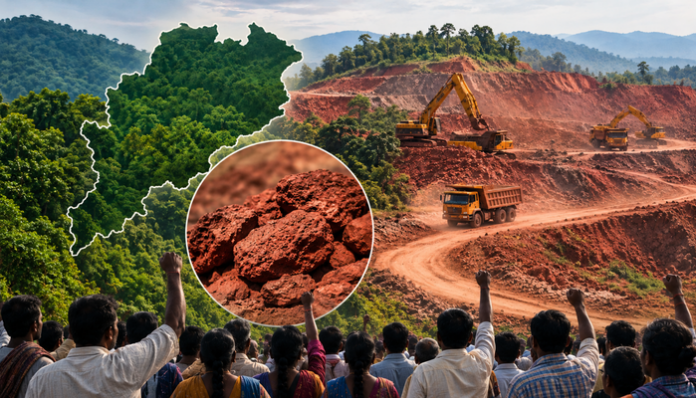
The Odisha Police recently arrested ‘activists’ Dr Randall Sequeira and Laxman Naik for instigating local tribals to attack security personnel in Kantamal in April this year over the Bauxite-mining issue. Sequeira and Naik were arrested on October 16, 2026, in connection with a clash between locals and police in Kantamal village in Rayagada district in April. The Police said that two ‘activists’ instigated members of the tribal communities to attack security personnel during a protest against mining activities in the district. While it is claimed that Randall Sequeira, who is a doctor from Mumbai, has been serving the local tribals in Odisha, the Police have maintained that he, along with Naik, has been misleading and instigating locals against bauxite mining in the region.
Notably, Sequeira and Naik have been supporting the agitation against bauxite mining in Odisha. The agitation relates to a conflict over a proposed bauxite mining site in the Sijimali hill region of Odisha. In 2023, the BJD government in Odisha auctioned the Sijimali bauxite block in Rayagada and Kalahandi districts, which was awarded to Vedanta Limited.
What is the issue?
In April this year, clashes erupted between locals and the police after the construction of an approach road to the mining site began near Shagbari village. The road started from Purlong/Purulang and went up to Sagabari Ghat, intended to connect State Highway 44 to the Sijimali hilltop.
The latest anti-mining protests organised earlier this month also demanded the withdrawal of the recently passed Mines and Minerals (Development and Regulation) Amendment Act, 2026. It is being claimed that the law would weaken state control over mineral resources and reduce mining revenue accruing to Odisha.
In 2023, Vedanta won the mining rights to the Sijimali bauxite block. It was allocated to Vedanta on a 50-year lease, covering 1,549 hectares, including roughly 699–708 hectares of forest land. The reserve is estimated at 311 million tonnes of high-grade bauxite.
The site also covers more than 44 villages, with communities largely belonging to Kondh and other Adivasi groups, alongside Dalit residents. The presence of the villages in the vicinity of the project has provided a trigger for the so-called pro-environment voices opposing the project. Some anti-development elements and vested interests have been resisting the mining project in the guise of raising ecological concerns and the rights of local tribals.
Once operational, the project is expected to have manifold benefits. It will supply raw-material security for industry, create considerable employment opportunities for locals, and generate public revenue. Unfortunately, most development projects in the country face similar roadblocks created by vested interests in the name of safeguarding the environment or community rights.
Odisha’s bauxite mining project is the latest target of a recurring pattern of political opportunism and hollow environmentalism. This is evident from the fact that the BJD government had granted the mining rights in the state to Vedanta, but the party has now joined the voices opposing the project.
Politics intensifies on Odisha Bauxite-mining issue
Earlier this month, on October 2, 2026, the BJD began a month-long padayatra and held a 12-hour economic blockade in Sundargarh coal areas against the Mines and Minerals (Development & Regulation) Amendment Act, 2026, which is also being opposed by those opposing the Sijimali bauxite mining project. The party alleged that the amended law diminishes the rights of mineral-rich states and affects their financial autonomy.
The latest anti-mining protests in Odisha have also received the support of the opposition parties, including the Congress. Recently, a senior Congress leader and the party’s general secretary (communications) condemned the arrest of Randall Sequeira and Laxman Naik, alleging that they were arrested because they supported protests by tribal and Dalit communities against bauxite mining projects. The Opposition’s stance packages the mining issue with other unrelated grievances (electoral rolls, regime change), which suggests a wider anti-government campaign rather than a mining-specific concern.
On 16 Oct, 2026, the Odisha police picked up physician and activist Dr Randall Sequeira and Dalit activist Laxman Naik. They have been supporting protests by Dalit and Adivasi communities against Bauxite mining projects. This is part of a larger campaign of repression in Odisha which has seen 43 police cases and over a 100 people jailed in three years. Congress MP from Koraput @saptagiriulaka and the Odisha Congress are providing support to the arrested activists. Bauxite mining projects in Sijimali, Kutrumali and Niyamgiri are being pushed through with brazen violations of Panchayat (Extension to Scheduled Areas) Act (PESA), 1996 and the Forest Rights Act, 2006, though these are Fifth Schedule areas. This contravenes the 2013 Supreme Court judgement on Niyamgiri which upheld the right of the Gram Sabhas to withhold consent for mining activity. In Sijimali, there are serious allegations of forging of Gram Sabha consent. The Congress has documented such cases of ‘Angutha Chori’ across BJP-ruled states. It is no surprise that one of the proposed mines is a Modani project. The Union Govt granted the Sijimali project environmental clearance in May 2026. Last month, the Odisha CM promised “all possible support” for such projects – following which, the crackdown on activists and local communities has intensified. This is the double engine model at work denying Adivasi communities their rights.
— Jairam Ramesh (@Jairam_Ramesh) October 21, 2026
An old anti-development pattern
Odisha’s bauxite mining is not an isolated case where so-called ecological warriors are up in arms against a major industrial or development project. Recently, we saw widespread protests and violence in Arunachal Pradesh against the proposed Siang Upper Multipurpose Project (SUMP). The project is an 11,000-megawatt mega-infrastructure and hydroelectric project planned along the Siang River in the Upper Siang district of Arunachal Pradesh. Beyond power generation, its large storage capacity serves as a flood-control mechanism to regulate water discharge during peak monsoon seasons, protecting downstream regions in Assam and Arunachal Pradesh.
A wannabe Medha Patkar has emerged in Arunachal Pradesh, where NHPC offices and police vehicles were set ablaze amid demands to halt the crucial Siang project. Who is backing this agitation, and what role is China playing? @banduneakanksha investigates. https://t.co/RugPj0YB1o
— OpIndia.com (@OpIndia_com) October 25, 2026
Despite the fact that the SUMP has a key geopolitical and strategic objective to protect India’s water security against China’s upstream infrastructure on the Yarlung Tsangpo (the Siang/Brahmaputra), the anti-development elements in the state have been creating unrest over it.
Clearly, their own vested interests are the motivation behind their actions rather than the interests of the nation or the local population. While the environmental rights or tribal rights champions leading such protests against development go on to receive global praise and acclamation, the local populations struggle to even maintain their livelihoods.
This reminds of the infamous ‘activist’ Medha Patkar, who led the ‘Narmada Bachao Andolan’ against the Sardar Sarovar Dam on the Narmada River, and deprived the locals of regular water supply for years. Because of the Andolan, the project was stalled for several years.
Many years later, in 2022, an FIR was registered against Patkar by the Enforcement Directorate (ED) for suspected money laundering during the famous Narmada Bachao Andolan. Additionally, the Department of Revenue Intelligence and the Income Tax Department also launched investigations into Patkar’s shady dealings. Interestingly, the so-called environmental activist was also seen taking part in Congress leader Rahul Gandhi’s Bharat Jodo Yatra.
Another such environmental champion named Alok Shukla rose to prominence through vigorous social media campaigns after he opposed the Rajasthan government’s mining endeavours in Chhattisgarh, where numerous coal blocks operate unhindered. Shukla was conferred the 2024 Goldman Environmental Prize.
He was given the prize for his efforts to safeguard Hasdeo Arand, a vast expanse of highly dense forest in central India covering 170,000 hectares, against coal mining operations. The conferment of the prize, which was conferred by the California-based Goldman Environmental Foundation on Shukla, underscores the influence of international forces on India’s energy security and economic progress.
Niyamgiri bauxite mining project in Odisha, the Kudankulam Nuclear Power Plant in Tamil Nadu, and the Sterlite Copper smelter in Tamil Nadu, the list of various industrial or development projects that were delayed or stalled because of unnecessary environmental activism is long. While the so-called ‘environment activists’ continue to progress in their lives, the progress of the nation as well as the local communities lags.


