

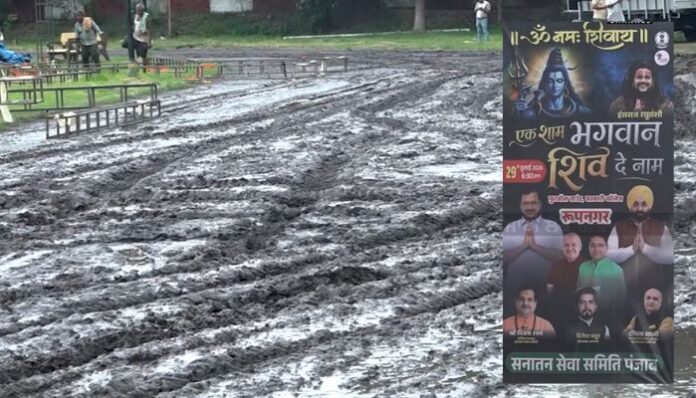
Players and athletes at Government College, Ropar, have expressed anger over extensive damage caused to the college football ground and running track during preparations for a government-organised religious programme.
The event is scheduled to be held at 6:30 pm on 29th July and is being organised by the Punjab chapter of Sanatan Seva Samiti, the religious wing of the Aam Aadmi Party. Singer Hansraj Raghuvani is scheduled to perform at the programme, for which arrangements are being made on the college football ground.
According to the players, heavy vehicles, tractors and construction machinery were driven across the ground, leaving the track covered in mud and several portions uneven. Poles and pillars were also installed inside the football ground. Rain reportedly worsened the situation, making parts of the field difficult even to walk across.
The athletes said they arrived with their sports kits, bags and water bottles for their regular practice but were shocked to find the ground unusable. One professional athlete said the running track had only recently been repaired. He pointed out that even bicycles were normally not allowed on the track, but heavy machinery had now been driven over it.
Players maintained the ground with their own money
The sportspersons said they had maintained the ground largely through their own labour and financial contributions. Members reportedly contributed amounts ranging from Rs 10 to Rs 500 for its upkeep. Nets, generators and grass-cutting equipment were also arranged by them.
They said the ground was earlier covered with thorny bushes and was later developed with the help of Baba Avtar Singh of Gurdwara Tibbi Sahib. Several players claimed they had spent years improving and maintaining the facility.
The track is used by youngsters preparing for Punjab Police and Army recruitment tests. One aspirant said the damage would force him to travel to a stadium farther from his home, increasing his daily fuel expenses. Others said practising on roads exposed them to accidents and knee injuries.
The players questioned why the programme was not organised at another available venue, such as the grain market or a larger stadium. They said they respected the religious nature of the event but argued that a government-backed programme should not come at the cost of sports infrastructure used daily by students and athletes.
Visibly distressed players feared that restoring the football ground and track could take months.
