

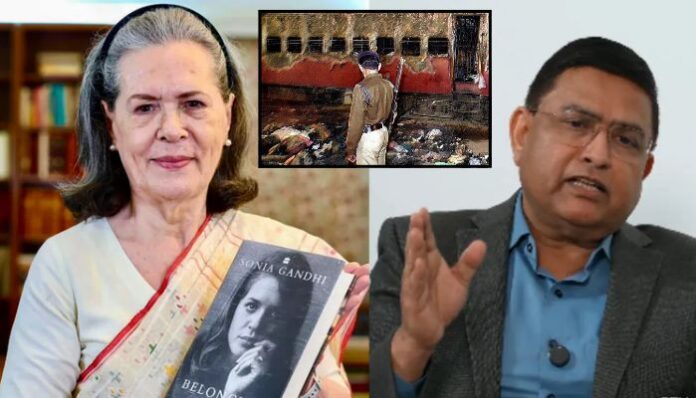
Former CBI Special Director and former Gujarat Police Special Investigation Team (SIT) chief Rakesh Asthana has strongly rejected Congress leader Sonia Gandhi’s description of the cause of the 2002 Godhra train burning as “disputed” in her memoir, Belonging: A Journey of Love. Asthana, who investigated the incident, said the probe was conducted without any political interference and that the evidence collected established a planned conspiracy behind the burning of the Sabarmati Express coach.
In an interview with ANI on Saturday, 14th November, Asthana also recalled how then Gujarat Chief Minister Narendra Modi provided him with Muslim police officers to assist in the investigation. He said he was given complete freedom to investigate the case and that neither the Chief Minister nor the state government interfered in the proceedings.
#WATCH | On being asked if he was under political pressure from the then CM Narendra Modi, Rakesh Asthana, who headed the Gujarat Police SIT probing 2002 Sabarmati Train fire, says, "There was no pressure… The area of the incident was predominantly inhabited by Muslims… I requested that a few Muslim officers be assigned to the investigation team and all the names I suggested were provided to us without any hesitation or objection. These Muslim officers played a very crucial role in our investigation…”
— ANI (@ANI) November 14, 2026
Rakesh Asthana says Modi provided Muslim officers for Godhra probe
Recalling the initial stages of the investigation, Asthana said the area where the incident took place was predominantly inhabited by Muslims. He explained that he needed officers familiar with the locality and therefore requested Muslim police personnel to join the investigation team.
“There was no pressure. On the contrary, I would like to say that in the initial investigation, I saw that the area in which the incident took place was totally inhabited by Muslims. So to investigate the Muslim area, you need Muslim officers, practically speaking, professionally speaking. I requested him to give me a few Muslim officers to be attached to the investigation team,” Asthana said.
He added that these officers played an important role in tracing the accused. In one instance, two Muslim constables worked undercover for nearly one-and-a-half months, disguising themselves as bangle and sari sellers to gather information about an accused who later escaped to Pakistan. “For a month and a half, they did this very diligently, honestly and sincerely. Undercover. And we could locate,” he said.
Asthana further recalled that when the police conducted a raid, the accused managed to escape and a mob attacked the police personnel. Despite these challenges, he said the officers continued their work and helped the investigation.
He maintained that the state government never restricted his investigation. Asthana said he was even allowed to select lawyers and hire an expensive advocate to represent the state’s case before the Supreme Court.
Asthana says court verdicts prove investigation was fair
The former SIT chief said the investigation was carried out independently and that the prosecution was able to secure convictions because of the evidence collected by the team.
He pointed out that not a single accused was granted bail by the Supreme Court during the initial years of the case. According to him, the judicial proceedings demonstrated that the investigation was not influenced by political pressure. “If the evidence was not sound, the courts would have found fault with the police. There was no interference, there was fairness,” Asthana said.
In 2011, a special court convicted 31 Islamists who were found guilty of the Godhra massacre on 22nd February, 2011, by the trial court (with only 11 receiving the death penalty and 20 receiving life imprisonment), and all 31 convictions were affirmed by the Gujarat High Court in October 2017, resulting in everyone receiving a life sentence.
59 Hindu pilgrims died in the Godhra train burning
Asthana also recalled the tragedy in which 59 innocent Hindu pilgrims lost their lives when Islamic jihadis set on fire the S6 coach of the Sabarmati Express near the Godhra railway station in Gujarat on 27th February, 2002. The victims also included 27 women and 15 children. This incident is known as the Godhra carnage or massacre.
He said many passengers were trapped inside the burning coach and could not escape. Those who managed to jump out were chased by the mob, with some being killed or injured.
Asthana rejected claims that the incident was merely an accidental fire and that there was no mob violence. “Therefore, the claim that it was an accidental fire and that there was no mob violence is not supported by the investigation,” he said.
Forensic evidence played a crucial role in securing convictions
Explaining the evidence that helped investigators establish the conspiracy, Asthana said, “As an investigator, I can say that mostly the forensic reports, the forensic examination of the burnt coach and the surrounding areas, have contributed mostly to securing the conviction.” He added that investigators traced the petrol used in the incident to an area near Aman Guest House, where a core group had reportedly met the previous night. The police also seized records relating to petrol being supplied in cans.
Asthana further revealed that investigators had found some links with a terrorist organisation during the probe. However, he clarified that the team could not gather enough prosecutable evidence to proceed against those links. “Some links with a terrorist organisation also emerged at the time, but we could not find prosecutable evidence, so we did not prosecute them,” he said.
He maintained that the investigation established a conspiracy involving planning, preparation and execution, with the attack being carried out according to the plan.
