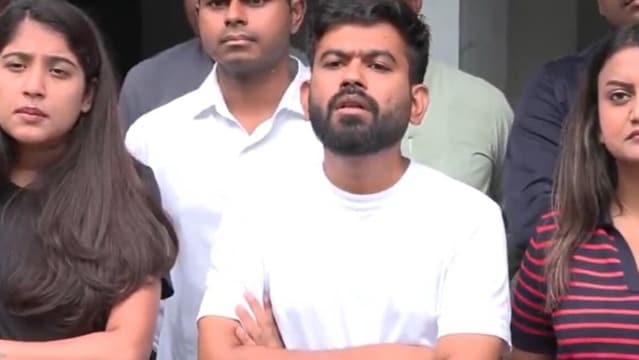
For nearly two weeks, thousands of Jharkhand Public Service Commission (JPSC) aspirants have been protesting in Ranchi over alleged irregularities in the recruitment process. Students allege paper leaks, manipulation in recruitment and a complete lack of basic facilities at the protest site, including drinking water, food and toilets. The agitation has snowballed into one of the biggest youth movements in the state in recent years, with critics accusing the Hemant Soren-led Jharkhand Mukti Morcha (JMM) government of displaying remarkable indifference towards the protesters.
Conspicuous by its absence, however, was the Cockroach Janta Party (CJP), a group that built its entire public identity around championing students’ causes.
Only after facing days of criticism on social media and being repeatedly accused of hypocrisy did CJP founder Abhijeet Dipke finally announce that he and his colleagues would visit Jharkhand in solidarity with the protesting students.
The timing is difficult to ignore.
An excuse that collapsed under its own weight
As questions mounted over why CJP had stayed away from Ranchi despite projecting itself as a national student movement, Dipke attempted to explain the absence.
In a now-viral interaction with journalist Sanket Upadhyay, Dipke claimed that he and other CJP leaders were unable to travel because they were exhausted and unwell following the prolonged Jantar Mantar protests.
Now this fraud Abhijeet Dipke is saying that his entire CJP team is sick, and that's why none of them are going to the Jharkhand JPSC protest.
— Amit Kumar Sindhi (@AMIT_GUJJU) August 4, 2026
So, did everyone get typhoid at the same time?
Has typhoid become a virus like COVID now?
Or did his boss Kejriwal tell him not to go? pic.twitter.com/LMNiyLfSs1
Had events ended there, the explanation may have appeared plausible.
Instead, reality punctured the narrative.
Soon afterwards, CJP leaders travelled to Dipke’s hometown of Sambhaji Nagar. Videos showed Dipke comfortably interacting with supporters outside his residence in the company of senior CJP leaders. Ironically, it was during this very interaction that Dipke finally announced the long-awaited Jharkhand visit.
"Definitely, we will go to Jharkhand. We stand with the students protesting there. We support their every demand."- CJP founder Abhijeet Dipke on Jharkhand Student Protest
— WION (@WIONews) August 5, 2026
(Source: ANI) pic.twitter.com/9ZQfLeZXd2
The contradiction was obvious.
If the leadership was genuinely too ill to travel to Ranchi to support students protesting for nearly two weeks, how was it healthy enough to undertake a political visit to Sambhaji Nagar and participate in public interactions?
The sequence strongly suggests that the Jharkhand visit was announced not because CJP suddenly discovered the students’ plight, but because remaining absent had become politically untenable.
A protest that became inconvenient
The political backdrop makes the episode even more revealing.
Jharkhand is not governed by the BJP.
It is ruled by the Jharkhand Mukti Morcha under Chief Minister Hemant Soren, with the Congress as a principal alliance partner.
For months, Dipke has faced allegations from critics that CJP functions less as an independent citizens’ movement and more as a pressure group whose activism disproportionately targets the BJP-led governments while remaining noticeably restrained when Opposition governments are under scrutiny. Dipke’s pictures with Kejriwal and Sisodia and his past links with AAP only adds weight to the allegation that CJP is yet another political movement under the guise of “championing students’ rights.”
Whether one agrees with that criticism or not, the Jharkhand protests have certainly strengthened that perception.
Had Dipke rushed to Ranchi from day one, he would have been compelled to question a JMM-Congress government over allegations of examination irregularities and administrative apathy. Instead came silence, followed by excuses, followed by mounting criticism, followed by an announcement only after social media users began openly questioning CJP’s credibility.
That is not how principled activism operates.
The movement that made CJP
The irony is difficult to miss because CJP owes much of its public visibility to student protests.
The organisation rose to prominence during the NEET paper leak controversy by aligning itself with activist Sonam Wangchuk’s fast and positioning itself as the face of student anger over alleged examination irregularities. CJP leaders projected themselves as uncompromising defenders of students and repeatedly claimed they would stand with young aspirants irrespective of political considerations.
Yet Jharkhand appears to have exposed the limits of that claim.
If student welfare is indeed the guiding principle, then the political identity of the government should be irrelevant.
A student protesting against alleged irregularities in Ranchi deserves no less solidarity than a student protesting over NEET in Delhi.
Celebrating a resignation while protesters struggled
Questions over CJP’s priorities did not begin with Jharkhand.
After sustained protests over the NEET controversy, Union Education Minister Dharmendra Pradhan resigned. Almost immediately, Abhijeet Dipke, Ashutosh Ranka, Saurav Das and other CJP leaders projected the resignation as a historic victory for their movement.
However, Pradhan himself presented an entirely different explanation.
In his resignation letter, he stated that he was stepping down so that vested interests would not mislead students into abandoning their studies and taking to the streets. According to him, his resignation was intended to remove himself as a political flashpoint and allow students to focus on preparing for their examinations and securing their future.
Whether one accepts that reasoning or not, it was certainly different from the triumphalist narrative promoted by CJP.
The optics became even more uncomfortable soon afterwards.
Videos of an “after-resignation party”, particularly featuring CJP leader Saurav Das, began circulating on social media. The celebrations triggered criticism not merely from political opponents but from individuals who had once associated themselves with the movement.
Among them was former Newslaundry journalist Meghnad S, who had briefly been associated with CJP during its formative phase. He publicly expressed disappointment, pointing out that while CJP leaders were celebrating, many volunteers and protesters were occupied arranging food, water and other necessities for fasting students at Jantar Mantar.
The criticism carried weight precisely because it came from someone who had once worked alongside the organisation.
It reinforced the growing perception that sections of the leadership were increasingly invested in optics and political theatre, while ordinary volunteers continued to perform the difficult work that sustains protest movements.
Jharkhand reinforces an old prejudice
Viewed against that backdrop, CJP’s delayed response to the Jharkhand protests appears less like an isolated lapse and more like a continuation of a familiar pattern.
When protests can be used to corner the BJP-led Centre, CJP displays extraordinary urgency.
When the allegations concern Opposition governments, hesitation suddenly sets in.
If CJP truly claims to represent students rather than political interests, its response should not vary depending on who occupies the treasury benches.
Selective activism inevitably invites accusations of political opportunism.
Public credibility is built on consistency. It cannot survive double standards.
Abhijeet Dipke’s eventual announcement of a Jharkhand visit may help contain immediate criticism, but it cannot erase the sequence that preceded it: prolonged silence, implausible explanations, contradictory public appearances and a sudden expression of solidarity only after accusations of hypocrisy began threatening CJP’s credibility.
For a movement that rose to prominence by claiming to speak for students across India, Jharkhand has become an uncomfortable test. Unless CJP demonstrates that it is willing to hold Opposition governments to exactly the same standards it demands of the Centre, the charge that its activism is guided more by political convenience than by principle will continue to shadow every future campaign.