

The Himachal government, ruled by the Congress, has imposed a new Widow and Orphan Cess of 60 paise per litre on petrol and high-speed diesel, adding another charge to fuel prices in the state. The new cess came into force from midnight on 11th August after the State Taxes and Excise Department issued a notification on Tuesday.
हिमाचल प्रदेश की तुलना में पंजाब, हरियाणा और उत्तराखंड में पेट्रोल-डीजल के दाम अधिक हैं। यहाँ विधवा बहनों के बच्चों और अनाथ बच्चों की पढ़ाई के लिए केवल 60 पैसे का सेस लगाया गया है।
— Sukhvinder Singh Sukhu (@SukhuSukhvinder) August 12, 2026
इस सेस के लिए विधानसभा में कानून भी पारित किया गया था। हमारा प्रयास है कि किसी बच्चे की पढ़ाई… pic.twitter.com/iMDXOhzQND
The notification was issued under Section 6-A of the Himachal Pradesh Value Added Tax Act, 2005, and has the approval of the Council of Ministers. The cess will be collected at the first point of sale of petrol and high-speed diesel in Himachal Pradesh.
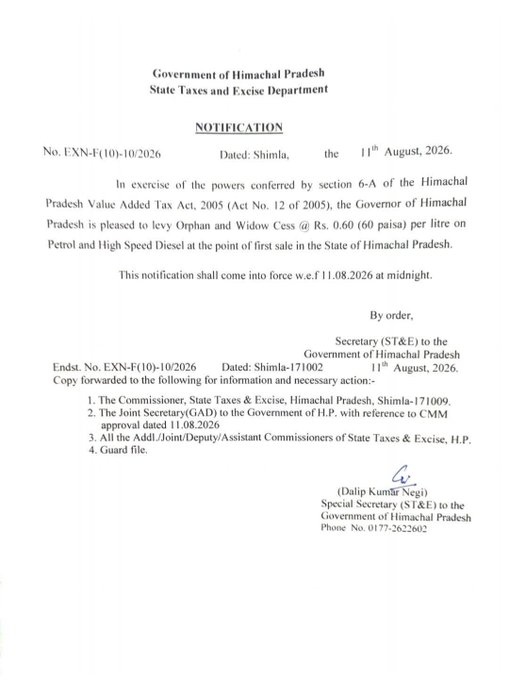
In simple terms, people buying petrol and diesel in the state will now pay an additional 60 paise for every litre. The money is meant for welfare measures related to widows and orphaned children. But the decision comes at a time when the financial condition of the Himachal Pradesh government has already been a major political issue.
The new levy also raises a bigger question: why is a government facing such serious financial pressure repeatedly looking for new ways to collect more money from ordinary people?
What is the widow and orphan cess?
The legal basis for imposing a widow and orphan cess was provided earlier this year when the Himachal Pradesh Legislative Assembly passed the Himachal Pradesh Value Added Tax (Amendment) Bill, 2026 during the Budget Session.
The amendment gave the state government the power to impose a Widow and Orphan Cess of up to ₹5 per litre on petrol and high-speed diesel. The Bill was passed by voice vote, giving the government the legal authority to introduce the additional levy.
The government has now decided to use that power, although it has fixed the cess at 60 paise per litre, much below the maximum limit of ₹5 allowed under the amended law.
The cess will be charged at the initial sale of fuel in the state. This means the levy is collected before the fuel reaches later stages of sale. The State Taxes and Excise Department has circulated the notification to the Commissioner, State Taxes and Excise, senior departmental officers and other concerned authorities for implementation.
The stated purpose is to generate money for welfare measures for widows and orphaned children. However, for people already paying high fuel prices and grappling with rising household expenses, another charge on petrol and diesel means another increase in their daily expenses.
Meanwhile, the BJP has raised some questions about the new cess. BJP’s Amit Malviya published an X post on 11th August, in which he said, “The Orphan and Widow Cess sounds like a noble cause, but in the absence of data on the likely beneficiaries and the proposed payouts against the collections through the cess, it is nothing more than another attempt to fleece the people of Himachal and upset their household budgets. Congress has run the worst possible government in Himachal Pradesh. The people will completely smash Congress out of power in 2027.”
The Orphan and Widow Cess sounds like a noble cause, but in the absence of data on the likely beneficiaries and the proposed payouts against the collections through the cess, it is nothing more than another attempt to fleece the people of Himachal and upset their household… https://t.co/gdMlst0NHJ
— Amit Malviya (@amitmalviya) August 11, 2026
A new cess in a state already struggling for money
Himachal Pradesh has been dealing with a serious financial crisis under the Congress government led by Chief Minister Sukhvinder Singh Sukhu, which came to power in December 2022.
The Congress had entered the election with a long list of welfare promises. These included free electricity, monthly financial assistance for women, restoration of the Old Pension Scheme, government jobs and several subsidy-based schemes.
The problem for the government has been that such promises require a steady flow of money. When revenue does not grow fast enough while expenditure continues to rise, the gap has to be filled through borrowing, higher charges, reduced subsidies or new taxes and cess.
That is the situation Himachal Pradesh has increasingly found itself in.
The latest 60-paise fuel cess therefore cannot be looked at in isolation. It comes after a series of decisions taken by the state government to increase revenue and control spending. The government has been under pressure to meet its regular financial commitments while also trying to continue with welfare schemes.
Salary and pension bills add to the pressure
One of the biggest challenges before the Himachal government has been its large salary and pension bill.
The state has monthly commitments of around ₹2,000 crore towards salaries and pensions alone. At one stage, delays in salary and pension payments affected a large number of government employees and retired employees, leading to a major political controversy.
The government also had to rely on additional borrowing to meet its expenditure requirements.
This is where the Congress government’s earlier welfare promises have become a difficult issue. Schemes announced during the election may create expectations among voters, but maintaining them requires money every month. When the state’s own revenue is not enough, the government has to find money from somewhere else.
More taxes, higher charges and fewer benefits
The government has already taken several steps to increase revenue.
The Assembly approved changes that introduced measures such as an environmental cess and milk cess. The government also reduced some subsidy benefits and increased certain user charges.
Changes in electricity benefits, higher diesel prices and increased water charges in rural areas have also become part of the wider debate over the state’s finances.
The government has even explored other possible sources of revenue, including discussions about regulated cannabis cultivation for industrial and medicinal purposes.
Taken together, these steps show the extent of the financial pressure facing the state. Instead of having enough room to comfortably fund its promises, the government has increasingly had to look for additional sources of revenue.
The new petrol and diesel cess adds another item to this list.
Even temple funds were brought into the welfare debate
The financial pressure has also reached temple trusts. The Congress government in Himachal Pradesh called on temple trusts to contribute funds towards welfare schemes. A notification encouraged temple trusts to provide money for programmes including the Mukhyamantri Sukh-Aashray Yojana and Mukhyamantri Sukh Shiksha Yojana.
The move became controversial because temple trusts and their funds are connected with religious institutions, while the government is responsible for arranging money for its welfare programmes through the state budget.
The fact that the government has had to look at temple trust funds, introduce new charges and reduce some benefits shows how tight the state’s finances have become.
Another burden on the people
Against this background, the 60-paise cess on petrol and diesel looks like another attempt to raise money from the public.
Sixty paise per litre may appear small when looked at separately. But petrol and diesel are used across the economy. Fuel is needed for private vehicles, public transport, goods vehicles, agriculture and businesses. Any increase in fuel costs can therefore have an indirect effect on transportation and other expenses.
The Congress government has kept the new cess far below the ₹5-per-litre ceiling provided by the amended law. Yet the basic issue remains that people are being asked to pay another charge at a time when the state government is already struggling with its finances.
The government may present the cess as a measure for widows and orphaned children, but the wider financial story is difficult to ignore. Himachal Pradesh needs money to meet salaries, pensions, welfare commitments and other regular expenses, while its revenue position remains under pressure.
The latest fuel cess is thus another sign of how the state’s financial problems are translating into measures that ultimately affect ordinary people.
For a government that came to power promising extensive welfare support, the growing list of new charges, higher costs, reduced benefits and borrowing has created a very different picture on the ground. Instead of having enough money to comfortably deliver its promises, the Congress government is increasingly looking towards additional collections from citizens.
And now, petrol and diesel buyers in Himachal Pradesh will pay 60 paise more per litre, with the government saying the money will be used for widows and orphaned children. The immediate burden, however, will be borne by the people buying fuel in the state.


