

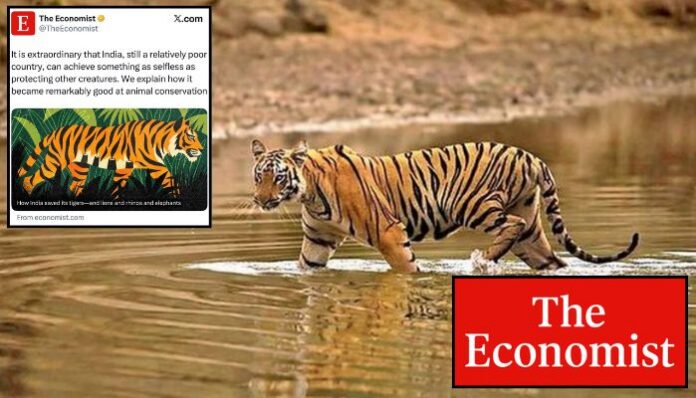
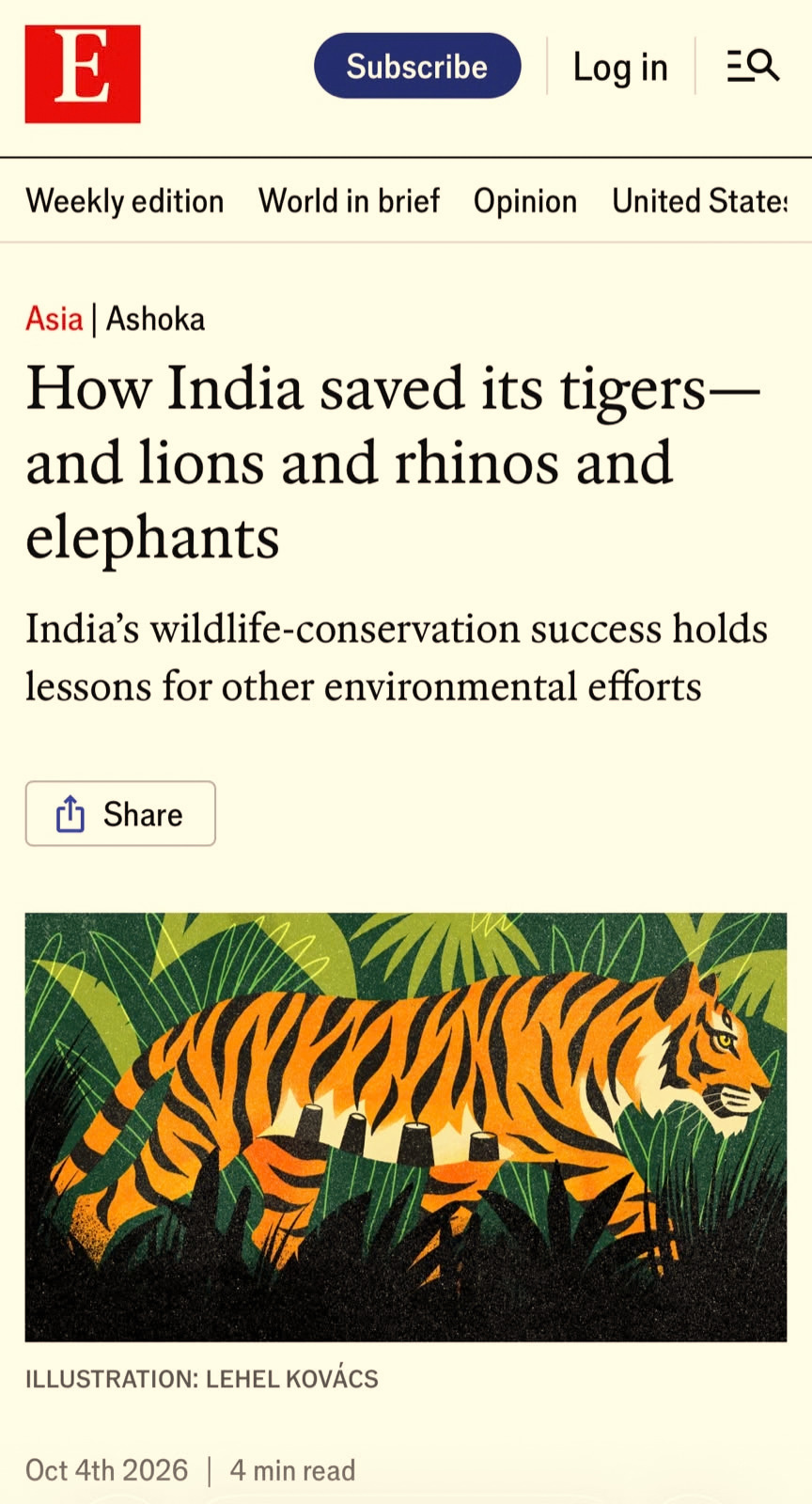
British Magazine “The Economist”, notorious for its bigoted and anti-India coverage, has published a report on Sunday, 4th October, highlighting the country’s success in wildlife conservation. Titled “How India saved its tigers, lions and rhinos and elephants”, the article, on the surface, appears to be a positive account of India’s conservation efforts. However, the magazine’s framing of India’s achievement has once again drawn attention, particularly after it described India as a “relatively poor country” while discussing its success in protecting wildlife.
Sharing the article on its X account, The Economist wrote, “It is extraordinary that India, still a relatively poor country, can achieve something as selfless as protecting other creatures.”
It is extraordinary that India, still a relatively poor country, can achieve something as selfless as protecting other creatures. We explain how it became remarkably good at animal conservation https://t.co/TP0ik9s4AT
— The Economist (@TheEconomist) October 5, 2026
As usual, the anti-India magazine again called India a poor country when it could have simply highlighted India’s conservation success. Instead, it chose to underline the country’s economic status through the lens of typical Western media, for whom India is always a poor country with limited resources that dismisses its achievements, whether in space or on land, like wildlife protection.
The article began by alleging the failure of the state, linking cases of people in India being killed in wild-animal attacks. It mentioned people being mauled by tigers in western India, attacked by leopards in the north and trampled by elephants in the east. “These deaths highlight the failures of the state,” the magazine wrote. The article thus found another way to criticise India even while highlighting a positive aspect of the country.
However, the article immediately turned the argument around, saying, “Yet, oddly, they also reflect its successes.” According to The Economist, Indians are encountering wild animals more often because India has become remarkably successful at protecting them.
The magazine used incidents of human-animal conflict and described them as failures of the state as the starting point for discussing India’s wildlife conservation success. While the article eventually acknowledged the country’s achievements, its opening framing placed the spotlight on deaths, failures and shortcomings before moving to the conservation story.
The magazine then moved to one of India’s biggest wildlife conservation successes, the tiger and wrote, “In the 1970s India’s national animal seemed to be heading towards extinction. Today the big stripey cat is thriving.” The article further read, “Over the past two decades numbers have more than doubled to nearly 3,700, even as populations collapsed in richer and less crowded parts of Asia, such as Malaysia.”
India’s Project Tiger: From nearly disappearing in the 1970s to nearly 3,700 tigers
This transformation did not happen by accident. India launched Project Tiger in 1973 when the tiger population was under severe pressure from hunting, poaching and habitat loss. The programme created protected tiger reserves and brought together conservation, protection and monitoring efforts.
The results have been significant. India’s tiger population had fallen to 1,411 in 2006. The 2022 tiger estimation recorded a minimum of 3,167 tigers, with the estimated population range extending to 3,925. India now accounts for around 70% of the world’s wild tiger population.
Project Tiger also went beyond simply increasing the number of tigers. It helped protect forests, prey species and entire ecosystems around tiger habitats. The programme eventually became a model for other conservation initiatives, including Project Elephant, Project Snow Leopard, Project Dolphin and Project Rhino.
India is now helping other countries bring tigers back
India’s tiger conservation model has become valuable to countries that have lost their wild tiger populations. One such example is Cambodia.
India and Cambodia signed an agreement to reintroduce six Royal Bengal tigers, two males and four females, into Cambodia. The country has been without wild tigers for years, and India has been helping Cambodian authorities prepare the habitat for their return.
The project has faced delays because of concerns over the availability of prey in Cambodia’s Cardamom National Park. Indian authorities are working with Cambodian officials on habitat preparation, prey-base improvement, technical training, anti-poaching measures and monitoring.
The National Tiger Conservation Authority (NTCA) and Wildlife Institute of India (WII) are also involved in consultations with Cambodian authorities. The objective is not simply to send tigers but to ensure that Cambodia has the ecological conditions and institutional capacity required to protect them.
India, hosting around 70% of the world’s wild tiger population, continues to draw on its extensive experience to support Cambodia’s reintroduction programme through technical training and expert consultations.
India’s conservation efforts go beyond tigers: Cheetah makes a comeback
India’s wildlife conservation story does not end with the tiger. The country also took up one of the most ambitious wildlife reintroduction projects in the world by bringing the cheetah back after the species had become extinct in India.
The cheetah was officially declared extinct in India in 1952. The last confirmed wild cheetahs were recorded in 1947, and the species disappeared because of hunting, habitat loss, decline in prey and other human pressures.
On 17th September, 2022, India launched Project Cheetah at Kuno National Park in Madhya Pradesh by bringing eight cheetahs from Namibia. More cheetahs were subsequently brought from Namibia and South Africa.
The project faced challenges, including the deaths of some adult cheetahs and cubs. However, the government’s assessment said the project was broadly moving on a favourable trajectory, with several of its short-term success criteria already achieved, including survival of introduced cheetahs, establishment of home ranges, reproduction and direct revenue contributions to local communities.
The project is not merely about bringing an extinct animal back to India. The government has described it as an effort to restore grassland and open-forest ecosystems and contribute to global cheetah conservation.
And the latest development has given another boost to the project. On 5th October this year, an Indian-born female cheetah gave birth to five healthy cubs at Kuno National Park. With the birth of the five cubs, India’s total cheetah population has risen to 60, including 41 Indian-born cheetahs.
Another historic and joyous milestone for Project Cheetah! 🐆❤️ KJP21, a 32-month-old Indian-born female cheetah, has given birth to five healthy cubs in Kuno National Park today. KJP21 is the third Indian-born female cheetah to give birth, after Mukhi and KGP12—an important milestone in the emergence of the next generation of India’s cheetah population. With the arrival of these five cubs, the cheetah population in India has reached 60, including 41 Indian-born cheetahs. Importantly, these cubs also mark the beginning of the Botswanan lineage in India, as their father is a Botswanan male cheetah—adding a new genetic lineage to India’s growing cheetah population. Another generation born on Indian soil, adding yet another beautiful chapter to the remarkable story of cheetah reintroduction in India. Heartfelt congratulations to the veterinarians, field staff, managers and everyone associated with Project Cheetah, whose dedication, commitment and tireless efforts have made these moments possible. Welcome to the world, little ones 🐆 #WildlifeWeek2026
— Bhupender Yadav (@byadavbjp) October 5, 2026
Union Environment Minister Bhupender Yadav described the development as an important milestone in the emergence of the next generation of India’s cheetah population. He also said the birth marked the beginning of the Botswana lineage in India because the cubs’ father is a Botswana-born male.
The development shows that the project has moved beyond simply transporting cheetahs to India. A new generation is now being born on Indian soil.
Himanta Biswa Sarma hits back at The Economist.
The Economist’s description of India as a “relatively poor country” did not go unnoticed. Assam Chief Minister Himanta Biswa Sarma directly responded to the magazine’s post on X, taking aim at what he called its colonial-era mindset.
Sarma wrote, “Bringing down rhino poaching to ZERO and eliminating poachers is way easier than bringing down the inherent racist mentality of the relics of the Colonial empire. But in Assam, we never say never…”
Bringing down rhino poaching to ZERO and eliminating poachers is way more easier than bringing down the inherent racist mentality of the relics of the Colonial empire. But in Assam, we never say never…
— Himanta Biswa Sarma (@himantabiswa) October 5, 2026
His response came at a time when Assam has been highlighting its success in bringing rhino poaching down sharply, particularly in Kaziranga and other rhino-bearing areas.
The Chief Minister’s reference to the “relics of the Colonial empire” was also a reminder of the history of wildlife exploitation during the colonial period.
From just 12 rhinos to a global conservation success story
Kaziranga National Park offers another powerful example of India’s wildlife conservation journey.
At the beginning of the 20th century, the greater one-horned rhinoceros was on the verge of disappearing from Assam. In 1908, the rhino population in Kaziranga had fallen to around 12. Sport hunting and poaching had played a major role in the decline. During the colonial era, British military officers in Assam were involved in large-scale hunting, with reports stating that some officers individually shot more than 200 rhinos.
The situation changed after conservation and protection measures were introduced. Today, Assam has more than 3,000 greater one-horned rhinos, while Kaziranga remains one of the world’s most important strongholds of the species.
The transformation is particularly striking because the same animal that was once reduced to a tiny population in Kaziranga is now thriving there. Assam has also taken an aggressive approach towards poaching. In 2022, the state reported zero rhino poaching losses, while anti-poaching operations, habitat protection and monitoring have continued. In 2022, Assam also carried out the symbolic cremation of 2,479 seized rhino horns. The ‘Daha Sanskar’ was intended to send a message that rhino horns had no medicinal value and that the horns were the remains of animals killed by poachers.
The conservation story of Kaziranga therefore stands as another example of how a species once pushed towards extinction can recover through sustained protection.
Netizens remind The Economist about the colonial history of wildlife hunting
Social media users were quick to react to The Economist for labelling India a poor country while conveniently ignoring the historical role of British colonisers in driving local species toward extinction.
One user remarked, “The nerve to bring negativity to a positive news. Only The Economist can do that, but also I saw some ‘en dashes’; someone is using an LLM to write the story. What’s the instruction, ‘Be a condescending assistant’?”
@TheEconomist The nerve to bring negativity on a positive news. Only Economist can do that but also I saw some " en dashes" , someone is using LLM to write the story. Whats the instruction , " Be a condescending assistant "?
— Just another human (@Justanother0987) October 5, 2026
Another user pointed towards the history of wildlife hunting during the colonial period and wrote, “Our tigers & Rhinos went near extinction, and our cheetahs got extinct because of your great-grandparents. We may be ‘poor’ today. We are the elephants who won’t forget anything.”
@TheEconomist Our tigers & Rhinos went near extension and our cheetahs got extent because of your great grandparents. We may be "poor" today. We are the elephants who won’t forget anything. https://t.co/EUkCPyNVw1
— KBG (@Camp_Dravid) October 5, 2026
Another user linked India’s conservation ethos with Hindu traditions, writing, “That’s because India is a Hindu country which believes all the creatures are one big family. That’s why we are majorly vegetarian. British and Muslims tried to destroy us but couldn’t succeed. We are bouncing back.”
@TheEconomist That’s because India is a Hindu country which believes all the creatures as one big family. That’s why we are majorly vegetarian. British and Muslims tried to destroy us but couldn’t succeed. We are bouncing back.
— Gems of BJP (@gemsofbhajpa) October 5, 2026
A long history of biased coverage
Anti-India propagandist British Magazine, The Economist, has regularly adopted a profoundly biased stance towards India. In a recent report, it attacked the Bharatiya Janata Party (BJP) government over the introduction of the Uniform Civil Code (UCC), questioning the move and referring to it as “communal.” However, the platform raised its voice against Sharia councils in Britain and argued that the country’s secular law should take precedence over any religious regulation or statute in a 2016 piece.
In another article, it went so far as to diminish India’s deeply rooted Hindu cultural and civilisational heritage, portraying the Mughals as having introduced not only architecture and music but also food and literature to the country.
The Economist acknowledged that the Mughals demolished temples but asserted that this was not an insult to the native community. It then simply ignored the imposition of “jizya,” the slaughter of Hindus, and the forced conversions that the Islamic rulers had emphasised in their own works.
Given the media outlet’s long record of anti-India propaganda, it is hardly surprising that when forced to acknowledge India’s remarkable wildlife achievements, The Economist still found a way to lead with state failure and disparage the nation as poor.


