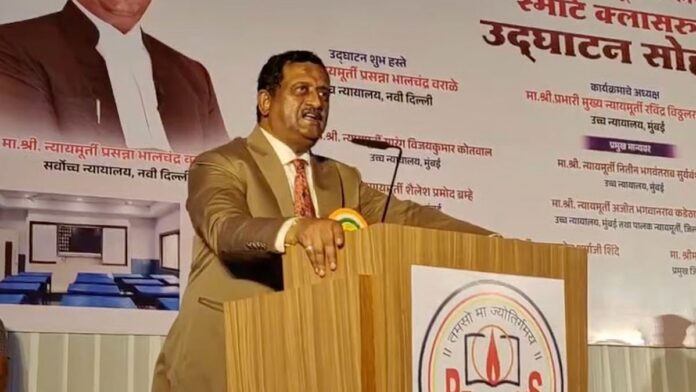
There is little to disagree with in the concern expressed by Supreme Court Justice Prasanna Varale over the deteriorating condition of Marathi-medium schools and residential schools in Maharashtra. If schools are genuinely being forced to shut down for want of a relatively small amount of money, the Maharashtra government must answer why it has failed to provide that money.
But the argument that even 0.1 per cent of the money allocated for the Nashik Kumbh Mela could have saved more than 100 Marathi schools gets the priorities of governance completely backwards.
Justice Varale, speaking during a visit to his former school in Nashik, said that if around Rs 32 crore, 0.1 per cent of the Kumbh allocation, had been spent on education, more than 100-150 Marathi schools could have been prevented from shutting down. The concern over educational infrastructure is legitimate. The comparison with the Kumbh, however, is not.
Why must schools and the Kumbh be competing priorities?
The first question that needs to be asked is: Why must the Kumbh Mela and Marathi schools be presented as competing priorities in the first place?
Maharashtra is perfectly capable of doing both.
The state has approved a comprehensive Rs 22,425.39 crore development plan for the Nashik-Trimbakeshwar Simhastha Kumbh Mela. The plan is not simply a cheque being handed over for religious festivities. The Kumbh requires enormous temporary and permanent infrastructure because lakhs of devotees will descend on Nashik, creating extraordinary requirements for roads, sanitation, water supply, transportation, medical facilities, crowd management, public safety and other civic infrastructure. The state has constituted dedicated committees and an authority precisely because the event requires large-scale administrative coordination.
So when someone says, “Take 0.1 per cent of the Kumbh allocation and save the schools”, the obvious response should be: Why take it from the Kumbh at all?
Why not ask the government to find Rs 32 crore elsewhere?
Why not ask why schools were allowed to reach a stage where Rs 32 crore could supposedly make the difference between survival and closure?
And if the state has Rs 32 crore to spare, why should that money become available for schools only after taking it away from an infrastructure programme connected with one of India’s largest religious gatherings?
Kumbh infrastructure is not simply “religious expenditure”
The comparison itself creates an unnecessary hierarchy: education is presented as an essential public good while the Kumbh is subtly reduced to an expendable cultural or religious expenditure. That is where the argument becomes problematic.
The Kumbh Mela is not some private religious function for a handful of people. It is a civilisational and spiritual gathering followed by millions of Hindus. The administration has a responsibility to ensure that people who participate in it have access to basic civic facilities and, more importantly, can do so safely.
Imagine the consequences if the government simply said that sanitation, roads, medical facilities, crowd-control infrastructure or public amenities at the Kumbh were unnecessary because the money could instead be spent elsewhere. The same people would quite rightly ask why the state failed to prepare for an event in which an enormous number of people are expected to gather at the same place.
The purpose of Kumbh expenditure is therefore not merely to “spend money on a religious event”. It is to build the infrastructure required to manage a massive congregation safely and efficiently.
Criticise waste, not the existence of the expenditure
To oppose wasteful expenditure is legitimate. To question whether every rupee is being spent wisely is legitimate. To demand greater allocation for education is legitimate.
But turning Kumbh expenditure into the explanation for the failure of Marathi-medium schools is not.
If Marathi schools are shutting down because of inadequate funding, the government should be asked why it failed to fund them. Period.
The state does not have a binary choice between a school and a toilet at the Kumbh.
It must provide both.
The larger question of government priorities
There is another uncomfortable question here. Maharashtra has several large welfare commitments, including the Mukhyamantri Majhi Ladki Bahin Yojana, under which eligible women receive Rs 1,500 per month. The scheme itself provides for the monthly Rs 1,500 benefit from July 2024.
One can certainly argue that welfare schemes serve a legitimate social purpose and that their beneficiaries cannot simply be deprived of promised assistance. But that is precisely why governments must be subjected to scrutiny on all expenditure, rather than selectively identifying one particular expenditure as the source of every fiscal problem.
If Rs 32 crore is the amount required to save 100-150 schools, why is the debate not about finding Rs 32 crore within a state budget running into lakhs of crores?
Why is the Kumbh being made the villain?
Would the same framing have been used if the expenditure were for a large government programme associated with another religious community? Would a commentator casually suggest that 0.1 per cent of the expenditure on an Islamic or Christian religious gathering should be diverted to save Marathi schools?
Perhaps that question is uncomfortable. But it is worth asking because public policy should not operate on the assumption that expenditure associated with Hindu religious traditions is inherently frivolous, while expenditure on religious congregations of other communities is automatically accorded greater social legitimacy under India’s famed secular framework.
The Kumbh deserves scrutiny over unnecessary expenditure. The government should be questioned if projects are overpriced, delayed or poorly executed. But the mere fact that money is being spent on Kumbh-related infrastructure does not make that expenditure illegitimate.
In fact, the irony is that the argument provides the government with an easy escape.
Instead of asking why it could not protect Marathi schools while simultaneously spending on the Kumbh, the government can simply say that education and Kumbh infrastructure are competing demands and that difficult choices have to be made.
No.
The government should not be allowed that cop-out.
Maharashtra can and must do both
A government capable of undertaking a massive infrastructure programme for the Kumbh should also be capable of ensuring that Marathi-medium schools do not collapse for want of basic funding. These are not mutually exclusive responsibilities.
Justice Varale’s concern about education deserves serious attention, particularly his reported remarks about the condition of residential schools and the need for modern classrooms, computers and laboratories. But the remedy cannot be to pit one legitimate public priority against another.
The better question is not whether 0.1 per cent of Kumbh funds could have saved Marathi schools.
The better question is: Why did the government need to be reminded about Marathi schools at all?
And there is a larger principle at stake.
The Kumbh Mela is not something that Maharashtra should be embarrassed about spending money on. It is an event that brings together an extraordinary number of people and therefore requires extraordinary civic preparation. Providing them with toilets so that people do not have to defecate in the open, ensuring drinking water, building roads, arranging medical facilities and preventing stampedes are not luxuries. They are basic responsibilities of a government hosting a congregation of such magnitude.
If the state can provide all of that and also keep every Marathi school functioning, it is doing its job.
If it cannot, the failure lies in its budgeting and governance, not in the fact that Hindus gathered for the Kumbh.
It is not an either-or choice
The government should therefore be asked to save the schools.
It should be asked to improve ashramshalas. It should be asked to modernise government schools. It should be asked to review inefficient spending and welfare expenditure wherever necessary.
And it should be asked to ensure that the Kumbh infrastructure is delivered efficiently and without waste.
But Maharashtra should not be forced into the false choice of schools versus Kumbh.
Both deserve to survive.
Both educational institutions and religious traditions deserve to be protected and supported. They are not competing priorities, nor should public policy force a choice between the two. It is not an either-or proposition; both deserve to be treated with equal seriousness.
How the Left employs sophistries of school over Hindu congregation, hospital over temple
There is also a familiar pattern in the way such debates are framed. The comparison of religious traditions, temple construction and religious infrastructure with hospitals, schools or other welfare institutions has long been a convenient rhetorical device for questioning the legitimacy of Hindu religious expenditure.
The argument is deceptively simple: why build a temple when a hospital could have been built instead? Why spend money on a religious gathering when the same money could fund schools? Why invest in religious infrastructure when there are supposedly more “useful” things the state could be doing?
The problem with this framing is not that hospitals and schools are unimportant. They are immensely important. The problem is the assumption that the existence of one legitimate social need automatically delegitimises another.
The same argument was prominently deployed around the construction of the Ram Mandir in Ayodhya. After centuries of contestation and a nearly 500-year-long civilisational struggle over the Ram Janmabhoomi, sections of the Left and its ideological ecosystem repeatedly asked why a hospital or other public institution could not be built at the site instead of a temple.
But why should the choice have been presented as Ram Mandir versus hospital in the first place?
India needs hospitals. India also has the right to build temples.
India needs schools. Hindus also have the right to preserve and celebrate their religious traditions.
A hospital does not become more valuable because it is rhetorically positioned against a temple. Nor does a temple become frivolous merely because someone can identify another public good that could theoretically have received the money.
This is precisely why the Kumbh-school comparison needs to be viewed with some scepticism. Once the debate is framed as religion versus development, Hindu religious expenditure is almost automatically placed on the defensive, as though every rupee spent on a Hindu religious tradition must first justify why it was not spent on a school, hospital or welfare scheme.
That is not secularism. It is a double standard masquerading as public-policy prudence.
The legitimate question is whether public money is being spent efficiently and whether citizens are receiving value for it. That standard should apply equally to every expenditure. But the answer to a school funding shortfall cannot always be to point at a temple, a Kumbh, a religious festival or some other Hindu institution and declare that the money should have gone there instead.
A civilised society does not have to choose between preserving its civilisation and building its institutions. It can, and must, do both.