

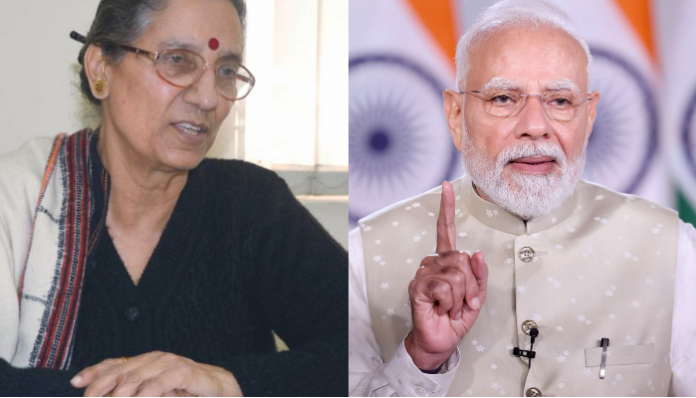
Amarjeet Kaur, national secretary of the Communist Party of India (CPI), caused a political controversy when she seemed to openly threaten Prime Minister Narendra Modi at Delhi’s Ramlila Maidan during a rally on 1st September (Tuesday). She brought up an alleged statement made by him against communists, claiming that he had characterised them and their flags as threats before spewing, “Tumko nipta denge (will finish you off).”
Kaur announced, “We cannot forget that three years ago, PM Modi met with other senior BJP officials, warning that these communists are a serious threat; those who wave the red flag are dangerous. This statement was made public. He stated that we must deal with them within this country. We have known from the beginning who you aim to eradicate. Today, we come to declare that we will finish you off,” while addressing her party cadres at the conclusion of nationwide “Badlaav zaroori hai” (change is necessary) campaign.
The comment faced strong backlash as Bharatiya Janata Party (BJP) national spokesperson Pardeep Bhandari described the statement as a “dimagi Naxal mindset” and further stated that this is the reason for public disdain towards CPM.
Amarjeet Kaur, National Secretary of the Communist Party of India says “Hum Modi Ko Nipta Daalenge”.
— Pradeep Bhandari(प्रदीप भंडारी)🇮🇳 (@pradip103) September 1, 2026
This is why PEOPLE of India hate CPM!
This is " Dimagi Naxal Mindset" ! pic.twitter.com/H7FmI9oWsJ
However, Kaur brazenly defended her remark and argued, “I stand by what I said, and I will not apologise. If PM can say communist ko nipata do then why can’t I,” while talking to News18.
It is crucial to emphasise that the government has consistently identified far-left extremism or Naxalism as a significant security threat to India and initiated a robust response against red terror within the nation, pledging to eliminate this threat by 31st March 2026. As a result, India has been declared virtually free of this menace, as the number of affected regions has decreased to zero. Naxal-related violence has experienced a substantial decline, with many prominent Maoist leaders either surrendering or being killed in confrontations alongside their associates. Furthermore, the government’s development policies in these sensitive regions have also played a key role in effectively eradicating Naxalism from its roots.
