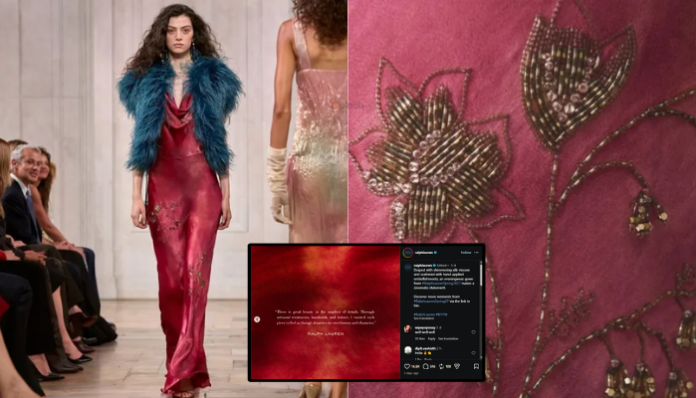
Indian traditions, jewellery, and attire have long been appropriated or copied by the West without any credit to India. In a latest such incident, US fashion brand Ralph Lauren showcased a deep pink evening gown carrying Indian Zardozi embroidery, sans credit to Indian craftsmanship,
On 12th September 2026, Ralph Lauren published several images of the deep pink gown, including a close-up of its embroidery; however, it made no mention of Indian Zardozi craftsmanship used in the embroidery.
The American fashion brand captioned the images as, “Draped with shimmering silk-viscose and scattered with hand-applied embellishments, an eveningwear gown from #RalphLaurenSpring2027 makes a cinematic statement.”
Zardozi, the Persian embroidery form that flourished in India to the extent of becoming Indian
Though of Persian origin, Zardozi handicraft gained prominence and significance in India in the medieval era, particularly in the 14th century. In India, Zardozi is more popularly known as Zari.
Kolkata, Delhi, Mumbai, Lucknow, Agra, Bareilly, Farrukhabad, Hyderabad, and Bhopal are among the key centres of Zardozi handicraft in India. This embroidery form has undergone notable evolution over the centuries.
The comment section of the said Ralph Lauren post is replete with comments from Indian users, who called out the American brand for using an Indian embroidery form without giving due credit.
Indian fashion designers are outraged over Ralph Lauren failing to credit India and describing Zardozi as mere ‘embellishments’
Fashion designer Prakhar Rao Singh Chandel has strongly criticised Ralph Lauren, highlighting that Zardozi is registered in Lucknow and six surrounding districts since 2013. He further emphasised that more than 1,75,000 artisans are working in the cluster.
Chandel also blasted Ralph Lauren for using the wording “embellishments” for Zardozi embroidery on its showcased evening gown. He noted that while Ralph Lauren provided an elaborate description, it reduced the intricate and sophisticated Zardozi handwork to just “embellishments”.
In addition, the US fashion brand’s post, says that through artisanal treatments, handwork, and texture, “I wanted each piece to feel as though it carries its own history and character”.
However, Ralph Lauren failed to highlight both the true history and the character of the Zardozi handicraft it copied and appropriated.
Similarly, Yash Sahu, Academic Lead & Design Faculty at IMS Design and Innovation Academy, Noida, opined that the handwork seen on the Ralph Lauren gown is much more aligned with the vocabulary of Indian Zardozi than generic embroidery.
“The metallic surface, raised embellishment and ornamental treatment are all strongly associated with Indian Zardozi traditions. But there may also be elements of Aari or other hand-embroidery techniques used alongside it,” Sahu told The Indian Express.
“A photograph can suggest a technique; it cannot establish the exact stitch construction. To definitively call it Zardozi, Aari or a combination, the garment itself would need to be examined,” he added.
Much like Chandel, Sahu raised strong objections to Ralph Lauren reducing Zardozi embroidery to mere embellishments, highlighting that it is not just a decorative aesthetic but a labour-intensive craft involving metallic threads and complex sewing techniques.
“Zardozi is a labour-intensive craft involving metallic threads and embellishments, traditionally including gold and silver elements, sequins, beads and metallic wires,” he explains, sharing how Aari is technically different as it uses a “hooked needle to create a chain-stitch construction,” he said.
A significant section of Indian fashion designers believe that the bigger question is not whether foreign brands can use Indian craft or not, but why are they not comfortable in using it by giving proper credit to the recognizable traditional Indian source.
When a craft is used without credit and the original source is made invisible, it is copying and stealing. When a craft is used acknowledging its source, origin and history, then it can be accepted as borrowing and taking inspiration.
This, however, is not the first time that globally popular fashion brands have copied without credit or attempted to appropriate Indian handicraft.
Ralph Lauren copied Jhumka-style earrings and a Bandhani print skirt without acknowledging Indian craftsmanship
In March-April 2026, Ralph Lauren presented jhumka-style earrings as “vintage accessories” and a bandhani-style printed shirt, without any credit of Indian craftsmanship.
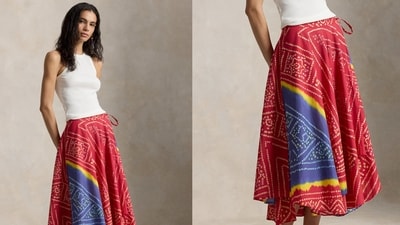
The skirt featured a wrap silhouette with a tie-up waist and flowy hem, described as drawing from traditional Bandhani tie-dye, although it was pointed out that they used a simple print technique instead of the traditional tie-and-dye craft, which has origins in Gujarat and Rajasthan.
Prada copied Kolhapuri chappals and denied credit, only to admit the act after outrage
In mid-2025, Italian luxury brand Prada “proudly” showcased a pair of flat, open-toe leather sandals in its Spring/Summer 2026 menswear line. While Prada was receiving praise for the unique and catchy footwear designs, it soon turned out the designs were an outright copy of Kolhapuri chappals, the traditional handcrafted sandals from India.

Kolhapuri chappals are named after Kolhapur in Maharashtra, India. These chappals are famed for their braided leather straps, intricate cutwork and durable handcraftsmanship. The designs of these slippers have been passed down through generations. They have carried a Geographical Indication (GI) tag in India since 2019, recognising their regional heritage and unique crafting process.
The Prada sandals, or the fake Kolhapuri chappals, came with a price tag of ₹1 lakh or $1,200, while in India, the original version lists for around ₹1,000.
Indian netizens noticed Prada’s copy-without-credit act and labelling of iconic Kolhapuri chappals as mere ‘leather sandals’. Calling out the deliberate erasure of the sandals’ origin, Indian social media users accused Prada of stealing the design but also of cultural appropriation.
Following a political and public backlash in India, particularly from Kolhapuri artisans, Prada’s Head of Corporate Social Responsibility, Lorenzo Bertelli, sent a letter to the Maharashtra Chamber of Commerce acknowledging the sandals’ Indian provenance. He explicitly credited the Kolhapuri chappal inspiration.
Dior copied Lucknow’s Mukaish embroidery without credit
Days after the Prada controversy in 2025, French fashion house Dior received backlash for showcasing a $200,000 overcoat embroidered with the traditional Indian Mukaish embroidery, without crediting Indian artisans or mentioning the country of origin.
During a Paris fashion show, Dior unveiled the ivory-and-gold overcoat featuring intricate Mukaish embroidery.
Notably, Mukaish is a hallmark of Lucknowi heritage and is also known as “badla work”. This ancient Lucknowi embroidery style is labour-intensive, in which artisans weave metallic threads into patterns. This embroidery style, creating a shimmering effect, is often found in kurtas, dupattas, and chikankari sarees.

Dolce & Gabbana and the Indian walnut carving row
In August 2025, Italian brand Dolce & Gabbana launched its Alta Moda SS25 collection and presented it at the Roman Forum in Italy. The presentation, however, featured a bag with a design combining a souvenir Trevi Fountain with a wooden jewellery box commonly found in Indian households, without giving credit to India.
Made using the traditional Jadankari, or walnut wood carving technique still practised by hand, particularly in Kashmir, these boxes are also made in Uttar Pradesh’s Saharanpur and hold a GI tag.
The Sabyasachi-H&M episode
In 2021, Indian celebrity fashion designer Sabyasachi Mukherjee drew flak for exploiting traditional crafts without properly involving or crediting the artisans behind them. Mukherjee collaborated with Swedish brand H&M and designed a collection titled Wanderlust. The affordable collection featured prints inspired by Indian textile traditions like Sanganeri block printing, which is a GI-tagged craft practised by the Chhipa community of Rajasthan.
The collection was sold out in no time, without a single Sanganeri block printing artisan from the Chhipa community getting any credit. Soon after, several artisan cooperatives wrote open letters condemning the incident, and accused Sabyasachi Mukherjee of allowing India’s rich craft legacy to be “bastardised by H&M’s conveyor belt”, all while marketing the collection with visuals suggesting handmade authenticity.
Gucci passed off Indian kurtas as an ‘organic linen kaftan’
Back in 2021, Italian luxury brand Gucci was mocked on Indian social media for selling what was essentially an Indian kurta by labelling it an “organic linen kaftan” at a whopping price of $3,500 or ₹2.5 lakh. Indians pointed out they could buy the same garment in local markets for a few hundred rupees. In addition to price comparisons, Indian netizens described it as a perfect case of cultural appropriation.
Are Indians being too possessive about Indian fashion and handicraft? Or do they know that today’s silence will lead to tomorrow’s erasure?
Fashion has always borrowed. That is not a problem. The problem is the fact that American, Italian, and French, and other big fashion houses are repeatedly taking a living, named, GI-protected craft, flattening it into a generic luxury word, selling the prestige, all without naming the source.
This inflicts not only financial loss but also reputational loss, as well as erasure of original authorship. By not giving explicit credit to original artisans, these big labels are essentially making huge money while killing the opportunities for original traditional craftsmanship to survive and shine.
Techniques practised for centuries by named clusters and local identities, in the public record, are reduced to just another Ralph Lauren or Dior detail. The original artisans, who are struggling to keep their craft alive, neither get credit nor a share of the markup. With this frequency of appropriation, even many Indians would start associating Bandhani, or Mukaish or Zardozi with Italian or French or American
In the 19th century, the now-famous Paisley pattern originated from the buta motif on Kashmiri shawls. These were so coveted that Scottish mills in Paisley began mass-producing cheap replicas, eventually pushing Kashmiri artisans out of the market. This is how appropriation destroys traditional craftsmanship and restricts their influence to just the local sphere.
The least luxury fashion houses can do is give proper credit to the country of origin and original artisans. Collaborations and payments would be even better. Artisan partnerships and ethical sourcing are a mutually beneficial approach.