

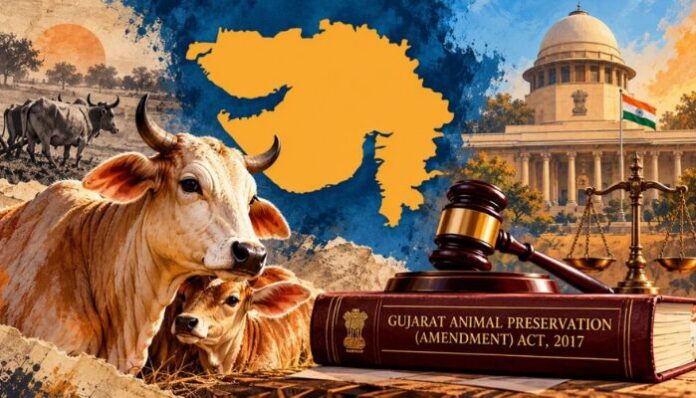
In a major development, a Sessions Court in Gandhinagar convicted 3 men in a 2024 cow slaughter case and sentenced them to life imprisonment. They were identified as Wasim, Mohammad, and Asfaq. A fine of ₹3 lakh was imposed on each of the accused.
While pronouncing the verdict, the court cited the Vedas and sacred scriptures and observed that the cow is like a mother to the universe and its protection is an act rooted in duty and compassion. The court pointed out that if stringent punishments are not imposed to set a precedent in society, the cow could become extinct in India.
While sharing the news on X (formerly Twitter), Minister of State Harsh Sanghavi wrote, “This verdict under the Gujarat Animal Preservation Act sends a clear message that the law will never spare anyone who commits cow slaughter in Gujarat. The protection of Gau Mata is Gujarat’s steadfast resolve.”
3 ગૌહત્યારાઓને આજીવન કેદ! ગાંધીનગર જિલ્લાના જામળા ગામમાં 277 કિલો ગૌમાંસ સાથે રંગેહાથ ઝડપાયેલા ત્રણેય આરોપીઓને કલોલ સેશન્સ અદાલતે આજીવન કારાવાસ અને પ્રત્યેકને ₹3 લાખના દંડની સજા ફટકારી છે. ગુજરાત પશુ સંરક્ષણ અધિનિયમ હેઠળનો આ ચુકાદો સ્પષ્ટ સંદેશ છે ગુજરાતમાં ગૌહત્યા કરનારને કાયદો ક્યારેય નહીં છોડે. ગૌમાતાની રક્ષા એ ગુજરાતનો અડગ સંકલ્પ છે. સચોટ તપાસ અને મજબૂત પુરાવા રજૂ કરનાર ગાંધીનગર પોલીસ તથા સરકારી પક્ષને અભિનંદન. #ગૌરક્ષા #GujaratPolice
— Harsh Sanghavi (@sanghaviharsh) October 29, 2026
The court sentenced the 3 men under Sections 325 (cruelty to animals) and 54 (abettor present when offense committed) of the Bharatiya Nyaya Sanhita, Section 119 of the Gujarat Police Act, Sections 5, 6(A), 6(B), 8(2), and 8(4) of the Gujarat Animal Preservation Act, 2017, Section 11(1)(l) of the Prevention of Cruelty to Animals Act, 1960, and Section 177 of the Motor Vehicles Act.
Courts in Gujarat have previously awarded life sentences to several convicts in cow slaughter cases as well. The basis for these rulings is a statutory amendment enacted by the Gujarat government in 2017. Because courts function strictly under statutory provisions, they cannot award stringent punishments such as life imprisonment without an explicit legal provision.
Gujarat: The only State that allows life imprisonment for cow slaughter
While cow slaughter is banned and regulated by legislation across several Indian states, Gujarat is the only state where the provision exists for punishment with life imprisonment. This provision was introduced in 2017.
In April 2017, the Gujarat government introduced the Gujarat Animal Preservation (Amendment) Bill, amending the original Gujarat Animal Preservation Act of 1954. Before that, several amendments had been enacted over the years, starting in 2011.
Under the Vijay Rupani administration in 2017, the newly amended Animal Preservation Act introduced life imprisonment for cow slaughter.
Even prior to this amendment, cow slaughter and the sale, storage, and transport of beef were already prohibited in Gujarat; however, the penalties were comparatively lighter.
Under the previous statutory framework, cow slaughter carried a prison sentence of three to seven years and a fine of up to ₹50,000. In effect, if an individual was caught, tried, and convicted of cow slaughter, the maximum sentence possible was seven years, with a minimum of three years, and the fine was capped at ₹50,000.
Similarly, the sale, storage, or transport of beef and beef-related products earlier attracted imprisonment of up to three years and a fine of up to ₹25,000. Additionally, authorities impounded any vehicle used to transport such items.
However, under the prior rules, it could not be released until a court order was issued or six months had passed, whichever was earlier. This allowed vehicles to be released either on court orders or upon the completion of six months.
In 2017, the Gujarat government made all these provisions considerably more stringent.
The government enhanced the punishment for cow slaughter from a maximum of seven years to life imprisonment, while the minimum sentence was raised from three years to 10 years. The fine was revised to a minimum of ₹1 lakh and a maximum of ₹5 lakh.
The 2017 amendments by the Gujarat government
Similarly, the penalty for selling, storing, and transporting beef was enhanced from up to three years to a minimum of seven years and a maximum of ten years, with fines ranging from ₹1 lakh to ₹5 lakh.
Furthermore, the earlier provision that allowed impounded vehicles to be released after six months was amended, providing that seized vehicles remain permanently confiscated by the government and cannot be released.
Animal Preservation Act: History and Evolution
The Animal Preservation Act was originally enacted in 1948 for the post-independence Bombay State. Since Gujarat had not yet been separated from Maharashtra at that time, Bombay’s statutes applied across the territory of present-day Gujarat.
In 1954, a new act was introduced and implemented. At that time, there was no total ban on cow slaughter, but regulations required official statutory permission before any bovine animals (cows, buffaloes, calves, bullocks) could be slaughtered.
Specific conditions governed these slaughter permits. Permission could not be granted for any bovine that was useful for agriculture, necessary for breeding, or classified as a milch animal. Permits were granted only for animals outside these categories.
The law also contained a religious exemption: animals over 15 years of age could be cleared for slaughter on religious grounds without requiring verification of their ongoing utility for agriculture or breeding.
Gujarat enacted a blanket cow slaughter ban in 1961
After Gujarat was formed in 1960, the statute remained in force alongside many other existing laws. The following year, in 1961, the Gujarat government enacted an amendment that enforced a total ban on the slaughter of cows.
The Gujarat Legislative Assembly inserted a section into the 1954 Bombay Act providing that no certificate or permission could be issued for the slaughter of a cow under any circumstances. Furthermore, cow slaughter was banned even for religious occasions.
The new clause specified that authorities could process slaughter permits for religious occasions only if the animal was not a cow.
The 1979 Amendment
In 1979, the Gujarat government amended the Animal Preservation Act again, expanding the protected category to include calves. It also prohibited the slaughter of bulls and bullocks below 16 years of age, meaning slaughter permits could only be issued for bulls aged 16 and above.
A parallel rule applied to permits for religious occasions: while cows and calves could not be slaughtered under any religious pretext, the age floor for bulls was set at 15 years, permitting the slaughter of bulls over 15 on religious grounds.
Bulls protected in 1994, Supreme court upheld the law in 2005
In 1994, the state government introduced another amendment extending the blanket ban to bulls and bullocks as well. The rationale provided was that these animals are vital for farming and rural transport. Their dung serves as agricultural manure and fuel for biogas, making them central to the agrarian economy.
This amendment was subsequently challenged in court, particularly the prohibition on slaughtering bulls and bullocks. The Gujarat High Court initially held that older, unproductive animals could be permitted for slaughter, ruling that a total ban infringed upon the fundamental right of butchers and traders to practice their trade. The Gujarat government challenged this ruling before the Supreme Court.
In 2005, a seven-judge Constitution Bench of the Supreme Court upheld the 1994 amendment. The apex court ruled that the protection of bovine progeny is in the public interest and that restrictions imposed under Article 19(6) of the Constitution were valid. The court also upheld the prohibition on slaughter for religious occasions, observing that bovine slaughter is not an essential religious practice and therefore does not violate religious freedoms.
The court noted that the law did not impose a total ban on the meat trade as a whole, but rather protected specific cattle categories on rational grounds.
2011: Curbs on sale, storage, and transport of Beef
Until 2011, there was no dedicated statutory framework prohibiting the sale, storage, or transport of beef. That regulatory gap was addressed when the government enacted provisions completely banning the sale, storage, and transport of beef, making them cognizable offenses. Rules were also introduced prohibiting the night-time transport of bovine animals even for agricultural or authorized purposes.
In 2011, the Gujarat government also enhanced penalties. Since 1954, violations of the act had carried a maximum sentence of only one year. In 2011, the sentence for slaughtering bovine animals was raised to between three and seven years, and the penalty for selling, storing, or transporting beef was set at one to three years.
Finally, the 2017 amendment introduced life imprisonment for cow slaughter and up to 10 years’ imprisonment for beef-related offenses. This 2017 statutory regime remains in force today, providing the legal basis on which courts award life terms in cow slaughter cases.
Previous cases and verdicts
In November 2025, the Amreli Sessions Court sentenced three convicts—Kasim, Sattar, and Akram—to life imprisonment in a cow slaughter case. The court noted that despite knowing the cow is regarded as sacred in Hinduism, the three committed slaughter and hurt the religious sentiments of the community.
The case originated in November 2023, when Amreli City Police raided Kasim’s residence, recovered beef, and arrested the accused. During sentencing, the court noted that adopting a lenient approach would send the wrong signal to society and fail to deter criminal mindsets.
In September 2024, an individual named Afzal Habib from Devgadh Baria was awarded a seven-year sentence for selling beef.
In September 2022, police acting on specific intelligence raided the premises of Afzal Habib Mirza and Hussain Ghanchi, apprehending both red-handed while running a beef trade. Police recovered nine live bovines, approximately 50 kg of beef, and other animals. Law enforcement seized the live animals and meat contraband, arresting the accused before securing a conviction in 2024.
In August 2024, a court in Amreli sentenced a man named Asif to 10 years’ imprisonment after he was caught with 50 kg of beef. Acting on a tip-off, police raided Asif’s residence and recovered 50 kg of beef along with butchering tools.
During the trial, the court observed that the accused was fully aware of the religious significance of cows to Hinduism, yet proceeded with the slaughter, hurting religious sentiments.
The court convicted Asif under IPC Sections 295 and 429, Section 8 of the Gujarat Animal Preservation Act (for violations of Sections 5(1)(c) and 6(b)), and Section 119 of the Gujarat Police Act. He was awarded two years’ imprisonment and a ₹2,000 fine under IPC 295; three years’ imprisonment and a ₹3,000 fine under IPC 429; ten years’ imprisonment and a ₹2 lakh fine under the Gujarat Animal Preservation Act; and two months’ imprisonment under Section 119 of the GPA.
In February 2026, a Godhra court sentenced a father and son, Mehboob and Farhan, to 10 years’ imprisonment each for trafficking beef.
The court noted that despite the explicit statutory prohibition against cow slaughter in Gujarat, the duo procured and transported a large consignment of beef with the intention of retailing it from their residence. The court stated that handing down sentences in line with the 2017 amendments serves the core objective of the legislation, deters such offenses across society, and enforces strict legal accountability against perpetrators.


