

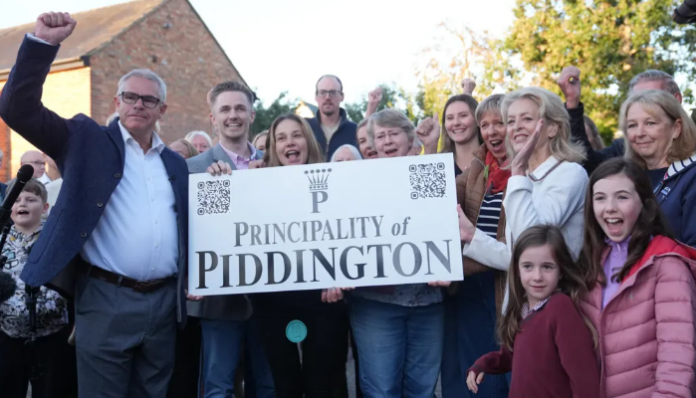
An Oxfordshire community has voted to declare independence from the United Kingdom in protest at the government’s plans to settle asylum seekers at a nearby old military base. Many villagers are upset about the plan, which would allow 1,256 people to relocate to the facility close to Piddington. Hence, they voted in an unofficial and symbolic referendum on 15th September (Tuesday).
The 350 locals were asked to vote in a little box outside Piddington’s village hall, which serves as the community centre. The local parish council orchestrated the referendum, during which 312 votes were cast in total. Of these votes, 285 supported leaving, 26 opposed the measure and one ballot paper was deemed spoiled.
The overwhelming majority decided to “secede from the UK and pursue self-determination.” The result, which was based on 92% turnout, was announced by vice chair of the council Susannah Pardenby on Wednesday morning. She expressed, “We are Piddington, the village that roars.”
Meanwhile, the campaign song, “It’s the battle for Britain, and Britain roars,” played in the background while a sign outside the hall stated the village’s unofficial new name.
The development took place after 96% of Piddington voters supported holding the referendum on 4th July, the 250th anniversary of American freedom. The move was intended to voice the worries about the camp’s threat to the way of life there. According to locals, there would be a nearly four-to-one ratio of male migrants to villagers, which would raise the possibility of criminality.
Oxfordshire County Council leader Tim Beader highlighted, “This referendum shows how strongly they feel about the proposal and that is partly about the proposal itself and partly about the way the government has gone about it, without engaging with local people and looking at the feasibility of the site,” while talking to BBC Radio 4.
“It’s partially about the proposal itself, and partially about how the government has gone about this without engaging with the local community or looking at the feasibility of this site. It’s the wrong site for the local communities, for the asylum seekers themselves, and for the taxpayer.”
According to Piddington parish councillor Joe Marshall, the community could elect leaders for its own “principality” and even design ID cards. He further noted that the forthcoming course of action is going to be based on the government’s response and its willingness to engage with the populace. He emphasised that the primary goal was to inspire other towns “to push for similar things.”
“I think they have (roared) – we have heard it, we are listening. I do really understand that when changes are made that affect your community, it can be very distressing. We inherited an enormous asylum backlog. We are processing claims much more quickly, and we are removing people who don’t have the right to be here. Small boat crossings fell this summer for the first time in many years because of the action we have taken. While we get a grip on the asylum chaos that we inherited, we do need to make sure that we live up to our obligations and house people coming to this country seeking safety,” Culture Secretary Lisa Nandy alleged in a conversation with the BBC.
500 town and village council members and citizens have contacted the parish for suggestions on how to duplicate the campaign, which was supported by the Liberal Democrats, Conservatives, and Reform. Last week, about 133 Piddington women wrote to every female MP, stating that if the plans for the migrant site were to proceed, “life as we know it will be destroyed.” They outlined, “We will not feel safe walking our streets. We are already living in fear.”
Concerned about their safety, the villages have planned to establish security patrols, an emergency alarm system, and a network of wireless CCTV cameras.
On the other hand, the clouds of trouble have been looming over the country, as Scotland, Wales and Northern Ireland have joined hands to secede from the UK. They have even signed an independence pact. The declaration is politically significant for one simple reason: for the first time since devolution began, Scotland, Wales and Northern Ireland are simultaneously led by politicians who favour independence or constitutional separation from the UK.
