

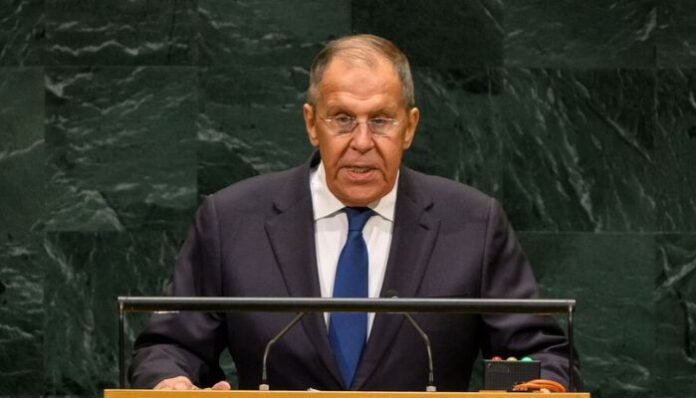
Russian Foreign Minister Sergey Lavrov has backed India’s candidature for a permanent seat on the United Nations Security Council (UNSC), saying any reform of the powerful UN body should give greater representation to Asia, Africa and Latin America.
Speaking at the United Nations General Assembly on Saturday, 26th September, Lavrov said Russia supports both India and Brazil for permanent membership. At the same time, he opposed adding more Western countries, particularly Germany and Japan, to the permanent category.
During his UN address, Russian Foreign Minister Sergey Lavrov backed India’s bid for permanent membership of the UN Security Council, reaffirming Moscow’s support#UNSC #UNGA #Russia #India #Diplomacy pic.twitter.com/4LmIrzQPE3
— WION (@WIONews) September 26, 2026
“We are in favour of broadening the representation of Asia, Africa, and Latin America. We support Brazil’s and India’s candidatures for a permanent seat,” Lavrov said.
He also said the interests of Africa should be taken into account in any reform of the Security Council.
Russia links UNSC reform to Global South
Lavrov said countries of the Global South and East are increasingly acting as independent centres of development. Quoting Russian President Vladimir Putin, he said the “dictatorship of a single hegemon” had become dangerous and argued for a more multipolar global order.
On Ukraine, Lavrov accused Western countries of continuing to supply weapons to Kyiv and helping it target Russia. He also accused European governments of obstructing peace talks between Russia and Ukraine.
“To pursue a utopian goal of containing Russia, the West dismantled the European security system and cultivated a Russophobic regime in Kyiv,” Lavrov said. He further accused European governments of helping Ukraine attack Russian civilians and civilian infrastructure.
Why a permanent UNSC seat is important for India
The UN Security Council currently has 15 members: five permanent members and 10 elected members. The permanent members are the United States, China, France, Russia and the United Kingdom. The five permanent members, known as the P5, have veto power, while the 10 elected members serve two-year terms and do not have veto rights.
The presidency of the Security Council rotates every month among its 15 members. The 10 non-permanent members are elected by the UN General Assembly and are expected to contribute to maintaining international peace and security. The Council also follows the principle of equitable geographical representation.
The veto is one of the biggest powers attached to permanent membership. Any of the five permanent members can block a substantive Security Council resolution or decision. A permanent member can also choose to abstain instead of using its veto.
The veto has been used extensively since the UN Security Council was established in 1945. Russia, including the Soviet Union’s use of the seat, had used the veto 162 times by August 2026, while the United States had used it 95 times. China has used the veto less often overall but more frequently in recent years. France and the UK have not used their veto since 1989.
For India, permanent membership would therefore mean a long-term seat in the body responsible for major international peace and security decisions, along with the veto power currently enjoyed by the P5.
