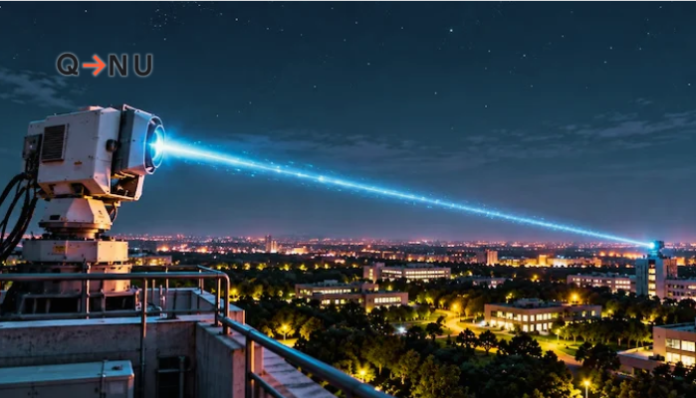
In a major breakthrough, India has successfully demonstrated its first free‑space Quantum Key Distribution (QKD) link at a scale of 5.56 km. QNu Labs collaborated with Bhaskaracharya National Institute for Space Applications and Geo‑informatics (BISAG‑N) and IIT Gandhinagar to achieve this remarkable feat during the field test on the night of 27-28 September 2026 between the BISAG and IIT Gandhinagar sites.
Using QNu’s Pointing, Acquisition and Tracking (PAT) system and its Armos QKD device, the link held a stable Quantum Bit Error Rate (QBER) below 5% and generated secure keys at 230–260 bits per second.
Those keys were fed into BISAG‑N’s post‑quantum cryptography-enabled Vedic Kavach platform, enabling successful end‑to‑end encryption and decryption of test messages, the Ministry of Electronics stated.
The setup couples a hardware quantum channel, Armos over free-space optics, with a software post-quantum layer, so security can continue despite a temporary drop in the optical link.
What a free-space Quantum Key Distribution link means
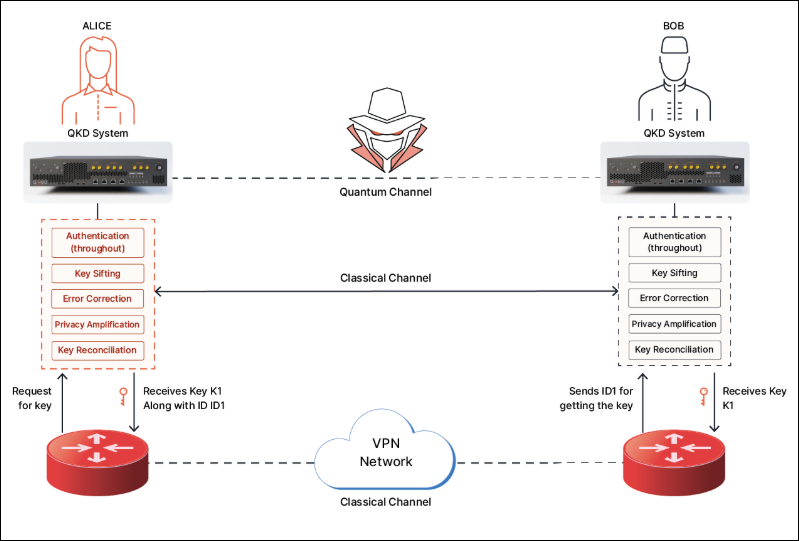
Quantum Key Distribution (QKD) allows two parties to share secret encryption keys whose security rests on quantum mechanics rather than computational hardness.
Under typical prepare-and-measure protocols like BB84, single photons are encoded in polarisation or phase. Attempts to copy or measure them disturb the quantum state; the consequent surge in error rate or Quantum Bit Error Rate (QBER) reveals the eavesdropper. After a clean key is distilled, it is normally utilised with conventional symmetric encryption like Advanced Encryption Standard for the actual data.
In current times, most operational QKD travels via optical fibre. Free-space QKD transmits the same quantum signals as a narrow optical beam through the open atmosphere, removing the need for a fibre span but introducing alignment, turbulence, absorption, and background-light problems.
The transmitter and receiver are locked by the PAT system to ensure that the faint photon stream remains coupled.
The timing of QNu’s QKD trial is interesting. The trial was conducted at night, when solar background is lowest, which is a significant practical constraint for atmospheric links.
It is notable that the reported key rate is the rate at which usable secret key material is produced and not the speed of the encrypted messages themselves.
Standard error-correction and privacy-amplification steps can still extract a secure key if the QBER is below 5%.
From fibre QKD to free-space QKD: Why it matters
In India, Fibre Quantum Key Distribution (QKD) is already being demonstrated over long terrestrial distances, including a reported 1,000 km quantum-secure network earlier in 2026 under the National Quantum Mission. It was free-space QKD that remained a missing piece for links that cannot be cabled, including building-to-building urban hops, mobile nodes, and most strategically significant ground-to-satellite and inter-satellite segments.
For intercontinental quantum-secure key exchange, satellite QKD is the practical route given fibre loss restricts trusted-node or pure quantum links to a few hundred kilometers sans repeaters.
China’s Micius satellite and similar European programmes have already demonstrated space-to-ground QKD; India’s National Quantum Mission ambitiously targets secure quantum communications over 2,000 km, including satellite segments.
A stable multi-kilometre atmospheric link with indigenous hardware and tracking is an essential engineering stepping stone toward the coveted ground stations and terminals.
The dual-layer design, which includes QKD keys, post-quantum cryptography, and quantum random numbers, also indicates a realistic security posture, wherein QKD identifies eavesdropping on the key-exchange channel, while post-quantum algorithms shield against future large-scale quantum computers that could break today’s public-key systems (RSA, elliptic-curve) through Shor’s algorithm.
Notably, Shor’s algorithm is a quantum computer program that detects the prime factors of a large number in polynomial time.
The following are the areas where QKD is applicable
- Transition to unconditionally secure symmetric key generation
- Data Centre (DC) to Data Recovery (DR) Data Transfers
- Quantum security for critical infrastructure
- 5G backhaul using QKD Network
- End-to-End Encryption
How the Modi government is facilitating India’s rise in quantum technologies
The Modi government at the Centre has, over the years, taken serious measures to scale up research and development concerning quantum technology.
In the Budget 2020 speech, Finance Minister Nirmala Sitharaman made a significant announcement for Indian science, stating that, over the next five years, she proposed spending ₹8,000 crore on a National Mission on Quantum Technologies and Applications.
In 2019, India initiated QuEST (Quantum-Enabled Science & Technology), with an investment of Rs 80 crore (around $11 million) over the next 3 years to develop quantum technology.
In April 2023, the Central government approved the National Quantum Mission (NQM) with a budget of Rs 6003.65 crore. The mission will span from 2023–24 to 2030–31.
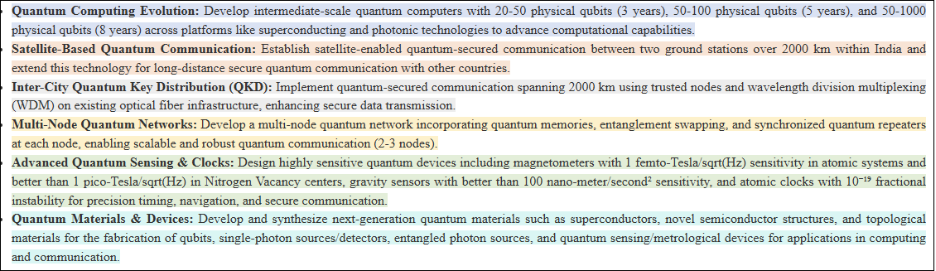
The MQM aims at developing intermediate scale quantum computers with 50-1000 physical qubits in 8 years in various platforms like superconducting and photonic technology. Satellite-based secure quantum communications between ground stations over a range of 2000 kilometres within India, long-distance secure quantum communications with other countries, inter-city quantum key distribution over 2000 km, as well as a multi-node Quantum network with quantum memories are also some of the deliverables of the Mission.
Its key objectives also include development of magnetometers with high sensitivity in atomic systems and Atomic Clocks for precision timing, communications, and navigation. It will also support the design and synthesis of quantum materials such as superconductors, novel semiconductor structures, and topological materials for fabrication of quantum devices. Single-photon sources/detectors and entangled photon sources will also be developed for quantum communications, sensing, and metrological applications.
Development of the following are NQM’s core objectives:
- Quantum Computing Evolution
- Satellite-Based Quantum Communication
- Inter-City Quantum Key Distribution (QKD)
- Multi-Node Quantum Networks
- Advanced Quantum Sensing & Clocks
- Quantum Materials & Devices
In addition to NQM, the Modi government also announced plans to set up four Theintic Hubs (T-Hofbs) in top academic and National R&D institutes on the domains of QuantumComputing, Quantum Communication, Quantum Sensing & Metrology and Quantum Materials & Devices.
In November 2025, one of the startups supported under the NQM of the Department of Science and Technology (DST) successfully demonstrated India’s first extensive Quantum Key Distribution (QKD) network, spanning over 500 kilometers and deployed over existing optical fiber infrastructure.
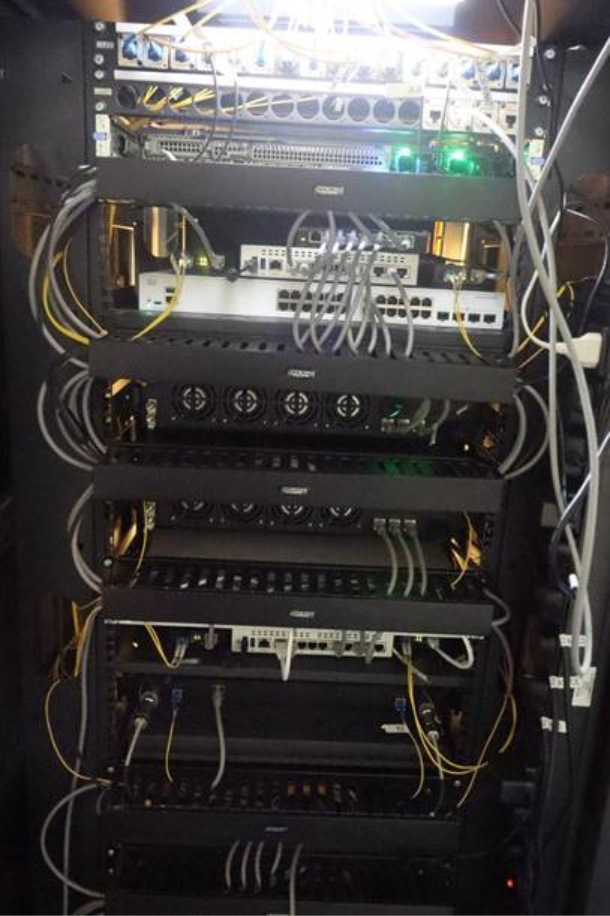
Interestingly, this breakthrough was also achieved by QNu Labs with the Indian Army and its Southern Command contributing significantly to the capability demonstration.
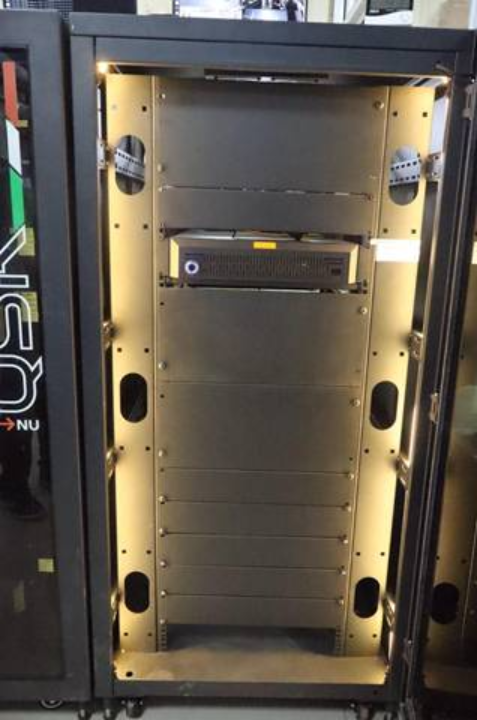
Development of Quantum Technologies in the Indian military domain
To advance the development of Quantum technologies in the Indian military domain, India’s then Chief of Defence Staff Anil Chauhan released the Military Quantum Mission Policy Framework on 22nd January 2026. This framework document includes the policy and the roadmap to implement Quantum Technologies in the Armed Forces.
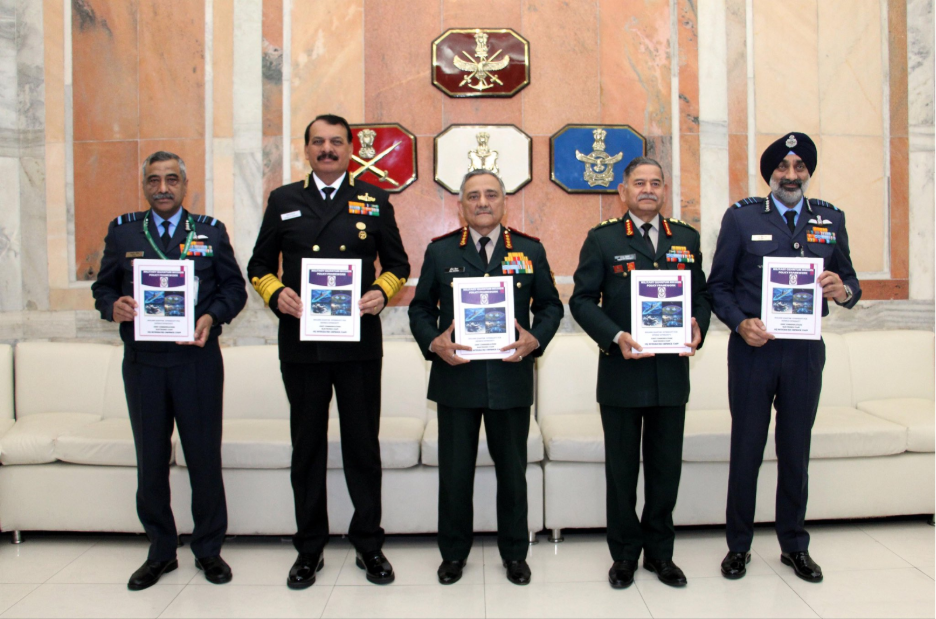
The MQMPF aims to integrate the four pillars of Quantum technologies, Quantum Communication, Quantum Computing, Quantum Sensing & Metrology and Quantum Materials and Devices – into the Tri-Services to empower to prepare for the future battlefield and to achieve technological dominance in the rapidly evolving world.
Before this, in March 2025, the Indian Army and Navy procured indigenously developed QKD solutions and announced quantum-safe communication capabilities.
In July 2026, the Defence Research and Development Organisation (DRDO) announced the successful conclusion of military field trials for a scalable, fibre-based QKD system in collaboration with the Bengaluru-based startup Taqbit Labs.
Moreover, the DRDO has backed a Young Scientists’ Laboratory for Quantum Technologies, which has focused on system- and prototype-level demonstration projects across multiple quantum application fields, which include superconducting quantum computing, atomic magnetometers under sensing, and quantum random number generators under communication.
Conclusion
Previous international experiences demonstrate that pivoting from a few-kilometre night-time trial to operational satellite QKD demands larger apertures, better adaptive optics, higher-efficiency detectors, and extensive link-budget validation. Overall, while it is true that India has a long way to go in the arena of Quantum technologies, the country is headed in the right direction.