

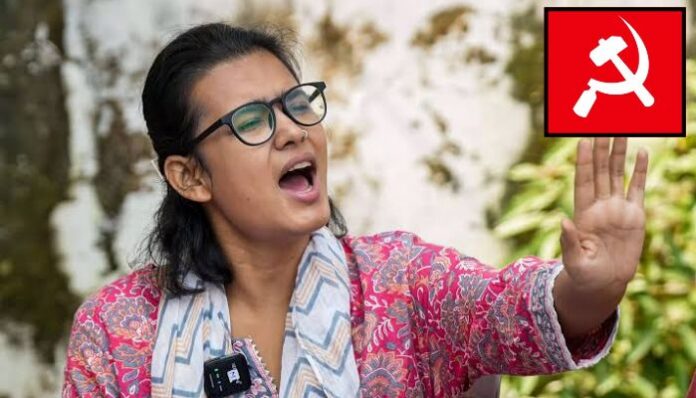
Far-left Anarchist AISA president Neha Bora has triggered a controversy with her recent remarks targeting Hindu religious traditions, Brahmins and temple priests. In a recent interview, Bora spewed venom against Hindus, Brahmins, and Hinduism by selectively quoting and misrepresenting traditional texts. During the discussion, she cited the line, “Gareeb, shoodra, pashu, nari taadna ke adhikari hai”. Emphasising the word “taadan,” she projected her own translation onto it, asserting: “The poor, Shudras, animals, and women are deserving of chastisement.”
She emphasised the word “taadan”, which means chastisement according to her (Her Translation: The poor, Shudras, animals, and women are deserving of chastisement), but her statement is pure propaganda because the Hindi word ‘taadan’ means “To look after/Care”. So the real translation is ” The poor, the Shudras, animals, and women are entitled to care.
Shocked to Listen the Hindu Hate of Neha Bora Without Any Fear. "Pujari rapes women in Temples" "Women needs protection from Brahmans" This women was given stage by Rahul Gandhi. With her Rahul Will Win UP Elections? https://t.co/Cf3tnm7Ssp
— Dear Men (@DearMenLife) November 2, 2026
She further spewed venom in Hindu hate: “Mandiro main pujaari rape karte hai” (Translation: priests commit rapes inside temples); later, she said women, including Brahmin women, are unsafe under what she called the “Brahmanical system”.
She tried to paint an entire class of Hindu religious functionaries as predators. This is not a call for women’s safety. It is a deliberate desecration of the temple as an institution, using the language of feminism as a sham for Hinduphobia.
SC Advocate Amita Sachdeva approaches Delhi Police, seeks FIR against Neha Bora
Following these controversial remarks, Supreme Court advocate-on-record Amita Sachdeva approached the Delhi Police seeking the registration of an FIR against Neha Bora for her damaging assertions regarding temple priests and Hindu traditions.
According to media reports, Sachdeva submitted formal complaints to both the Parliament Street Police Station and the Cyber Police Station in New Delhi on Tuesday, 3rd November. She requested immediate legal action under Section 196 of the Bharatiya Nyaya Sanhita (BNS), 2023, saying that Bora’s public statements were calculated to promote hostility between different groups and disturb public tranquillity.
Speaking to ANI, advocate Amita Sachdeva detailed the rationale behind the legal complaint and said, “Such statements have the potential to create disharmony, hostility and enmity between communities. These individuals seem to believe that no action will be taken against them. However, the law provides remedies to address such statements, and we are fully entitled to pursue appropriate legal action. We will take this matter to its logical conclusion before the Court, just as we have done in the matters involving Rana Ayyub, Dhruv Rathee, Karishma Aziz and several others.”
Neha Bora’s statement alleging that Brahmin women are raped by Pujaris in temples is a sweeping and highly derogatory generalisation against Pujaris as a whole. Such statements have the potential to create disharmony, hostility and enmity between communities. These individuals seem to believe that no action will be taken against them. However, the law provides remedies to address such statements, and we are fully entitled to pursue appropriate legal action. We will take this matter to its logical conclusion before the Court, just as we have done in the matters involving Rana Ayyub, Dhruv Rathee, Karishma Aziz and several others. She must understand that freedom of speech is not absolute and is subject to reasonable legal restrictions. No one is above the law.
— Amita Sachdeva, Advocate (@SachdevaAmita) November 4, 2026
Neha Bora’s political ideology and the history of crimes against women
Neha Bora is the national president of the All India Students’ Association (AISA), a left-wing group associated with the Communist Party of India (Marxist-Leninist) Liberation. The party describes itself as a communist organisation rooted in the Marxist-Leninist tradition and the Naxalbari movement.
Bora adheres to a far-left anarchist ideology that historically projects structural oppression onto traditional institutions while ignoring its own historic record. This political ideology carries a documented worldwide history of violence, systemic abuse, and sexual exploitation against women spanning several decades.
While far-left figures lecture traditional societies on women’s safety, the historical and global execution of communist doctrine reveals a consistent pattern of severe human rights violations against women.
Bantala gang rape case: The horrific 1990 incident in West Bengal
The grim reality of communist-linked violence against women in India has deep historical roots. One of the most disturbing cases associated with the political history of communist-ruled West Bengal is the Bantala rape and murder case of May 1990. On 30th May, 1990, three women health officials and their driver were returning to Kolkata after executing a child vaccination drive in Gosaba when they were ambushed by local CPI(M) cadres in Bantala, an established CPI(M) stronghold near Kolkata.
The victims included Anita Dewan (Deputy District Extension Media Officer), Uma Ghosh (senior official in the West Bengal Health Department), Renu Ghosh (associated with UNICEF and WHO programmes), and their driver, Avni Naiya. Around 6:30 PM, their vehicle was intercepted near a local CPI(M) party office. Fearing for their safety, the driver tried to speed away, but the car overturned. A large mob of CPI(M) goons quickly surrounded the wreckage.
The mob dragged the women out of the vehicle and set the car ablaze. When driver Avni Naiya attempted to defend the women, he was brutally beaten by the mob, suffering 43 injury marks and crushed genitals; he died from his injuries on June 4, 1990, at SSKM Hospital. The three women officers were dragged into nearby paddy fields and gang-raped by CPI(M) goons. Anita Dewan died as a direct result of the assault, while Uma Ghosh and Renu Ghosh survived with critical injuries. Post-mortem reports for Anita Dewan noted extreme physical torture, including a one-foot-long metallic torch inserted into her private part.
Police arrived nearly five hours after the assault began. In the aftermath, the then West Bengal Health Minister Prasanta Sur attempted to shield the perpetrators by claiming the local villagers had merely mistaken the officers for child kidnappers. Adding to the controversy, the then Chief Minister Jyoti Basu dismissed the horrific crime, stating publicly: “Such things keep happening!”
D. Bandopadhyay, former Director of the Asian Development Bank (ADB), later revealed that Anita Dewan was targeted specifically because she had uncovered evidence of large-scale financial corruption and misappropriation of UNICEF rural development funds by CPI(M)-led panchayats in Gosaba.
The terror of Sutia under Communist rule
Another disturbing chapter from communist-ruled West Bengal emerged from Sutia village in North 24 Parganas district during the early 2000s. At the time, the state was governed by the CPI(M)-led Left Front government under Chief Minister Buddhadeb Bhattacharjee.
In Sutia village of Gaighata Block in the North 24 Parganas district, an organised criminal gang headed by Sushanta Chowdhury created an atmosphere of terror, subjecting women to systemic sexual violence. Officially, 33 rapes and 12 murders were recorded, though the actual number was widely believed to be much higher.
The gang enjoyed the patronage of local CPI (M) goons, and anyone who dared protest faced savage retaliation, including multi-week gang rapes targeting entire families. The terror was finally challenged when Barun Biswas, a schoolteacher and social activist, formed the “Sutia Pratibad Mancha” in 2002. Urging citizens to protect their honour, Biswas spearheaded a mass mobilisation that eventually compelled the criminals to surrender, though at an immense personal cost.
Shobha Mandi’s revelations: Sexual exploitation and wife-swapping in Maoist ranks
The exploitation of women within Communists is not limited to parliamentary factions; it is equally prevalent inside underground Maoist networks. In her published memoir Ek Maowadi Ki Dairy, former Jhargram area commander Shobha Mandi documented widespread abuse, sexual exploitation, and enforced wife-swapping within high-ranking Maoists.
Mandi detailed how she was subjected to continuous sexual assault by senior commanders over seven years. Despite taking her grievances to top leadership figures, including guerrilla leader Kishanji, her complaints were ignored. Mandi further disclosed that pregnant female cadres were routinely forced to undergo abortions, as leadership viewed motherhood as a threat to combat readiness and operational mobility.
Jharkhand, Odisha and Bihar: Women Maoist cadres expose sexual exploitation inside the organisation
The allegations of sexual exploitation within Maoist organisations are not limited to West Bengal. Women cadres who surrendered from Maoist groups operating in Jharkhand, Odisha, Bihar, Maharashtra and other Left-Wing Extremism (LWE)-affected states have disclosed instances of rape, molestation and forced marriages by senior male cadres.
A particularly revealing incident came to light during a Border Security Force (BSF) operation in January 2012. During a search operation at a Maoist hideout in the Niliguda forest area under Podia police station in Odisha’s Malkangiri district, security personnel recovered a large number of pregnancy test kits, condoms and contraceptive pills.
Similar recoveries were reportedly made in other states. The government statement also referred to cases in which women Maoist cadres who became pregnant were forced to undergo abortions against their wishes. Even married women were prevented from having children because the Maoist leadership considered motherhood incompatible with their responsibilities as guerrilla fighters.
Nepal’s Maoist insurgency: Women suffered sexual violence during the civil war
The history of sexual violence associated with communist armed movements is not confined to India. Nepal’s decade-long civil war between government security forces and the Communist Party of Nepal (Maoist) also left thousands of victims of human rights abuses.
During the decade-long civil war in Nepal between government forces and the Communist Party of Nepal (Maoist) [CPN-M], which resulted in over 13,000 deaths, human rights bodies documented extensive sexual violence. Female cadres and civilian women in rural areas were subjected to physical abuse and rape by Maoists whenever communities refused to comply with party demands or supply food and shelter. Security personnel sexually assaulted female Maoist combatants after arrest and targeted female relatives of suspected Maoist supporters.
Another dark chapter in the history of communist rule concerns the Soviet Union’s Gulag labour camp system. The Gulag forced-labour camp system in the Soviet Union exhibited routine sexual violence against female political prisoners. Historical accounts and memoirs document how female prisoners were stripped of their clothing by criminal syndicates, subjected to extreme violence, and gang-raped within the camp transportation networks and barracks under the supervision of state guards.
Sexual violence under communist regimes: A pattern stretching across countries and decades
The history of sexual violence under communist regimes and armed movements extends far beyond India, Nepal and the Soviet Union. From Cambodia to China and Eastern Europe, women have faced sexual abuse, forced marriages and exploitation under political systems that claimed to fight inequality and establish a more just society.
Mass rapes by the Red Army (1944–1945): During the final stages of World War II, advancing Soviet Red Army troops engaged in mass sexual violence across Europe. Historical research estimates that over 2 million German women and young girls were raped. Similar widespread assaults occurred during the Soviet occupation of Hungary (where an estimated 50,000 women were assaulted in Budapest alone), Poland, and Manchuria.
The Khmer Rouge in Cambodia: Following the takeover in April 1975, the Communist Party of Kampuchea instituted forced mass marriages. Women who refused forced sexual relations were routinely executed or gang-raped by party cadres as political punishment.
China’s Land reform campaigns: Documented accounts of the Chinese Communist Party’s early land reform initiatives show that local party cadres frequently committed sexual assaults against women of targeted landlord classes, with historical estimates running into hundreds of thousands of incidents.
Modern insurgencies: Armed left-wing insurgencies, including the New People’s Army (NPA) in the Philippines, the Shining Path in Peru, and FARC in Colombia, have faced repeated international investigations for systematic sexual abuse, forced coercion, and rights violations against women within their territories.
Conclusion: The contradiction between revolutionary claims and the treatment of women
When evaluated against global and domestic history, the statements made by Neha Bora reflect a familiar political strategy. While so-called communist leaders utilise modern academic terminology to criticise Hindu traditions, priests, and temples, the broader political ideology they represent has historically produced systemic violence and exploitation against women on a global scale.
Bora attempts to target Hindus, Brahmins, and temple institutions under the guise of progressive feminism; the ideological family she represents carries a multi-decade, worldwide record of severe sexual exploitation, brutality, and violence against women. From the atrocities of Bantala and Sutia in West Bengal to internal abuse inside Maoist cadres and historical Red Army campaign excesses, the ideological tradition behind these movements reveals a persistent pattern. The targeting of Hindu traditions by far-left anarchists stands in sharp contrast to the documented history of their own political ideology.


