On 5th October (Monday), Chief Justice of India Surya Kant stated that the Supreme Court had not sanctioned any modification to Form 6. The Election Commission of India (ECI) had earlier clarified that the additional declaration attached to the voter enrolment form during the Special Intensive Revision (SIR) had been upheld by the apex court.
Since then, however, the opposition ecosystem, led by the Indian National Congress, has sought to portray the development as validation of its unfounded allegations against Chief Election Commissioner (CEC) Gyanesh Kumar and the Modi government, accusing them of acting in collusion to benefit the Bharatiya Janata Party (BJP) and spreading misinformation over the sensitive subject.
Rahul Gandhi went a step further during an I.N.D.I. Alliance protest, threatening, “What has been done to the country is treason. Be it Prime Minister Narendra Modi, Amit Shah, Mohan Bhagwat or Gyanesh Kumar, none will be spared.”
More than 300 Opposition MPs marched from Parliament to the Election Commission today to meet the Election Commissioners. We represent crores of Indians. – Why aren’t the Election Commissioners meeting us? – Why is the police stopping and threatening us? https://t.co/tlIck8WoZX
— Rahul Gandhi (@RahulGandhi) October 6, 2026
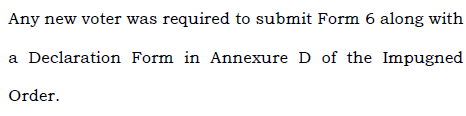
As a political script unfolds and the opposition attempts to exploit the issue to save its fast-eroding political space, it needs to be recounted that the Supreme Court not only upheld the ECI’s authority to conduct the Bihar SIR but also conveyed that a person applying for registration as a new voter was required to submit Form 6 along with Annexure D in an earlier ruling on 27th May by a two-member bench of CJI Surya Kant and Justice Joymalya Bagchi.
The court stated, “Through the deliberate insertion of Section 21(3) in the RP (Representation of the People Act), the legislature has affirmatively vested the Commission with the power to direct a special revision in such manner as it may think fit.” It added that the basis of the arguments of the petitioners regarding complete field occupation is significantly undermined whenever Parliament itself use such wording and thus establishes a discretionary domain for the Commission.
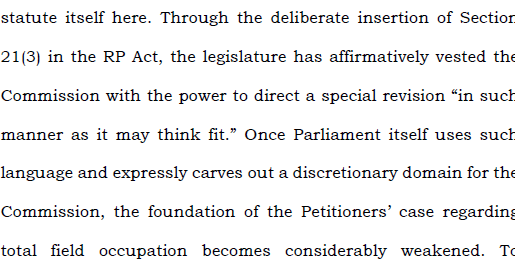
The court noted that Section 21(3) is a conscious attempt by the legislature to provide the Commission with the power to conduct SIR of the electoral records, which is different from the ordinary revision framework and beyond the limits set by Section 21 (2).
The court conveyed that the “opening non-obstante clause unequivocally disengages the exercise from the impediments imposed on the ordinary revision mechanism under Section 21(2) and hints at a legislative intent to create an unfettered source of authority.”
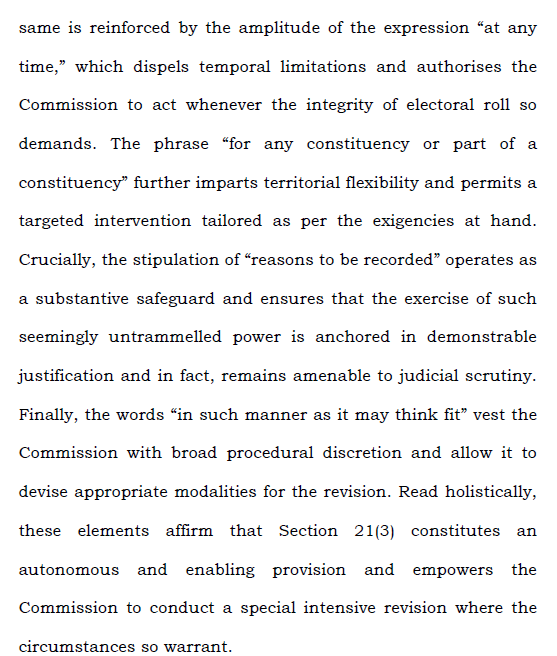
It was also pointed out that this was affirmed by the expression ‘at any time,’ which eliminates temporal restrictions and enables the Commission to take action whenever the integrity of the electoral roll requires it.
“The phrase ‘for any constituency or part of a constituency’ further imparts territorial flexibility and permits a targeted intervention tailored as per the exigencies at hand,” the court mentioned.
It remarked that the need for ‘reasons to be recorded’ functions as a substantive protection and guarantees that the use of such ostensibly unrestricted power is based on verifiable reasoning and continues to be subject to judicial review.
The bench emphasised that the Commission is allocated extensive procedural discretion ‘in such manner as it may think fit,’ enabling it to create suitable revision proceedings.
It then declared, “Read holistically, these elements affirm that Section 21(3) constitutes an autonomous and enabling provision and empowers the Commission to conduct a special intensive revision where the circumstances so warrant.”
ECI granted an independent source of power
The petitioners argued that the non-obstante clause in Section 21(3) cannot be interpreted to afford the Commission unrestricted discretion by negating the responsibilities of the preceding sub-section and the RP Act’s organised framework. However, the court countered that the argument presented by the respondents on the precise extent and impact of the non-obstante clause had merit.
It had highlighted that “the Commission retains a degree of residual authority to formulate an appropriate documentation framework suited to the exigencies of a Special Intensive Revision.”
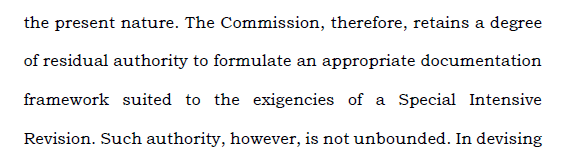
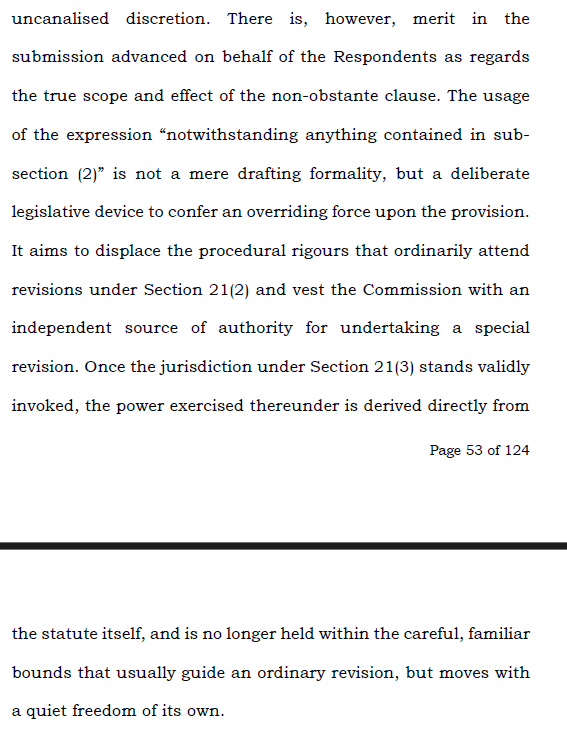
The court observed, “The usage of the expression ‘notwithstanding anything contained in subsection (2)’ is not a mere drafting formality, but a deliberate legislative device to confer an overriding force upon the provision. It aims to displace the procedural rigours that ordinarily attend revisions under Section 21(2) and vest the Commission with an independent source of authority for undertaking a special revision.”
It stressed that the authority used under Section 21(3) is taken straight from the statute itself after it is duly invoked and no longer operates within the cautious, recognisable constraints that usually steer an ordinary revision, but rather “moves with a quiet freedom of its own.”
The verdict read, “As regards the expression ‘in such manner as it may think fit,’ the petitioners contend that since sub-sections (1) and (2) of Section 21 mandate preparation and revision of electoral rolls in the prescribed manner, sub-section (3) can, at best, be understood as permitting only a limited procedural flexibility, albeit within the confines of the RP Act and the 1960 Rules.”
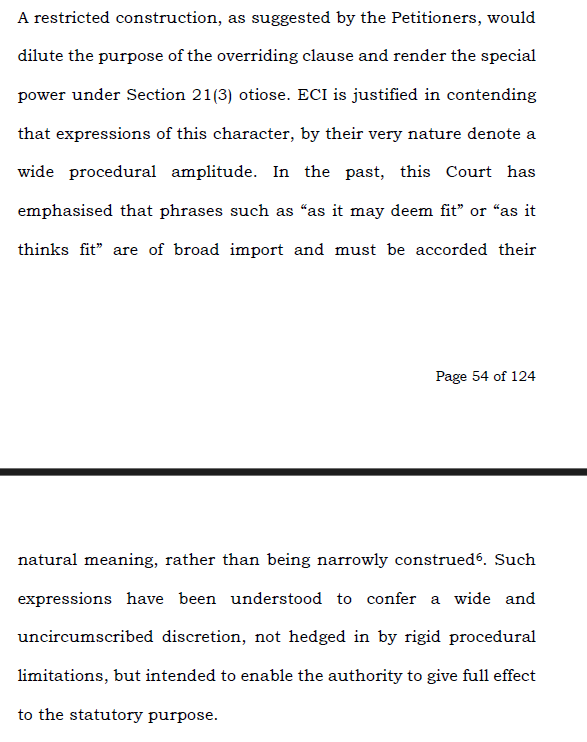
However, the respondents argued that the term was very important and meant to lend the Commission the capacity to modify the special revision process to suit the circumstances. The court also agreed that “a restricted construction, as suggested by the petitioners, would dilute the purpose of the overriding clause and render the special power under Section 21(3) otiose.”
The bench sided with the ECI and termed it right for countering that wording of this nature reflected a broad procedural amplitude by definition, remarking, “In the past, this court has emphasised that phrases such as ‘as it may deem fit’ or ‘as it thinks fit’ are of broad import and must be accorded their natural meaning, rather than being narrowly construed.”
It also announced, “Such expressions have been understood to confer a wide and uncircumscribed discretion, not hedged in by rigid procedural limitations, but intended to enable the authority to give full effect to the statutory purpose.”
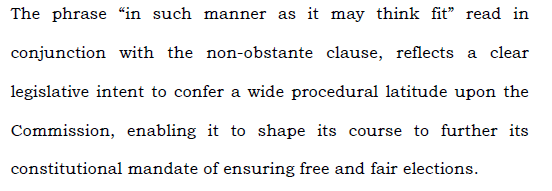
The court reiterated that the phrase ‘in such manner as it may think fit’ when read in connection with the non-obstante clause implied a clear legislative intent to hand over broad procedural liberty to the Commission. The objective is to empower it to guide itself to accomplish its constitutional obligation to ensure free and fair elections.
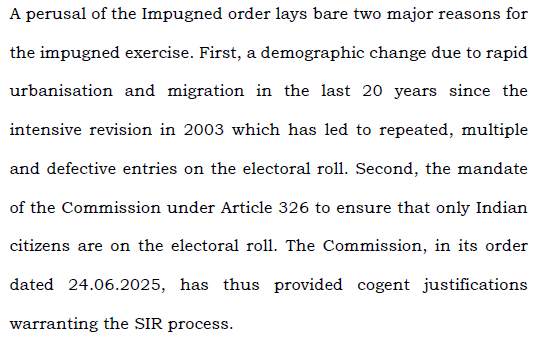
Furthermore, the court listed two reasons provided by the Commission in its order and outlined, “First, a demographic change due to rapid urbanisation and migration in the last 20 years since the intensive revision in 2003, which has led to repeated, multiple and defective entries on the electoral roll. Second, the mandate of the Commission under Article 326 to ensure that only Indian citizens are on the electoral roll,” calling them “cogent justifications warranting the SIR process.”
Supreme Court outlines pressing need for SIR, expresses satisfaction with ECI’s work
In addition, the bench decided in favour of the Commission on matters of whether the order explicitly flouted the RP Act and the 1960 Rules and if it undermines the constitutional principle of free and fair elections.
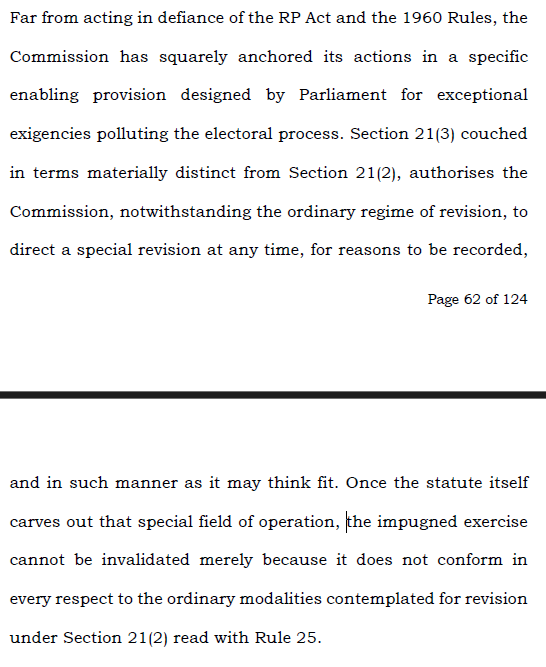
It stated, “Far from acting in defiance of the RP Act and the 1960 Rules, the Commission has squarely anchored its actions in a specific enabling provision designed by Parliament for exceptional exigencies polluting the electoral process.”
Notwithstanding the regular regime of revision, Section 21(3), set forth in a manner quite distinct from Section 21(2), allows the Commission the discretion to initiate a special revision at any time, for reasons to be documented, and in any way it considers suitable.
The exercise cannot be treated as invalid simply because it is not entirely in line with the standard procedures considered for revision under Section 21(2) read with Rule 25 “once the statute itself carves out that special field of operation.”
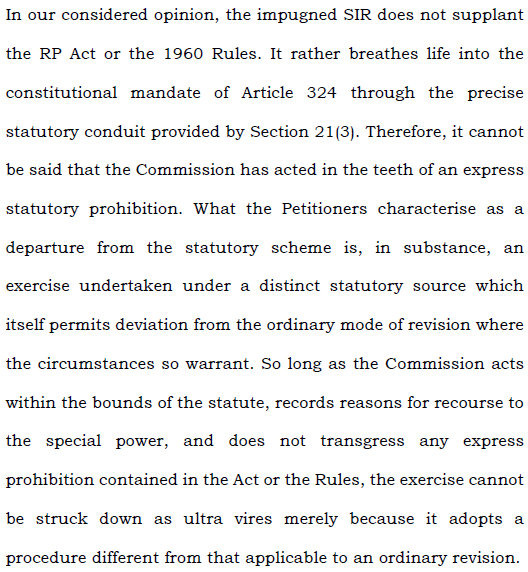
The bench mentioned, “In our considered opinion, the impugned SIR does not supplant the RP Act or the 1960 Rules. It rather breathes life into the constitutional mandate of Article 324 through the precise statutory conduit provided by Section 21(3). Therefore, it cannot be said that the Commission has acted in the teeth of an express statutory prohibition.”
The court further stated that what the petitioners claimed as a departure from the statutory scheme is actually an action executed under a separate statutory source, which itself facilitates a divergence from the standard manner of revision where the circumstances justify it.
It pronounced that the exercise cannot be classified as ultra vires (outside legal power) simply because it adopts a procedure that differs from that applicable to an ordinary revision, provided that the Commission conducts itself within the parameters of the statute, maintains reasons for recourse to the special power, and is not in breach of any explicit prohibition imposed by the Act or the Rules.
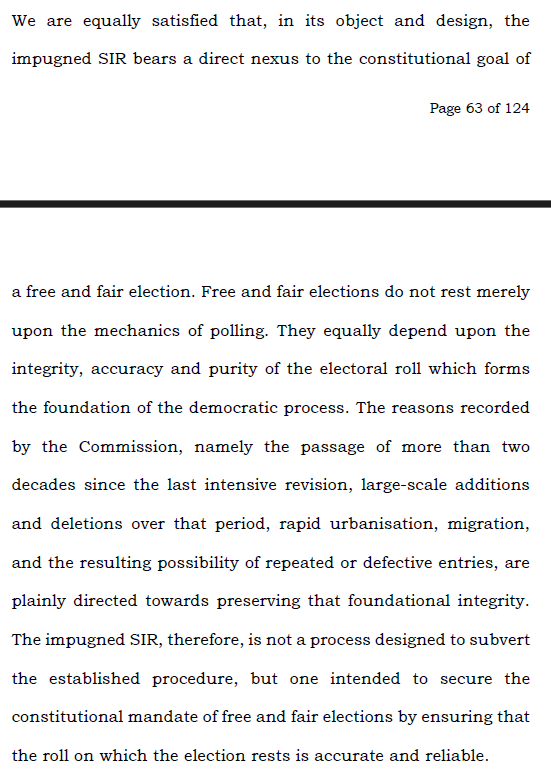
The court voiced its satisfaction with SIR’s mission and design, which are closely linked to the constitutional objective of a free and fair election. It emphasised that the integrity, precision, and purity of the electoral roll, which serves as the cornerstone of the democratic process, are just as important to free and fair elections as the procedures of polling.
It highlighted, “The reasons recorded by the Commission, namely the passage of more than two decades since the last intensive revision, large-scale additions and deletions over that period, rapid urbanisation, migration, and the resulting possibility of repeated or defective entries, are plainly directed towards preserving that foundational integrity.”
The court referred to SIR as a mechanism devised to uphold the constitutional mandate of free and fair elections by ensuring the accuracy and dependability of the roll on which it is founded and not an instrument of undermining the existing process.
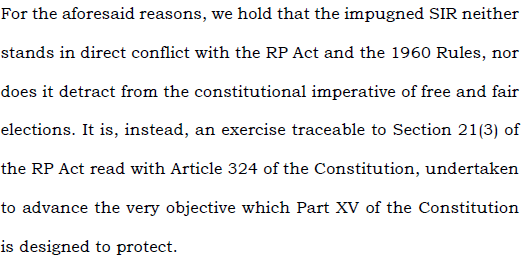
Afterwards, the bench conveyed, “For the aforesaid reasons, we hold that the impugned SIR neither stands in direct conflict with the RP Act and the 1960 Rules, nor does it detract from the constitutional imperative of free and fair elections. It is, instead, an exercise traceable to Section 21(3) of the RP Act read with Article 324 of the Constitution, undertaken to advance the very objective which Part XV of the Constitution is designed to protect.”
Exercise grounded in constitutional principle, statutory design
According to the bench, the prescribed objective was to ascertain that all eligible voters were included in the electoral roll and that all ineligible individuals were excluded, as it explored the exercise’s legal purpose and pointed to the order regarding SIR in Bihar.
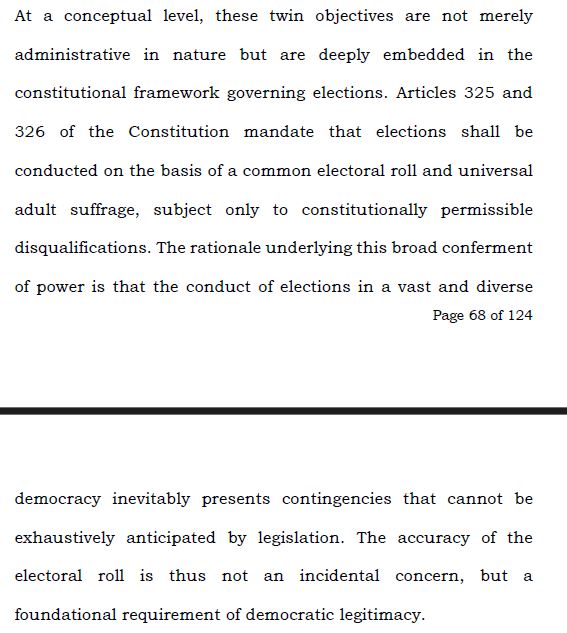
It stated that these two goals are fundamentally ingrained in the constitutional framework governing elections and are not solely administrative in character. The court added that elections must be held using a common electoral roll and universal adult suffrage, subject only to disqualifications allowed by the Constitution, pursuant to Articles 325 and 326.
The bench conveyed, “The rationale underlying this broad conferment of power is that the conduct of elections in a vast and diverse democracy inevitably presents contingencies that cannot be exhaustively anticipated by legislation. The accuracy of the electoral roll is thus not an incidental concern, but a foundational requirement of democratic legitimacy.”
It expressed that the establishment and maintenance of electoral rolls must be recognised as a dynamic and continuous responsibility since these are not static records and must adapt to changes in eligibility, population, and place of residence. It acknowledged that the notion of electoral equality is immediately impacted by any structural error in the roll, whether by a wrong inclusion or exclusion.
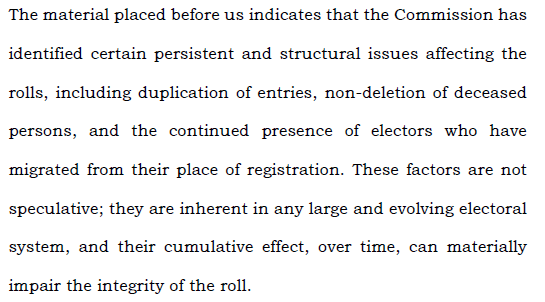
The court conveyed, “The material placed before us indicates that the Commission has identified certain persistent and structural issues affecting the rolls, including duplication of entries, non-deletion of deceased persons, and the continued presence of electors who have migrated from their place of registration. These factors are not speculative, they are inherent in any large and evolving electoral system, and their cumulative effect, over time, can materially impair the integrity of the roll.”
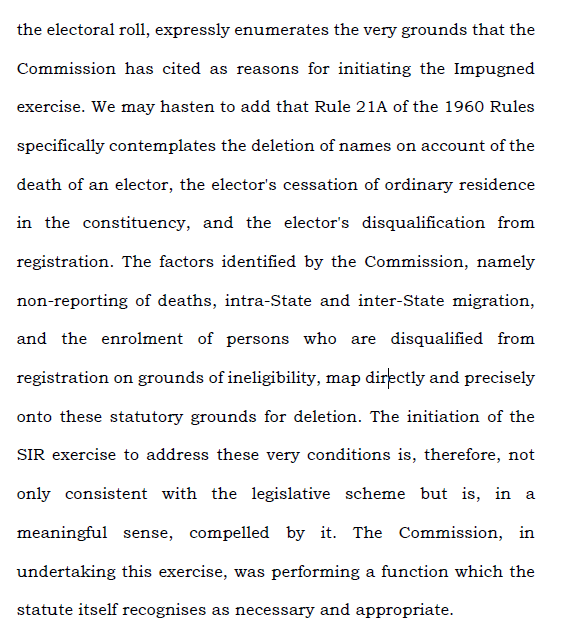
The court determined that the governing statutory framework itself sufficiently recognises these contingencies. It added that Rule 21A of the 1960 Rules, which oversees the procedure for removing names from the electoral roll, expressly lists the same justifications that the Commission provided as reasons for commencing the exercise.
It was emphasised that the rule expressly considers the removal of names in the event of an elector’s death, termination of regular residence in the constituency, or disqualification from registration.
The bench pointed out that the statutory reasons for deletion are concisely and directly mapped onto the factors that the Commission evaluated, including non-reporting of deaths, intra-state and inter-state mobility, and the enrolment of persons who are ineligible for registration.
“The initiation of the SIR exercise to address these very conditions is, therefore, not only consistent with the legislative scheme but is, in a meaningful sense, compelled by it. The Commission, in undertaking this exercise, was performing a function which the statute itself recognises as necessary and appropriate,” it declared.
In light of the fact that more than 20 years had passed since the last such exercise, the court advised that a decision to undertake an extensive review after a protracted interval should be regarded in this context. It expressed, “A system that relies exclusively on summary revisions over such an extended period may reasonably be expected to accumulate inaccuracies that cannot be effectively addressed through incremental corrections.”
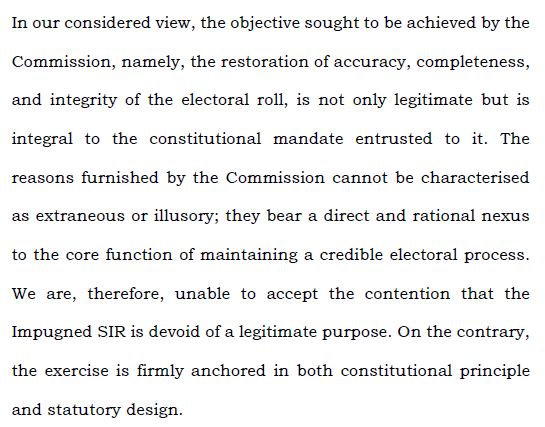
The bench conveyed, “In our considered view, the objective sought to be achieved by the Commission, namely, the restoration of accuracy, completeness, and integrity of the electoral roll, is not only legitimate but is integral to the constitutional mandate entrusted to it.”
It explained that the rationales provided by the Commission have an obvious and logical connection to the primary goal of supporting an honest voting process and cannot be described as superfluous or illusory. It therefore concluded that the argument that the SIR has no valid function cannot be accepted. On the other hand, the exercise is deeply embedded in both legislative design and constitutional principles.
SIR for purity and accuracy of electoral roll
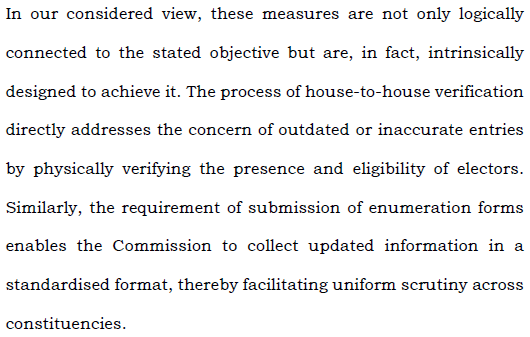
The court restated that the goal of the procedure is to ensure that eligible voters are included and unlawful people are removed to restore the accuracy and integrity of the electoral roll. It added, “The measures adopted to effectuate this object include, inter alia, a structured house-to-house enumeration, the requirement of submission of enumeration forms, and the verification of eligibility on the basis of prescribed documentation.”
According to the court, these actions are not only logically related to the original objective, but they are also inherently intended to accomplish it. It was noted that by personally confirming the presence and eligibility of electors, the house-to-house verification approach addresses the issue of out-of-date or incorrect entries.
The court further noted that the Commission could gather current information in a common format by requiring the completion of enumeration forms, which makes it easier for constituencies to be scrutinised consistently.
The bench stressed, “It is equally significant that the Impugned exercise does not operate in isolation but is embedded within a broader procedural framework that includes scrutiny by designated officers, issuance of notice in cases of doubt, and the availability of appellate remedies.”
It then stated, “These procedural safeguards reinforce the rational connection between the means adopted and the objective sought to be achieved by ensuring that the process of verification is neither arbitrary nor unguided.”
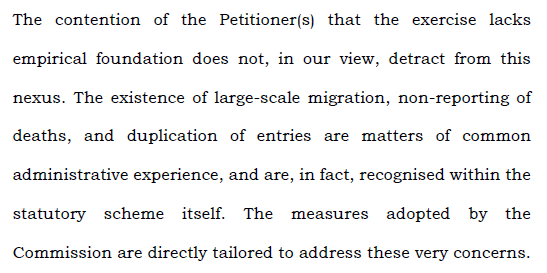
The court pronounced that this relation is not compromised by the submission that the exercise has no empirical substance, as the statutory scheme itself acknowledges the occurrence of large-scale migration, non-reporting of deaths, and duplication of entries as a result of common administrative experience. It added that the Commission’s actions have been tailored to deal with these problems.
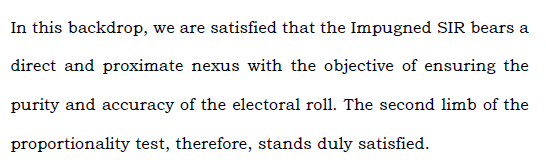
As a result, it announced, “In this backdrop, we are satisfied that the Impugned SIR bears a direct and proximate nexus with the objective of ensuring the purity and accuracy of the electoral roll. The second limb of the proportionality test, therefore, stands duly satisfied.”
Conclusion
The opposition and its supporters want to run propaganda against the ECI and the ruling party over the SIR drive. However, the Supreme Court’s observations cannot be overlooked amid the political brouhaha.
SIR was considered highly necessary to cleanse the voter list, as the court expressed its satisfaction while endorsing the steps undertaken by the Commission to strengthen the democratic process in accordance with the Constitution.
It further highlighted the Commission’s independent source of authority and identified Form 6 as an integral component of the procedure, noting that the latter possesses residual power to establish a documentation framework adapted to the requirements.