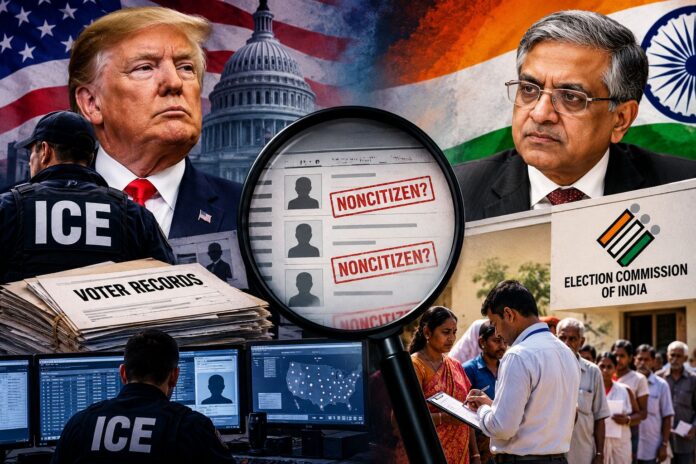
For months, India’s Opposition has attempted to turn the Special Intensive Revision (SIR) of electoral rolls into a political controversy. Opposition parties have repeatedly alleged that the exercise could exclude genuine voters and have sought to portray voter-roll verification as an attack on democracy.
But an interesting development in the United States offers a rather different perspective.
The United States government has launched an extensive operation to scrutinise voter-registration records, investigate suspected illegal registrations and identify cases involving people who may not have been eligible to vote. The exercise is being driven in significant part by Homeland Security Investigations (HSI), the investigative arm of US Immigration and Customs Enforcement (ICE).
The scale of the operation is striking.
According to internal documents reviewed by CNN, HSI described its undertaking as a phased national initiative involving voter-roll acquisition, data analysis, investigative leads and field investigations. Investigators had ingested 50.6 million records from a Justice Department dataset and another 48.4 million records obtained from what officials described as independent sources.
In other words, the world’s most powerful democracy is not treating voter rolls as untouchable documents that cannot be scrutinised.
It is doing precisely the opposite: collecting data, comparing records, identifying anomalies and investigating cases where officials believe electoral laws may have been violated.
What exactly is ICE doing?
It is important to understand that ICE itself is a large federal law-enforcement agency, while Homeland Security Investigations is one of its investigative components. HSI normally deals with serious transnational crimes such as human trafficking, drug smuggling, organised crime, financial crimes and document fraud.
Its involvement in election-related investigations represents a significant deployment of federal investigative resources.
It was reported in September that HSI had launched what internal guidance described as a “coordinated criminal voter fraud surge initiative.” The operation involved pursuing investigative leads, conducting field interviews and supporting prosecutorial review. Offices in nine states were assigned investigative leads, including Washington, Wisconsin, Missouri, Georgia, California, Pennsylvania, Nevada, New York and Connecticut.
The operation was not limited to checking whether somebody’s name appeared on a voter list.
Investigators were examining voter-registration data and following leads that could potentially result in criminal investigations. HSI was also communicating with election officials and examining whether people who were not eligible to vote had registered or cast ballots.
The distinction is important because the US system, like India’s, has multiple layers of voter eligibility and registration requirements. Therefore, identifying a questionable record does not automatically mean that fraud has occurred. A discrepancy is a lead to be investigated, not proof of wrongdoing.
And the American operation illustrates precisely why verification matters.
Tens of millions of records under scrutiny
The documents reveal the enormous data infrastructure being used by the US administration.
HSI had access to tens of millions of records and was using data analysis to identify potential investigative leads. The operation also involved voter-roll information from several states.
The US Department of Homeland Security has also been seeking access to voter rolls from states for auditing purposes. CNN reported that DHS had pushed states to share their voter-registration lists, while HSI investigators were being tasked with following potential fraud leads.
The purpose, according to the administration, is straightforward: identify people who may have registered or voted despite being legally ineligible.
That includes investigations involving alleged non-citizen registration and voting.
Internal records show that HSI was looking beyond individual voters as well. Investigators examined voter-registration organisations and nonprofits in states including Pennsylvania and New Jersey. They also developed what internal documents described as a “network-based investigative approach”, looking at organisations and possible facilitation networks rather than simply examining isolated individual cases.
Some of these investigations produced no evidence of wrongdoing. That is itself significant.
The documents say investigators found no derogatory information on dozens of New Jersey organisations, found no suspicious financial activity in another nonprofit review and closed an Ohio inquiry after exhausting investigative leads.
This demonstrates an important principle of any serious verification exercise: flagging a record for investigation is not the same as declaring somebody guilty.
ICE is also examining immigration records
The US operation becomes particularly interesting because HSI can draw upon the federal government’s extensive immigration databases.
The internal documents show that investigators distributed more than 1,500 leads generated from immigration records to field offices across the country. By late May, HSI had opened 418 voter-fraud cases and made 64 administrative arrests, although hundreds of the cases had not been referred for prosecution at that stage.
ICE lawyers have also issued guidance concerning the immigration consequences of unlawful voting by non-citizens. The guidance stated that, under certain immigration provisions, a conviction may not be required for unlawful voting to have immigration consequences.
HSI has even been examining whether people who subsequently became naturalised American citizens had registered to vote or voted before obtaining citizenship. This was among the areas receiving investigative attention.
The administration has therefore constructed an extensive system in which voter-registration records can be compared with immigration information and other government data, with questionable cases sent for further investigation.
So what does this have to do with India’s SIR?
This is where the political debate in India becomes interesting.
India’s SIR is not the same thing as America’s HSI investigations. SIR is an electoral-roll revision conducted through India’s election machinery, whereas HSI is a federal law-enforcement agency pursuing suspected violations of US law.
But the underlying democratic principle is remarkably familiar.
Both exercises begin with the recognition that the integrity of an election depends, among other things, on the integrity of the electoral roll.
If a person has died, moved permanently, been registered twice, is otherwise ineligible, or is not entitled to vote under the applicable law, there has to be a mechanism for identifying and correcting the record.
That should not be controversial in any democracy.
Indeed, the American example makes one question particularly difficult to ignore: if the United States can deploy federal investigators, vast databases and field investigations to scrutinise voter registrations, why should the mere act of reviewing electoral rolls be presented in India as inherently anti-democratic?
Interestingly, US President Donald Trump has himself recently pointed to India’s election system as a model for strengthening electoral safeguards in America. In August 2026, Trump publicly cited a conversation involving Chief Election Commissioner Gyanesh Kumar, saying Kumar had questioned how the US could conduct elections without requiring a valid photo ID.
Trump highlighted India’s voter-identification system and the scale of its 2024 general election while renewing his call for the SAVE America Act, which seeks stricter proof-of-citizenship and voter-ID requirements for federal elections.
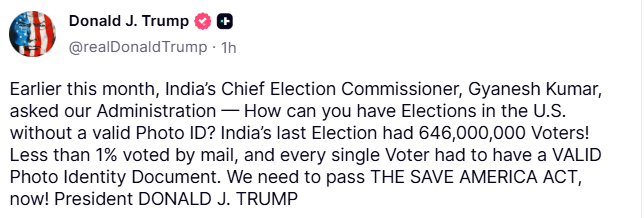
The significance is hard to miss. While India’s Opposition has been portraying SIR and the Election Commission’s voter-roll verification efforts as inherently suspect, the US President was simultaneously pointing to India’s electoral safeguards while arguing that America should strengthen its own system.
This does not make the two countries’ electoral processes identical, but it does undermine the suggestion that rigorous voter verification is somehow incompatible with a modern democracy. India’s Ministry of External Affairs welcomed Trump’s statement, stating that the credibility and robustness of India’s election machinery are globally recognised.
Verification is not disenfranchisement
There is, of course, a legitimate concern whenever voter lists are revised: genuine voters must not be arbitrarily removed.
That principle applies equally in India and the United States.
But the answer to that concern is better verification, transparent procedures, opportunities to submit claims and objections, and due process; not abandoning voter-roll revision altogether.
Even the American investigation illustrates this distinction. Investigators have pursued leads, but several inquiries have produced no evidence of wrongdoing and were closed.
The existence of a verification mechanism does not mean every person flagged by it is guilty. It means the electoral system has a mechanism to distinguish legitimate voters from potentially ineligible registrations.
That is precisely how a serious democracy should function.
The irony of the Indian debate
The irony, therefore, is that while India’s Opposition has sought to portray SIR as uniquely sinister, the United States, often presented as the gold standard of liberal democracy, is simultaneously undertaking an enormous voter-registration scrutiny exercise of its own.
America has gone further in some respects, with federal law-enforcement agencies analysing tens of millions of records, pursuing investigative leads, interviewing people and examining organisations suspected of facilitating illegal registration.
This does not prove that every aspect of the American approach is correct, nor does it mean that India and America have identical electoral systems.
It proves something much simpler.
Reviewing voter rolls is not inherently undemocratic.
In fact, democracies worldwide recognise that elections cannot be credible if nobody ever checks who is actually registered to vote.
The real democratic safeguard is not an electoral roll that is never questioned.
It is an electoral roll that is accurate, periodically verified and subject to transparent correction, with genuine voters protected throughout the process.
India should therefore be able to conduct SIR without treating every verification exercise as an assault on democracy.
And perhaps the American example provides the simplest answer to the political noise surrounding the issue: a democracy does not weaken itself by checking its voter list. It strengthens the credibility of the mandate by ensuring that the electoral roll reflects those who are actually entitled to cast a ballot.