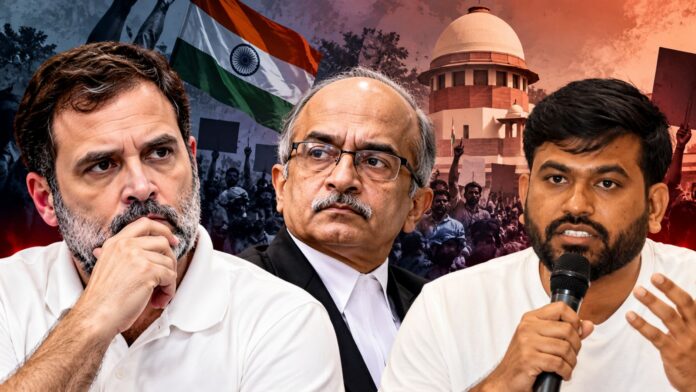
The Opposition’s campaign against Chief Election Commissioner Gyanesh Kumar has exposed an interesting spectacle of political opportunism, competing egos and selective solidarity. The Congress, which viewed the Cockroach Janta Party (CJP) as an Aam Aadmi Party (AAP) proxy, has now reached out to the same outfit through lawyer-activist Prashant Bhushan. CJP leader Dipke, however, was reportedly not particularly enthusiastic about the overture.
There is a lesson here for all three parties to this little political drama: Congress, CJP and Prashant Bhushan. None emerges from this episode looking particularly principled.
Let us begin with the Congress.
The grand old party reportedly kept a close watch on CJP’s October 10 protest against CEC Gyanesh Kumar in Delhi. Its assessment was that CJP had failed to mobilise a sufficiently large crowd, unlike the protests at Jantar Mantar in June and July. A section of the Congress leadership also reportedly viewed CJP as an offshoot or front of AAP, with concerns that it could occupy political space that the Congress would rather control itself.
Yet, within days, the Congress was attempting to establish contact with CJP through Bhushan.
What changed? Did the Congress suddenly develop confidence in CJP’s political credentials? Did it discover some extraordinary ideological affinity with the outfit? Or did it simply conclude that every additional organisation protesting against the CEC could help its campaign?
The last explanation appears the most plausible.
Rahul Gandhi declared on Monday that all protests against the CEC were part of one movement and that the Congress would support anyone defending the Constitution, regardless of the political formation they belonged to. On paper, this sounds like a reasonable appeal for Opposition unity. In practice, however, the reported outreach to CJP raises questions about the Congress’s earlier assessment of the organisation.
If CJP was merely an AAP proxy, as sections of the Congress leadership reportedly believed, why was its participation suddenly desirable? And if CJP was a legitimate political formation capable of contributing to a common cause, why was the party so concerned about the political space it might occupy?
The Congress cannot have it both ways. It cannot dismiss a rival formation when it fears competition and then seek its cooperation when doing so becomes politically convenient.
The party’s problem is not merely that its overture reportedly received a lukewarm response. It is that its conduct reinforces the impression that its appeals for Opposition unity are often subordinate to calculations about who gets to lead, who gets visibility and who gets credit.
CJP wants political relevance but cannot escape questions about its own motives
CJP, meanwhile, should not mistake the Congress’s reported outreach for a political victory.
The outfit has emerged as a recent phenomenon in the Opposition ecosystem and has sought to establish its identity through protests against everything under the sun. From resignation of the Education Minister to the resignation of the CEC, it appears that resignation is the currency on which CJP operates. And this currency is fuelled by the ‘blackmailing’ and holding the nation hostage through disruptive protests.
CJP has every right to organise demonstrations, criticise the government and demand accountability, but it must also accept that its political positioning and methods will attract scrutiny.
According to the report, Congress believed that CJP had failed to mobilise the numbers it had hoped for during its October 10 protest. The protest was disrupted by a substantial security deployment and police action, with an estimated 7,000 people detained across Delhi. The circumstances make it difficult to draw definitive conclusions about CJP’s mobilisation capacity from that episode alone.
Nevertheless, the organisation faces a basic question: does it want to function as an independent political force, or does it want to become part of a larger Opposition campaign whenever doing so offers greater visibility?
Its decision to stay away from the INDIA bloc’s march to the Supreme Court on Monday suggests that it was not prepared to participate in that particular programme. That is its prerogative. But if CJP insists on maintaining an independent political identity, it must be prepared to build its own support base rather than depend on the recognition or endorsement of established Opposition parties.
There is also an uncomfortable irony in the organisation’s position. If CJP resents being viewed as an AAP proxy, it must demonstrate that its political decisions are driven by its own priorities rather than by the calculations of another party. Independence cannot be established merely by refusing an invitation from the Congress. It must be demonstrated through consistent political positions, transparent objectives and an ability to mobilise supporters on its own terms.
At the same time, CJP should not be expected to join every Opposition programme simply because Congress or Rahul Gandhi calls for unity. A common cause does not require every organisation to surrender its identity. The point is that CJP cannot simultaneously seek recognition as an independent political force and treat every question about its political positioning as illegitimate.
Why is Prashant Bhushan being used as the intermediary?
Then there is Prashant Bhushan, whose reported role as an intermediary adds another layer to this political spectacle.
According to The Indian Express, the Congress approached Bhushan and asked him to reach out to Dipke. Sources close to Bhushan confirmed that a request came in, though the circumstances made direct coordination difficult: Dipke was in Maharashtra, while senior CJP leaders Ashutosh Ranka, Saurav Das and Ajinkya Shinde were in police custody.
Bhushan is a “lawyer-activist” who has frequently been associated with political and civil society campaigns. He has long been a fervent critic of the Modi government, often amplifying fake news and blatant lies before quietly deleting them after being called out. His name also came up as the facilitator of the meeting of the characters currently charged with orchestrating the bloody anti-Hindu riots in Delhi in 2020.
But the episode raises a legitimate question about the political networks and individuals who project themselves as intermediaries that emerge around such campaigns. When a party that reportedly suspects a new organisation of being a rival’s proxy seeks to approach it through an “activist” who operates in overlapping Opposition circles, it becomes difficult to separate the language of a common cause from the practical business of political networking.
If the objective was simply to convey an invitation, there is little to criticise about the act of mediation itself. The larger question is whether the participants are interested in building a coherent campaign around clearly defined demands or merely coordinating whenever their immediate interests overlap.
An intermediary can bring people to the same table. He cannot manufacture ideological consistency where none exists.
Kejriwal’s snub avenged?
There is also a delicious irony here, given how Congress treated Arvind Kejriwal in 2019. Ahead of the Lok Sabha elections, Kejriwal had desperately sought an alliance with the grand old party, arguing that the anti-BJP vote should not be divided. “Humare mann mein desh ko lekar bahut zyada chinta hai… Usi wajah se hum lalayit hain. Unhone lagbhag mana kar diya hai,” he said on February 14, 2019, effectively admitting that Congress had almost rejected his overtures.
The remark became a political meme, immortalising the humiliation of a party chief seeking an alliance with a Congress that was not particularly interested. Nearly seven years later, the tables appear to have turned. Congress, which reportedly viewed CJP as an AAP proxy, is now reaching out through Prashant Bhushan, only to encounter a lukewarm response from Abhijit Dipke. Did CJP just deliver Congress its own “unhone lagbhag mana kar diya” moment?
Opposition unity or a convenient political arrangement?
Rahul Gandhi’s subsequent condemnation of the arrests of CJP leaders further demonstrated the Congress’s willingness to extend public solidarity to the organisation. On Wednesday, he declared that waving the Tricolour at Jantar Mantar during a peaceful protest was not a crime and described the jailing of young protesters as an act of cowardice.
Dipke thanked Gandhi for speaking out against the arrests and later called for Tiranga marches, including one at Central Park in Delhi’s Connaught Place on Friday, October 16.
These exchanges may help the two sides find common ground. But public messages of solidarity do not resolve the underlying tensions between competing Opposition formations. Nor do such exchanges whitewash the fact that CJP leaders were arrested not for unfurling the Tiranga but because they intended to protest at a site that was denotified as a protest site. However, truth hardly matters when the goal is to build opportunistic alliances and wrest power from the democratically elected entity.
The INDI bloc is supposed to bring together parties that disagree on numerous political questions but cooperate against a common opponent. It is obvious that removing the Modi government from power is the glue that is keeping these disparate elements together. Otherwise, there is no vision or ‘concern for democracy’ that has brought them together.
The problem arises when the language of constitutional principles becomes inseparable from calculations about political ownership. If every protest is one movement, as Gandhi argues, then the Congress must be willing to recognise the autonomy of other organisations even when they do not participate in its programmes. Equally, CJP must accept that independence brings responsibility and that it cannot demand recognition without demonstrating sustained political credibility.
And Bhushan, like other activists who facilitate these interactions, should be judged by the substance of the causes he supports rather than by his proximity to political figures. He should also be judged for subsequent violence and disruptions such associations and alliances may cause.
There is a distinction between cooperating on a specific demand and pretending that all participants share the same political objectives. The former is practical politics; the latter is often little more than messaging.
The Congress wants to lead the Opposition. CJP wants to establish itself as a political force in its own right. Activists such as Bhushan operate in the space where these ambitions intersect. Their interests may occasionally align, but that does not automatically make them a coherent movement.
Ultimately, the reported outreach and the lukewarm response tell us less about a sudden political realignment than about the transactional nature of Opposition politics. The Congress appears willing to approach a formation it reportedly viewed with suspicion. CJP appears unwilling to be drawn into a programme on the Congress’s terms. And Bhushan has reportedly been asked to help bridge the divide.
Everyone is entitled to pursue their political objectives. But none should be allowed to disguise political calculations as unquestionable moral virtue.
If the campaign against the CEC is genuinely about constitutional principles, its participants should be able to explain their demands, defend their methods and cooperate without pretending that their competing ambitions have magically disappeared. If the CEC is compromised, which all three actors — CJP, Prashant Bhushan, and Congress—believe, then why can’t they explain how the same CEC presided over Opposition victories in Punjab, Karnataka, Kerala, and Telangana?
Until then, the spectacle of the Congress courting CJP, CJP maintaining its distance and Bhushan being asked to facilitate contact looks less like a united political movement and more like a negotiation over who gets to occupy the Opposition’s increasingly crowded stage.