

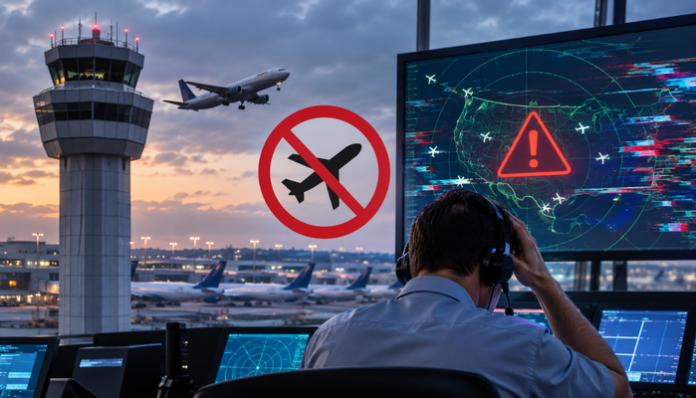
The US aviation network experienced a rare nationwide flight operations shutdown on Friday (November 13, 2026) following an air-traffic-control (ATC) communications failure. The US Federal Aviation Administration (FAA) suspended all flight departures at around 3:53 p.m. ET after an ATC glitch, and the suspension remained in effect for about 4 hours.
The flight shutdown, which was the longest such nationwide shutdown since the 9/11 terror attack, affected around 1,000 flights carrying over 1.5 million passengers that had been scheduled to depart shortly after. Flights already in the air were given clearance to land and some international flights were also permitted to depart before the restrictions were lifted at t 8:15 p.m. ET.
Flights delayed, passengers stranded
The sudden flight restrictions left thousands of passengers stranded at the airports. Over 6,600 flights were cancelled and around 8,600 delayed. Besides, around 1,500 flights scheduled for Sunday were also cancelled. Following the flight shutdown, Homeland Security Secretary Markwayne Mullin and Transportation Secretary Sean Duffy addressed the media on the situation. Mullin ruled out that the disruption was the result of a cyberattack or any other threat.
Transportation Secretary Sean Duffy attributed the shutdown to a data overload in the FAA’s legacy network. Duffy said that switches and routers in the network were suddenly overloaded with data, leading to an ATC communications failure.
Secretary Mullin and Secretary Duffy Brief Members of the Press on the FAA Ground Stop https://t.co/uyvQ5bVOvb
— The White House (@WhiteHouse) November 14, 2026
“Our switches, our routers actually got overloaded with data, and they started to give us inconsistencies in the data from those routers, and because of that we shut the system down,” Duffy said. However, he added that the communication was not completely out, which is why the aircraft in the air could be safely landed.
Duffy said that the shutdown was caused by ageing telecommunications infrastructure. “What we have is an incredibly old air traffic control system. It’s an old system that went down and went down everywhere. It got overloaded,” he said.
The disruptions in one of the world’s busiest aviation networks came a day after the White House and Department of Transportation urged Congress to approve $30.1 billion to upgrade the country’s ageing airports and air traffic control infrastructure.
An ageing aviation communication network
Reports highlight that much of the US ATC communications system is outdated, which was a major factor behind the flight disruption. As per Reuters, in 2024, the Government Accountability Office reported that the FAA reviewed more than three-quarters of the air traffic control systems. It classified 51 of 138 air traffic control systems as unsustainable and another 54 as potentially unsustainable.
Earlier in September, FAA Administrator Bryan Bedford also reportedly highlighted the same problem. Bedford said that over 300 air traffic facilities across the country operate as fragmented systems. He said that the systems rely on decades-old computers and telecommunications systems that cannot communicate seamlessly with one another. A similar glitch happened in January 2023, when a failure of the FAA system responsible for distributing critical safety notices to pilots halted departures for less than two hours and disrupted more than 10,000 flights.
In July 2025, Congress approved $12.5 billion to upgrade the country’s air traffic control infrastructure, including telecommunications and radar systems. But Bedford said that merely replacing the old infrastructure with a new one would not suffice; a modern telecommunications network is required.
