

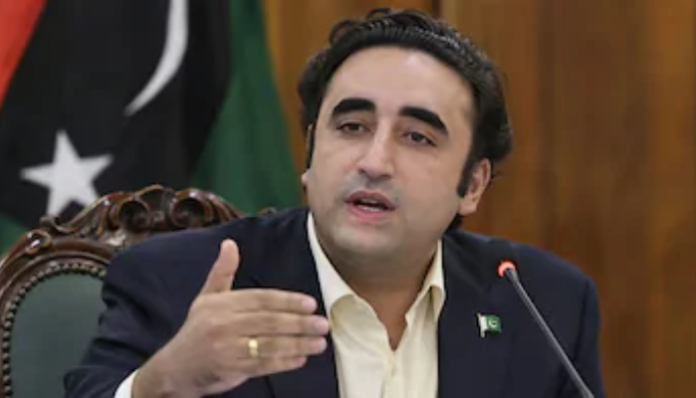
Pakistan Peoples Party (PPP) Chairman Bilawal Bhutto-Zardari has warned that “blood will flow” on the streets of Karachi if Sindh is divided by force. It opened a fierce political front against a government-backed plan to redraw Pakistan’s provincial map and create new provinces through a referendum.
Bilawal said, “If Sindh is divided by force, questions will be asked about the blood that flows on the streets of Karachi.” On Tuesday at the Karachi Press Club event, he said, “I do not want to see that bloodshed.” He further warned the streets would see “blood, not garbage,” and that any violence would not remain confined to a single city or a single death. He named Hyderabad and other parts of Sindh as potential flashpoints.
The controversy erupted over a proposal by Pakistani Interior Minister Mohsin Naqvi. The proposal called for holding a referendum on creating new provinces. Naqvi first floated the idea in early November, arguing that Pakistan’s existing administrative structure had “collapsed” and that the public should have a direct say in redrawing provincial boundaries. The proposal has been widely interpreted in Sindh as a precursor to carving out new units from the province. It includes Karachi and Hyderabad. Bilawal’s PPP sees it as an existential threat to its political heartland. PPP has governed Sindh continuously since 2008.
If anyone tries to divide Sindh, everyone will take up arms. There will be bloodshed everywhere, in every city, and brothers will kill brothers. — Bilawal Bhutto https://t.co/RntYMzXg6J
— برهان الدین | Burhan uddin (@burhan_uddin_0) November 17, 2026
Bilawal’s opposition is rooted in three interlocking objections. First, he argues that the referendum proposal is an attempt to bypass the Constitution. Under Article 239(4). It says that altering a province’s boundaries requires a two-thirds vote in the relevant provincial assembly, followed by a constitutional amendment in Parliament. A referendum, legal experts say, is “neither parallel to nor a substitute for” that process. Bilawal asked, “If you are looking for an unconstitutional method, how can the PPP be with you?” He accused the government of seeking a backdoor route to division.
Second, he says the move is being driven by coercion rather than consent. The PPP chairman insists his party is not blanket-opposed to new provinces in principle. If it is created through constitutional, democratic and legal procedures. It should reflect people’s wishes. Bhutto says, “Where we are opposing, it is over force and coercion. We do not want division through force.” He pointed out that neither Parliament nor the federal cabinet had debated the proposal. He claimed that he and President Asif Ali Zardari had not been consulted. “If the prime minister cannot control his own minister, then the system is heading towards collapse,” he remarked.
Third, Bilawal frames the warning as a sober reading of Sindh’s political history. Karachi and urban Sindh were scarred by ethnic violence from the mid-1980s through the 1990s. This led to the rise of MQM (Muttahida Qaumi Movement). Muhajirs and Sindhis fought each other, leaving thousands dead. Bilawal explicitly invoked that history, saying he was “sounding the alarm, not issuing a threat”. He warned that forcibly dividing the province could push ordinary people to take up arms. Unrest will spread across Karachi, Hyderabad, Mirpur Khas, Tando Allahyar and Nawabshah.
The federal government and its allies have pushed back sharply. Information Minister Attaullah Tarar said the debate on provinces “cannot be stopped” and dismissed Bilawal’s bloodshed warning as beyond understanding. He called a referendum the best way to ascertain the public’s will. Defence Minister Khawaja Asif insisted that no political system could be changed without public support. Health Minister Mustafa Kamal said that Bilawal would be held responsible if “even a single drop of blood is shed”.
On Wednesday, Bilawal said, “It appears they have decided to pick a fight with me for speaking the truth.” He dared the government to hold an open debate on the issue.
The standoff has exposed a rare public rupture within the ruling coalition. PPP is a key partner in that, with 74 seats. Bilawal is willing to confront the Shehbaz Sharif government and the military establishment over Sindh’s boundaries. It signals that the PPP is facing an existential challenge to its power base. PPP is prepared to mobilise street-level sentiment rather than concede quietly.
