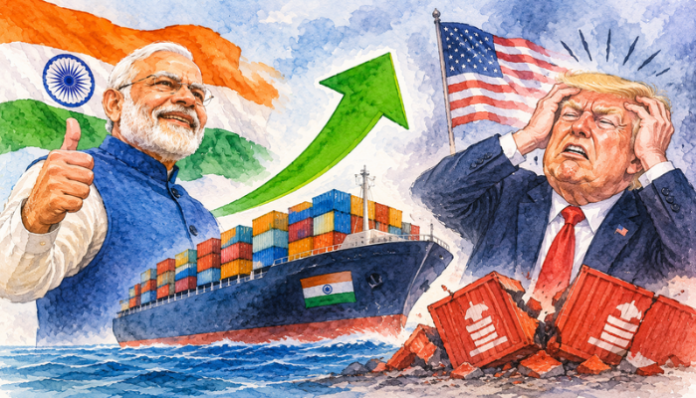
India’s merchandise exports to the United States rose 11 per cent year-on-year to USD 50.80 billion in April–September FY27, up from USD 45.73 billion in the same period a year earlier, according to Department of Commerce data presented on 13 November. The performance is striking not because the number is exceptional, but because it came through a period of sustained tariff hostility from Washington that, at its peak, saw Indian goods facing a 50 per cent duty in the US market.
The tariff fiasco: From verbal attacks to a February reset and then more uncertainty
The turbulence began almost as soon as the second Trump administration settled in. In February 2025, President Donald Trump announced a “reciprocal” tariff architecture under which the US would charge Indian goods the same rates India levied on American products, and the two sides agreed to work toward a limited trade deal with a target of doubling bilateral trade to USD 500 billion by 2030.
But the political theatre that accompanied the tariff war was as much a war of words as it was of duties. White House trade adviser Peter Navarro stated, “It was a shame to see Modi getting in bed, as a leader of the biggest democracy in the world, with the two biggest authoritarians in the world in Putin and Xi Jinping. That doesn’t make any sense. I’m not sure what he’s thinking, particularly since India has been in a cold war, and sometimes a hot war, with China for decades. We hope the Indian leader comes around to seeing that he needs to be with the US, Europe as well as Ukraine and not Russia.”
He branded India the “maharaja of tariffs” and accused New Delhi of operating as an “oil money laundromat” for the Kremlin. Writing in the Financial Times, Navarro described India’s oil trade as “opportunistic” and “corrosive,” arguing that India “keeps slamming the door on American exports through high tariffs and trade barriers” even as Western taxpayers foot the bill for Ukraine’s defence. He later claimed he had been “firebombed” by Indians online for his remarks.
Commerce Secretary Howard Lutnick framed the failure to close a trade deal as a personal snub. He claimed the agreement was “all set up” but fell apart because Prime Minister Narendra Modi was “uncomfortable” making a direct call to Trump, suggesting the tariff escalation stemmed as much from bruised ego as from trade mathematics.
Lutnick also publicly warned that unless New Delhi reduced its tariffs, India could face a “tough time”. A subsequent book recounted that Trump had exploded at Lutnick inside the White House, dismissing official USTR tariff data as “bullshit numbers” and insisting India’s duties on American goods were at least 175 per cent.
Treasury Secretary Scott Bessent was more measured but no less pointed. He defended the 25 per cent Russia-linked penalty as a success, stating flatly: “We put 25% tariffs on India for buying Russian oil. And the Indian purchases, by their refineries, of Russian oil have collapsed. That is a success”. He also criticised Europe for refusing to impose similar tariffs on India, accusing “virtue-signalling European allies” of prioritising a trade deal with New Delhi over pressure on Moscow.
And Trump himself set the tone from the top. He called India a “tariff abuser” and the “tariff king,” and in a Truth Social post announcing the 25 per cent tariff, he wrote: “I don’t care what India does with Russia. They can take their dead economies down together, for all I care”. He also repeatedly claimed credit for brokering a ceasefire between India and Pakistan through trade pressure, a claim New Delhi firmly rejected.
In July 2025, instead of announcing the expected trade deal, he imposed a 25 per cent tariff on Indian goods; by August, that had been raised to 50 per cent, with a 25-percentage-point “penalty” component explicitly linked to India’s continued purchases of Russian oil. India termed the tariffs “unfair” and vowed to defend its national interests.
Then came the pivot. On 2 February, 2026, after a phone call between Trump and Prime Minister Narendra Modi, the US announced a trade deal cutting tariffs on Indian goods from 50 per cent to 18 per cent, in exchange for India halting Russian oil purchases and lowering trade barriers. A joint statement and an interim framework followed, and the White House issued a fact sheet on 9 February detailing sector-level gains.
Through it all, the bilateral trade agreement itself has remained a work in progress. A US delegation was in New Delhi on 2-3 November 2026 for talks on customs procedures and trade facilitation; Commerce and Industry Minister Piyush Goyal has said most discussions are concluded, and the two sides are fine-tuning the remaining details.
Commerce Secretary Rajesh Agrawal said talks are “on the right track,” with a first tranche targeted for completion by the end of the financial year. Crucially, the US has now assured India of a comparative tariff advantage over competitors, a demand Indian officials had made a precondition for signing.
The broader picture: exports are not just surviving; they are diversifying
India’s combined merchandise and services exports for April–September FY27 are estimated at USD 476.20 billion, up 13.84 per cent from USD 418.31 billion in H1 FY26, according to provisional PIB data. Merchandise exports alone stood at USD 259.89 billion, a rise of 18.51 per cent year-on-year. Non-petroleum merchandise exports grew 15.56 per cent to USD 218.70 billion.
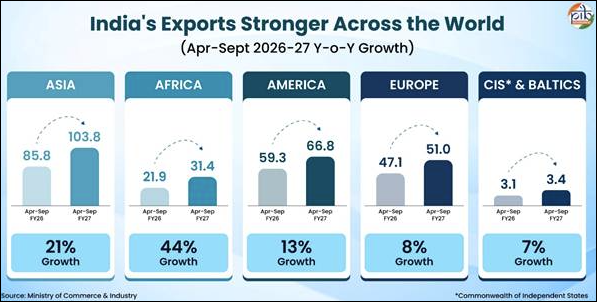
The growth is geographically broad-based. Exports to the Americas as a whole rose 13 per cent to USD 66.82 billion. Beyond the US, Brazil (up 14 per cent to USD 4.33 billion), Mexico (up 26 per cent to USD 3.45 billion) and Canada (up 18 per cent to USD 2.67 billion) all recorded double-digit increases.
Exports to Europe rose 8 per cent to USD 51.04 billion, with the UK up 7 per cent and Germany up 12 per cent, supported by the India–UK Comprehensive Economic and Trade Agreement that came into force on July 15, 2026, granting zero-duty access for nearly 99 per cent of Indian exports to the UK. Africa was the fastest-growing major region, with exports up 44 per cent to USD 31.42 billion, while Asia rose 21 per cent to USD 103.84 billion.
Sectorally, the September 2026 data showed electronic goods exports up 70.44 per cent, petroleum products up 31.90 per cent, organic and inorganic chemicals up 24.21 per cent, engineering goods up 20.91 per cent, and cotton yarn and handloom products up 20.76 per cent.
The February 2026 tariff rationalisation has been particularly consequential for textiles and apparel, where duties fell from 50 per cent to 18 per cent, with silk securing zero-duty access into a USD 113 billion US market; machinery tariffs also dropped to 18 per cent, opening opportunities in a USD 477 billion market, and USD 1.36 billion of agricultural exports received zero additional duty.
The competitive differential matters. While India’s effective tariff rate has come down, competitors continue to face elevated duties: China at 35 per cent, Vietnam at 20 per cent, Bangladesh at 20 per cent, and Malaysia, Indonesia, the Philippines, Cambodia and Thailand at 19 per cent. That gap has given Indian exporters a price advantage that partly explains why shipments to the US grew even while the tariff regime was being rewritten month by month.
The road ahead
The immediate outlook hinges on the finalisation of the bilateral trade agreement’s first tranche. The US assurance of comparative advantage is significant, but the final tariff structure remains linked to the outcome of Washington’s second Section 301 investigation, launched in March 2026, covering 60 economies including India and examining forced-labour practices. A further investigation into excess capacity could also trigger additional duties.
For now, the numbers suggest that India’s export machine has absorbed the tariff shock better than many feared. The 11 per cent rise in US-bound shipments achieved against a 50 per cent peak tariff, verbal broadsides from the Oval Office, a Supreme Court ruling, a temporary global tariff, a “forced labour” levy and an ever-shifting negotiation is a data point that policymakers in both capitals will find hard to ignore. Whether it survives the next round of tariff uncertainty is the question that will define FY27’s second half.