

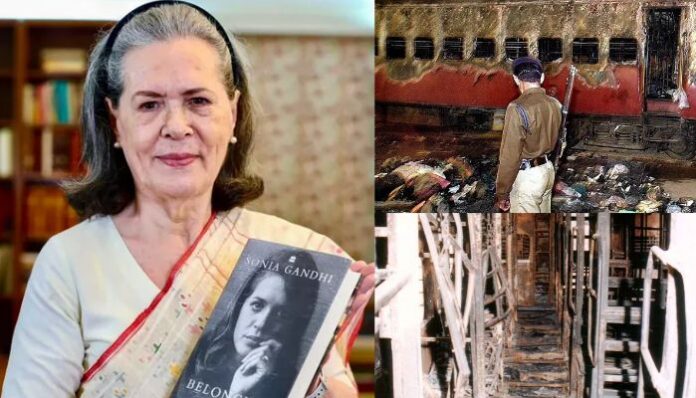
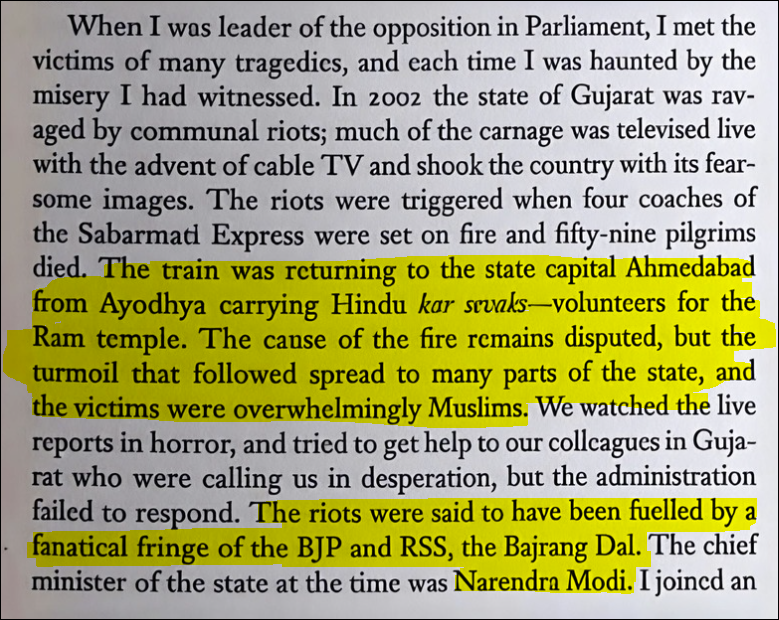
Congress leader Sonia Gandhi has attempted to whitewash the role of the Islamists responsible for the 2002 Godhra train carnage by describing the cause of the fire as “disputed” in her memoir, Belonging: A Journey of Love. The Muslim perpetrators set the S-6 coach of Sabarmati Express on fire on 27th February, 2002, killing 59 Hindu Karsevaks who were returning from Ayodhya. Nearly 24 years later, survivors and eyewitnesses have recalled the horrific scenes from that day, questioning attempts to dilute the responsibility of those behind the well planned attack.
Following the deliberate attempt of shielding Muslim perpetrators, Hindu victims and eyewitnesses who were aboard the train shared their ordeal with Gujarati Media outlet Divya Bhaskar. Their accounts describe the attack, the desperate attempts to escape the burning coaches and the terror faced by passengers trapped inside.
Survivor Ashwin Patel calls Godhra train burning a planned conspiracy
Ashwin Patel, who was travelling aboard the Sabarmati Express on the day of the attack and is now the Gujarat state secretary of the Vishwa Hindu Parishad (VHP), rejected the suggestion that the incident was simply a fire whose cause remained unclear. He described it as a planned conspiracy to target the passengers.
Recalling the incident, he said, “I was present inside the train when it was set on fire. The Sabarmati Express incident was not merely an incident of arson. It was a planned conspiracy.”
According to Patel, the train was attacked with stones and acid bombs. Questioning the description in the book, he asked why it did not clearly mention who had set the train on fire. “If the train was set on fire, why has the book not clearly mentioned who did it?” he questioned.
Kalpesh Jha recalls passengers struggling to escape the burning coach
Kalpesh Jha, who was also aboard the Sabarmati Express on the day of the attack, recalled the horrifying events. At the time, he was the VHP in-charge of the Sabarmati Express.
Jha said that several VHP workers and Ram devotees were returning from Ayodhya. Bhajan groups were singing devotional songs inside the train, and passengers were travelling in a religious atmosphere. When the train reached Godhra station, the situation initially appeared normal. Vendors were selling snacks on the platform and passengers were preparing to continue their journey.
However, things changed suddenly when a large crowd gathered, and the train came under attack. Jha said the train moved away from the platform towards Sabarmati around two minutes after the attack began.
As the passengers feared further violence, they shut the doors and windows of their coaches. Jha further recalled that grass beneath coach S-6 was set on fire, following which flames and smoke began spreading inside the coach. “The smoke started filling the coach, and passengers began suffocating. When they tried to open the doors and windows to escape, people outside attacked them with iron rods,” he said.
The passengers were forced to close them again. As smoke continued filling the coach, several people lost their lives due to suffocation.
Amid the chaos, VHP workers tried to rescue passengers through the rear door of the coach. Women were moved to a nearby ditch to keep them safe from the attackers, Jha recalled.
Jha further said that a police team reached the spot some time later, following which the attackers fled. He claimed that many passengers had already lost their lives during the period before the police arrived.
“Even after 24 years, whenever those memories return, it feels as if an earthquake has struck my mind. The terrible atmosphere inside the train, the screams of passengers, the smoke, the fire and the efforts to save people’s lives — those scenes still appear before my eyes,” he said.
31 Islamists convicted in the Godhra train burning case
While Sonia Gandhi claims that the cause of the fire is ‘disputed’, 31 Islamists were found guilty of the Godhra massacre on February 22, 2011, by the trial court (with only 11 receiving the death penalty and 20 receiving life imprisonment), and all 31 convictions were affirmed by the Gujarat High Court in October 2017, resulting in everyone receiving a life sentence.
The Sabarmati Express was carrying Hindu pilgrims and Karsevaks returning from Ayodhya when coach S-6 was set on fire near Godhra’s Signal Falia area. A large mob of around 2000 Islamists had gathered around the train and set the 59 Hindu pilgrims, including women and children, on fire.
The names of the Islamists who received the death penalty include Abdul Razzak Kurkur, Ismail Suleja, Jabbir Binyamin Behra, Ramzani Binyamin Behra, Mehboob Hassan, Siraj Bala, Irfan Kalandar, Irfan Patadia, Hassan Lalu, Mehboob Chanda, & Salim Zarda.
Among the convicted, the other 20 were awarded life sentences. They included Suleman Ahmad Hussain, Abdul Rehman Abdul Majid Dhantiya, Kasim Abdul Sattar, Irfan Siraj Pado Ghanchi, Anwar Mohmmad Mehda, Siddik, Mehboob Yakub Mitha, Soheb Yusuf Ahmed Kalandar, Saukat, Siddik Mohmmad Mora, Abdul Sattar Ibrahim Gaddi Asla, Abdul Rauf Abdul Majid Isa, Yunus Abdulhaq Samol, Ibrahim Abdul Razak Abdul Sattar Samol, Saukat Yusuf Ismail Mohan, Bilal Abdullah Ismail Badam Ghanchi, Farook, Ayub Abdul Gani Ismail Pataliya, Saukat Abdulah Maulvi Isamail Badam, Md Hanif.
The latest survivors’ ordeal bring back the horror faced by the Hindus trapped inside the train.
