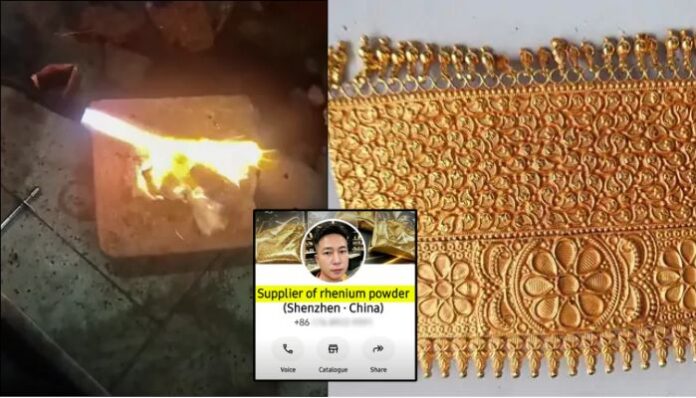
As the wedding season approaches, the purchase of gold jewellery is expected to rise exponentially. However, before the ‘gold rush’ begins, an alarming new gold adulteration method, which goes undetected during conventional testing procedures, has surfaced. A Dainik Bhaskar report from Rajasthan has claimed that cheap Chinese rhenium powder is being mixed with gold to increase weight, and this adulteration is going undetected in purity tests.
Chinese suppliers, Indian traders: How cheap rhenium powder is being sourced and used to adulterate gold
Dainik Bhaskar reporters executed an undercover-style experiment and ended up tracing the gold adulteration racket’s China link.
The investigators contacted an agent in China’s Shenzhen, who allegedly claimed that his company made rhenium powder specifically for mixing with gold. He said that the rhenium powder could be added up to nearly 25% without detection by standard methods.
Pertinently, the Chinese agent claimed to be in contact with numerous dealers across several Indian cities.
A 1-gram sample was obtained through a Mumbai-based dealer for Rs 5,000.
Thereafter, Bhaskar investigators took help from a local jeweller’s shop in Jodhpur to mix 1 gram of rhenium powder into 7.830 grams of 24-carat pure gold, raising its weight to 8.830 grams.
Subsequently, the mix was tested as 24-carat gold on available purity testing equipment.
Then it was alloyed further, with about 0.75 grams of other metal, into a traditional Rajasthani ornament, desi aad, weighing 9.580 grams.
When tested, a hallmarking centre issued a 91.6% 22-carat mark.
This essentially means that if the gold price is ₹1.5 lakh per tola, a customer buying just one tola of such jewellery would suffer a direct loss of around ₹14,700.
Meanwhile, the showroom XRF-style machines reported higher gold percentages, about 93.7% of gold, with silver and copper.
It is even more shocking that the machines did not flag the presence of rhenium.
The actual gold content in the finished jewellery piece was only 81.7%, which is about 20-carat equivalent, based on the original pure gold used.
There are several stages in the execution of this adulteration mechanism.
The first is sourcing the adulterant.
Those involved in this gold-rhenium adulteration scam obtain fine rhenium powder, mainly from Chinese suppliers and intermediaries in cities like Mumbai.
There are also some online listings which market “rhenium gold powder or similar alloys for industrial or jewellery-related uses.
The second stage is ‘mix and melt’.
Under this, a calculated percentage, say 11-12%, is blended in the initial mix with molten gold or gold alloy. Since the densities are close, the overall specific gravity does not shift significantly.
The third stage is fabrication.
Under this, the alloy is formed into ornaments like traditional pieces, bangles, etc., likely with conventional alloying metals for 22-carat appearance and workability.
The final and most important stage is passing purity tests.
In this, the adulterated piece is presented at hallmarking centres or retail testing.
As common acid or touchstone tests react primarily to surface chemistry, they might miss the heavy-metal addition.
Several commercial XRF machines, particularly lower-resolution or poorly calibrated ones, report high gold content without isolating rhenium.
XRF, or X-Ray fluorescence, is a non-destructive method commonly used in jewellery shops and hallmarking centres.
It identifies elements through characteristic fluorescent X-rays.
Rhenium L-lines align close in energy to gold, so lower-resolution detectors can blur the peaks.
The software might fold the rhenium signal into gold and report high purity.
Thus, the tested jewellery received a 22K/916 hallmark and is sold at full weight multiplied by declared purity.
Outcome? Profit!
The seller charges for the full weight as if it were genuine gold of marked purity and devoid of rhenium content.
The buyer pays money for the declared weight and purity of gold despite receiving less actual gold.
The difference is a pure margin for adulterators.
The Dainik Bhaskar report says that six tests, including hallmarking, were conducted on the rhenium-mixed piece, and none of those tests could detect rhenium.
“The ornament was tested using a carat-testing machine at a showroom on Nai Sadak. The screen showed 93.70% gold, 5.39% silver and 0.90% copper. There was no mention of rhenium,” Dainik Bhaskar reported.
Previously, similar concerns have been flagged about dense platinum group or refractory metals like osmium, iridium, ruthenium, and tungsten.
These metals have been used as “gold powder” or weight-padding agents, found to be entering via Maharashtra or West Bengal routes.
Rhenium, however, is not entirely undetectable. High-resolution Silicon Drift Detectors (SDD) with enhanced spectral deconvolution and proper calibration can resolve and quantify rhenium, even at low percentages.
Detection also depends on other factors like measurement time, surface cleanliness, and whether the Rhenium adulterant is uniformly mixed or concentrated deeper than the X-ray penetration depth.
There are destructive methods also, including fire assay/cupellation, detailed ICP-OES/MS, and electron microscopy.
These are, however, slower, costlier, and not practical for every retail transaction.
BIS hallmarking is there; however, it is not enough.
The authorities must fill the gaps in surveillance, equipment quality, and calibration to curb vulnerabilities, especially when gold adulteration techniques involving denser metals with harder-to-detect physical and spectroscopic signatures are evolving rapidly.
Why is Rhenium used in gold adulteration despite being rarer and expensive in absolute terms?
Rhenium is a rare, silvery-grey transition metal. It is one of the densest and highest-melting elements.
It has a density of about 21.02 g/cm³. This closeness allows it to add mass without massive density anomalies that simple hydrostatic or visual inspections would catch.
Rhenium has a melting point of 3,186 °C, which is far higher than gold’s 1,064 °C. This lets Rhenium survive melting and alloying processes used for jewellery-making.
In addition, Rhenium has high hardness, great high-temperature strength, and corrosion resistance.
Rhenium is primarily used in nickel-based superalloys for jet-engine turbine blades, platinum-rhenium catalysts in petroleum refining, and specialised high-temperature applications.
Pertinently, Rhenium is extremely rare in Earth’s crust.
It is produced almost totally as a byproduct of molybdenum, specifically from copper-molybdenum ores.
Chile, China, Poland and the US are Rhenium’s major producers.
In absolute terms, Rhenium is expensive. Recent benchmarks are reported around $5,000-$6,500+ per kg for metal/powder.
The question here is that if Rhenium is so expensive and rare, why is it used in gold adulteration?
Rhenium is expensive; however, it is still cheaper per gram than gold.
While one gram of Rhenium would cost a few dollars to tens of dollars depending on purity and market, one gram of gold is more expensive in India at prevailing rates.
Thus, if the material can pass as gold, Rhenium clearly offers an economic incentive for adulteration, though at the cost of defrauding buyers.