

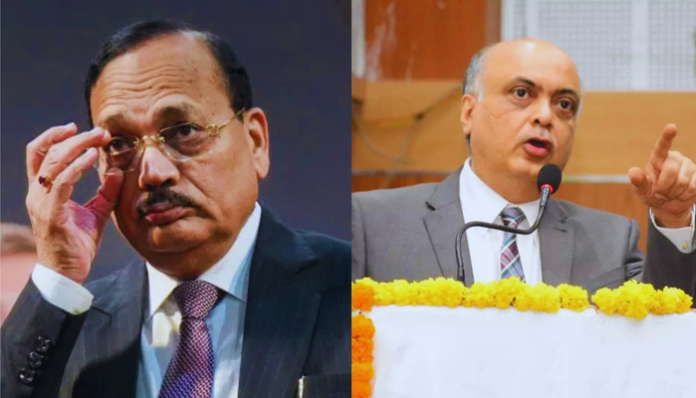
In a significant move, Chief Justice of India Surya Kant has withdrawn some cases from benches headed by Justice Ahsanuddin Amanullah and transferred them to other benches. As per reports, the decision comes after the bench headed by Justice Amanullah decided to expand individual disputes into nationwide public interest litigations (PILs) in the course of the hearings.
Justice Amanullah’s bench was not allocated PIL matters by the CJI, who, as the master of the roster, is responsible for allocating cases to various benches. But the bench still proceeded to expand the scope of individual cases to nationwide PILs, which amounted to bypassing the established system of case allocation. The concerns were originally heard by the bench as individual grievances, but it later passed directions to address nationwide policy and administrative issues.
Reports suggest that the decision to transfer the cases to appropriate benches was taken by the CJI in consultation with four senior Supreme Court judges. CJI Kant consulted with Justices Vikram Nath, BV Nagarathna, MM Sundresh, and PS Narasimha, after which the court decided to withdraw the cases.
This comes after the CJI asserted that all judges should hear cases strictly in compliance with their assigned roster during a Full Court meeting held about four weeks ago. CJI Kant said that the established system for case allocation and the prescribed roster must be followed in all judicial proceedings.
Out of the cases that have reportedly been withdrawn from the benches headed by Justice Amanullah, two are Ayesha Jain v. Amity University, Noida and Loganathan v. State of Tamil Nadu. In Ayesha Jain v. Amity University, Noida, the petitioner approached the Supreme Court alleging harassment by officials of Amity University, Noida after she legally changed her name from Khushi Jain to Ayesha Jain.
She alleged that the university officials failed to update her changed name in university records, which resulted in loss of her academic year as her attendance was not recorded. During the course of the hearing, the bench expanded the proceedings into a nationwide examination of the establishment, funding and regulation of private universities, issuing directions to the Centre, states and regulatory authorities.
CJI Kant withdrew the case from the bench of Justices Amanullah and NV Anjaria and reassigned it to a three-judge bench led by Justice Vikram Nath, including Justice R Mahadevan and Justice Aparesh Kumar Singh. The next hearing is scheduled for November 19.
The other case, Loganathan vs State of Tamil Nadu, was being heard by Justices Amanullah and Mahadevan. The matter concerned unauthorised constructions and the commercial misuse of residential properties. The case originated from an individual dispute regarding a one-and-a-half-storey structure built in Chennai without an approved building plan.
The proceedings began on March 25 this year after the court took note of an individual case from Chennai involving the construction of a one-and-a-half-storey building without an approved plan. Subsequently, the bench proceeded to cover wider issues, such as illegal construction across the country and the commercial use of residential properties.
The bench sought responses from states and municipal authorities in major cities, including Delhi and the national capital region. Senior Advocate Ajit Kumar Sinha was appointed amicus curiae, and Advocate Govind Jee was directed to assist him. The case has now been transferred to a bench presided over by Justice B. V. Nagarathna. The next hearing is likely to take place on November 23.
According to the Times of India, there was another case before a bench including Justice Amanullah, wherein it directed all states and UTs to remove stray animals from public places, which would have included cows. A resident of Uttar Pradesh reportedly intervened in the matter through an application apprehending that the order was “capable of being implemented in a manner that may result in cows and their progeny being rounded up, transported or disposed of without regard to the special constitutional protection they are entitled to”. The case was subsequently taken away from the bench for the same reasons as mentioned above
